Introduction
The Southern Pochard, Netta erythrophthalma, is a medium-sized diving duck in the family Anatidae. It has a disjunct distribution in sub-Saharan Africa and northern and central South America, where it occupies freshwater wetlands and other suitable water bodies. Two subspecies are generally recognised: the African N. e. brunnea and the South American N. e. erythrophthalma. (birdlife.org.za)
Physical Description
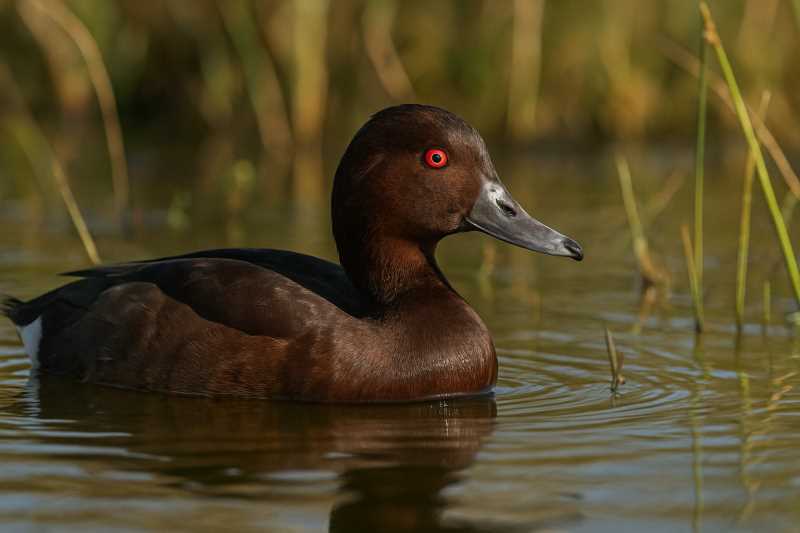
The Southern Pochard is approximately 48–51 centimetres long. The adult male has a dark bluish to purplish body, a blackish forehead and rich chestnut-brown colouring on the face, sides of the head, upper neck and throat. Its bright red eyes, blue-grey bill with a black nail, grey legs and black webs are useful identification features.
The wings are mainly brown, with white greater primary coverts and pale bases to the primaries and secondaries forming a conspicuous white wing bar. Females are duller and browner, with a pale facial crescent behind the eye and a pale patch at the base of the bill. Juveniles and immature birds resemble females or dull adults but usually have less distinct facial markings and paler plumage. (birdlife.org.za)
Range and Habitat
The species occurs in two widely separated regions. In South America, it is distributed across parts of the northern and central continent. In Africa, it occurs south of a broad line extending from Eritrea towards Angola, with important populations in southern Africa. The African subspecies, N. e. brunnea, and the South American subspecies, N. e. erythrophthalma, reflect this geographic separation. (birdlife.org.za)
Southern Pochards prefer large, deep, clear water bodies that may be permanent or temporary. Habitats include lakes, pools, shallow marshes, sewage ponds and other wetlands with submerged or emergent aquatic vegetation. Suitable water levels and healthy aquatic plant communities are particularly important for feeding, moulting and breeding. (birdlife.org.za)
The species is mainly sedentary, but individuals can move locally or over longer distances when rainfall, drought or changing water levels affect the availability of suitable wetlands. Some populations may move northwards during dry periods, although the extent and regularity of these movements remain incompletely understood. (birdlife.org.za)
Behaviour and Diet
Southern Pochards are diving ducks that feed mainly on seeds and the roots and vegetative parts of aquatic plants, including water lilies, bladderworts, duckweeds, bulrushes and rice. They also take grasses, sedges and aquatic invertebrates such as molluscs, insects and crustaceans. Their feeding ecology therefore combines plant feeding with opportunistic consumption of animal prey. (birdlife.org.za)
Pairs are generally monogamous, and nesting is usually solitary. Breeding dates vary geographically and may be influenced by rainfall and water availability. In southern Africa, nesting is often recorded between July and September, although nest records indicate that breeding can be more flexible or aseasonal in some areas. (birdlife.org.za)
The nest is a deep bowl made from grass stems and aquatic plants and lined with down. It is commonly placed among emergent vegetation over water or in dense grass on an island or embankment, usually within 20 metres of water. Clutches typically contain 6–15 eggs. The female normally incubates the eggs for about 20–28 days, and the young are precocial, leaving the nest soon after hatching. Fledging takes approximately 68 days. (birdlife.org.za)
Identification Tips
Look for the following combination of features:
- A compact, dark diving duck measuring about 48–51 centimetres in length.
- An adult male with a dark bluish or purplish body, chestnut-brown face and throat, bright red eyes and a blue-grey bill.
- A broad white wing bar visible in flight.
- A female with brown plumage, a pale facial crescent behind the eye and a pale patch at the bill base.
- Use of deep freshwater habitats, often with abundant submerged vegetation.
The Southern Pochard can be confused with the non-breeding Maccoa Duck, Oxyura maccoa. The Maccoa Duck has a pale cheek stripe, whereas the female Southern Pochard has a more distinct white vertical crescent behind the eye and a pale patch at the base of the bill. (birdlife.org.za)
Conservation Status
The Southern Pochard is currently assessed globally as Least Concern on the IUCN Red List. This global assessment does not mean that all populations are stable. In South Africa, Lesotho and Eswatini, the 2025 regional assessment lists the species as Near Threatened, following evidence of regional declines and contraction in parts of its range. (birdlife.org.za)
The principal threats are the loss and transformation of wetlands, declining water quality, reduced water availability, elevated salinity, entanglement in fishing nets, hunting and disease outbreaks such as avian botulism. The loss of submerged aquatic vegetation can be especially damaging because these plants provide important food and habitat. (birdlife.org.za)
Effective conservation depends on protecting and restoring wetlands, maintaining suitable water levels and water quality, safeguarding reed beds and other nesting areas, and monitoring population trends and movements. Continued surveys are particularly important because the global population size and the causes of observed regional declines remain incompletely known. (birdlife.org.za)
Frequently Asked Questions
Where does the Southern Pochard live?
The species occurs in sub-Saharan Africa and in northern and central South America. It inhabits lakes, marshes, pools, sewage ponds and other freshwater wetlands, especially where submerged vegetation is available.
What does the Southern Pochard eat?
Its diet consists mainly of seeds and aquatic plant material, including roots and stems. It also eats grasses, sedges and aquatic invertebrates such as molluscs, insects and crustaceans.
How can a Southern Pochard be identified?
Adult males have bright red eyes, a blue-grey bill, chestnut-brown facial plumage, a dark bluish or purplish body and a prominent white wing bar. Females are browner, with a pale facial crescent behind the eye and a pale patch at the bill base.
Is the Southern Pochard migratory?
It is mainly sedentary, but individuals can make local or longer-distance movements when water conditions change. Some African birds may move northwards during dry periods, although regular migration patterns are not fully established.
When does the Southern Pochard breed?
Breeding varies by region and is influenced by rainfall and water availability. In southern Africa, nesting is often recorded from July to September, but breeding may occur more flexibly in some areas.
Is the Southern Pochard endangered?
Globally, it is classified as Least Concern. However, some regional populations are declining. In South Africa, Lesotho and Eswatini, it is assessed as Near Threatened because of evidence of population and range declines.
References
- BirdLife South Africa. 2025. Southern Pochard, Netta erythrophthalma. In: The 2025 Red Data Book of Birds of South Africa, Lesotho and Eswatini. BirdLife South Africa. Available at: https://www.birdlife.org.za/red-data-book/red-list/southern-pochard/ (accessed 8 September 2026).
- BirdLife International. 2016. Netta erythrophthalma. The IUCN Red List of Threatened Species 2016: e.T22680354A92857172. Available at: https://doi.org/10.2305/IUCN.UK.2016-3.RLTS.T22680354A92857172.en (accessed 8 September 2026).
- Carboneras, C. and Kirwan, G. M. 2020. Southern Pochard, Netta erythrophthalma, version 1.0. In: del Hoyo, J., Elliott, A., Sargatal, J., Christie, D. A. and de Juana, E. (eds), Birds of the World. Cornell Lab of Ornithology, Ithaca, New York. Available at: https://doi.org/10.2173/bow.soupoc1.01.
- Cumming, G. S., Harebottle, D. M., Mundava, J., Otieno, N. and Tyler, S. J. 2016. Timing and location of reproduction in African waterfowl: an overview of more than 100 years of nest records. Ecology and Evolution, 6(3), 631–646. Available at: https://doi.org/10.1002/ece3.1853.
- Gill, F., Donsker, D. and Rasmussen, P. (eds). 2026. IOC World Bird List, version 15.2. International Ornithologists’ Union. Available at: https://www.worldbirdnames.org/ (accessed 8 September 2026).
- Russell, I. A. and Randall, R. M. 2017. Effects of prolonged elevated water salinity on submerged macrophyte and waterbird communities in Swartvlei Lake, South Africa. Water SA, 43(4). Available at: https://doi.org/10.4314/wsa.v43i4.14.
- Russell, I. A., Randall, R. M., Zimmerman, D. and Govender, D. 2019. Outbreak of avian botulism and its effect on waterbirds in the Wilderness Lakes, South Africa. Koedoe, 61(1), article a1553. Available at: https://doi.org/10.4102/koedoe.v61i1.1553.
Related posts