Introduction
The Collared Inca (Coeligena torquata) is a medium-sized hummingbird of humid Andean forests. It occurs from north-western Venezuela through Colombia and Ecuador to northern Peru, where it inhabits montane forest, woodland edges and nearby clearings. Several regional forms are recognised, and taxonomy within the group has changed as some formerly included populations have been treated as separate species.
Physical Description
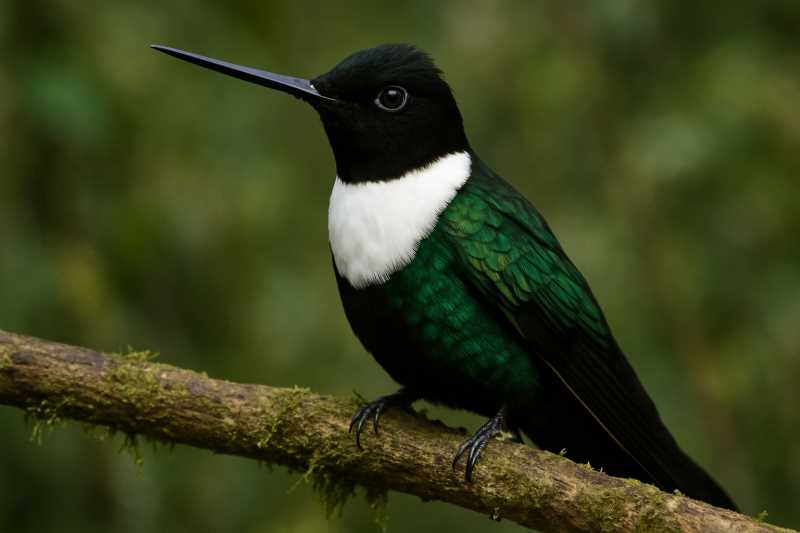
The Collared Inca is approximately 14 centimetres long and has a straight, slender black bill. Its dark green to nearly black plumage is set off by a conspicuous white breast patch or collar and white at the bases of the outer tail feathers. Depending on the subspecies and lighting, the crown and forehead may show metallic green, blue or violet tones.
Males are generally darker and more strongly iridescent than females. Females are usually greener overall, with a paler throat that may be white, buff or mottled with green. Regional variation is noticeable, particularly in the colour of the crown, throat and underparts, so birds from different parts of the range may not look identical.
Range and Habitat
The Collared Inca is native to the Andes of north-western Venezuela, Colombia, Ecuador and northern Peru. It is a resident species rather than a long-distance migrant, although individuals may move locally in response to flowering conditions and the availability of food.
It mainly occupies humid montane forest, cloud forest, forest borders and overgrown clearings. It is often found in the lower and middle forest strata, including areas with dense undergrowth, epiphytes, vines and flowering shrubs. Most records fall between approximately 1,800 and 3,400 metres above sea level, although the species may occur lower in some parts of its range.
The current species boundary follows the treatment used by the IOC World Bird List. Some other taxonomic authorities have treated certain geographically distinct populations differently, so older sources may show a broader distribution for C. torquata.
Where to See This Species
Yanayacu Biological Station, Napo Province, Ecuador
The Collared Inca has been documented breeding at Yanayacu Biological Station near Cosanga in north-eastern Ecuador, including observations at approximately 2,160 metres. The station’s humid montane forest and forest-edge habitat provide suitable conditions for looking for this species, particularly where flowering plants and epiphytes are abundant.
Nearby accommodation: Cosanga is the nearest practical settlement, with guest houses, small lodges and other nature-tourism accommodation in the surrounding Napo highlands.
Tapichalaca Biological Reserve, Zamora-Chinchipe, Ecuador
The species has also been documented at Tapichalaca Biological Reserve, where breeding observations were made at approximately 2,400 to 2,700 metres. Birders should search forest trails, edges and flowering areas in the reserve’s humid montane habitat. The reserve is managed as a wildlife-viewing destination and supports a wide range of Andean forest birds.
Nearby accommodation: Valladolid is the principal nearby gateway, with lodges, guest houses and other small-scale accommodation serving visitors to the reserve and surrounding forests.
Tatamá National Natural Park, Risaralda, Colombia
Collared Inca is recorded from Tatamá National Natural Park, a protected area on Colombia’s western Andes with extensive montane and high-elevation forest. The park is open for guided nature tourism in designated areas, including birdwatching routes reached from the Pueblo Rico area. Forest edges and mid-elevation cloud-forest habitats are the most suitable places to look.
Nearby accommodation: Pueblo Rico is the main gateway settlement, with guest houses, small hotels, ecolodges and guided birdwatching accommodation in the surrounding region.
Behaviour and Diet
The Collared Inca is usually solitary and often follows a regular route between scattered flowering plants, a foraging strategy known as trap-lining. It may feed at different heights, but is frequently seen in the lower and middle levels of forest and along edges. Its flight is fast and agile, with brief hovering while it probes flowers with its long bill.
Nectar provides most of its energy, particularly from long, pendant or tubular flowers. The bird also takes small insects and spiders, which provide protein and other nutrients. By visiting flowers as it feeds, it contributes to pollination within the montane forest community.
Males may defend feeding areas or favoured flower-rich routes from other hummingbirds. Territorial encounters can include rapid chases, hovering displays and sharp calls. The species is not known to undertake regular long-distance migration.
Breeding observations from eastern Ecuador indicate that the female alone attends the nest and cares for the young. Nests are placed in forest vegetation and may be built from soft plant fibres, seed down and other fine materials. The breeding season can vary with local conditions and available food.
Identification Tips
- Look for a medium-sized hummingbird with a straight black bill and a bold white breast patch.
- The dark body, contrasting white collar or chest and white markings at the base of the outer tail feathers are useful field marks.
- Males often show stronger violet, blue or green iridescence on the forehead and crown, while females are generally paler and greener.
- Search shaded forest edges, flowering shrubs, vines and epiphyte-rich vegetation between roughly 1,800 and 3,400 metres.
- Do not rely on colour alone. Plumage varies geographically, and strong sunlight can make the dark body appear greener or blacker than it does in shade.
The Collared Inca can be confused with other Coeligena hummingbirds, especially where their ranges overlap. The combination of a prominent white breast patch, white tail-base markings and a generally dark green or black appearance is usually more reliable than any single shade of iridescence.
Conservation Status
The Collared Inca is currently classified as Least Concern on the IUCN Red List. It has a broad Andean distribution and remains common in parts of its range, although a precise global population estimate is not available.
The principal concerns are the loss and degradation of montane forest through agricultural expansion, grazing, road construction and other land-use changes. Climate-driven changes in temperature, rainfall and flowering patterns may create additional pressures at higher elevations. Protected areas, forest restoration and the maintenance of connected cloud-forest habitat are important conservation measures.
Frequently Asked Questions
Where is the Collared Inca found?
The Collared Inca occurs in the Andes from north-western Venezuela through Colombia and Ecuador to northern Peru. It is mainly associated with humid montane forest and cloud-forest edges.
What does a Collared Inca look like?
It is a hummingbird of about 14 centimetres with a straight black bill, dark green to black plumage, a conspicuous white breast patch and white markings at the base of the outer tail feathers.
What does the Collared Inca eat?
It feeds mainly on nectar from flowering plants and supplements its diet with small insects and spiders.
Is the Collared Inca migratory?
It is generally regarded as a resident Andean species. Local movements may occur when flowering conditions or food availability change, but it is not a regular long-distance migrant.
Where can I see a Collared Inca?
Documented viewing locations include Yanayacu Biological Station and Tapichalaca Biological Reserve in Ecuador, and Tatamá National Natural Park in Colombia. Forest edges and flowering areas at middle and high elevations are productive places to search.
Is the Collared Inca endangered?
No. The species is currently listed as Least Concern, although habitat loss and degradation remain important local threats to its montane forest habitat.
References
- IOC World Bird List
- BirdLife International
- Breeding biology of the Collared Inca (Coeligena torquata) in Eastern Ecuador
Related posts