Introduction
The Scaly-bellied Woodpecker, scientifically known as Picus squamatus, is a captivating bird species that belongs to the family Picidae. This bird is known for its distinctive scaly pattern on its belly and is native to the woodlands of the Himalayas and surrounding regions. This article delves into the various aspects of the Scaly-bellied Woodpecker, including its habitat, physical characteristics, behavior, diet, and conservation status.
Habitat and Distribution
The Scaly-bellied Woodpecker is predominantly found in the hilly regions of the Himalayas, extending from Pakistan through northern India to Nepal, Bhutan, and parts of Tibet. These woodpeckers thrive in temperate forests, preferring deciduous and mixed woodlands rich in oak and conifer trees. They are often seen at altitudes ranging from 1,500 to 4,000 meters, where they make use of the abundant tree cover for foraging and nesting.
Physical Characteristics
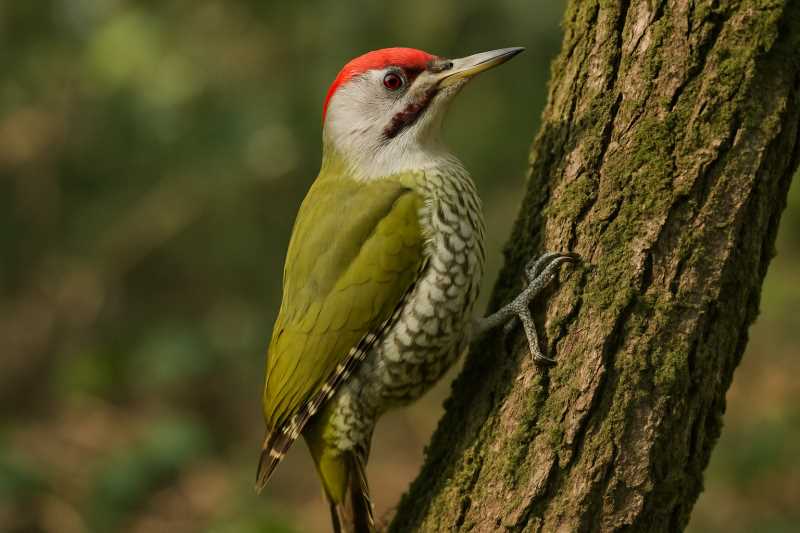
One of the most striking features of the Scaly-bellied Woodpecker is its intricate plumage. As its name suggests, the bird’s belly is covered with a pattern resembling scales, which gives it a unique and identifiable appearance. The upperparts are predominantly green, while the wings and tail are barred with black. Males and females are similar in appearance, although males typically have a red crown, which is absent in females, who instead have a black crown. Their beaks are strong and chisel-like, adapted for pecking into wood to find insects.
Behavior and Social Structure
Scaly-bellied Woodpeckers are generally solitary or found in pairs. They are known for their territorial behavior, often defending their chosen area from other woodpeckers. Their drumming on tree trunks serves as a means of communication, marking territory, and attracting mates. During the breeding season, which occurs from April to June, these woodpeckers are particularly active in establishing and defending their territory.
Diet and Foraging
The diet of the Scaly-bellied Woodpecker mainly consists of insects, which they skillfully extract from the bark of trees using their strong beaks. They are adept at hunting for ants, beetles, and their larvae. Occasionally, they may also consume fruits and nuts, especially during the winter months when insects are less abundant. Their foraging technique involves a combination of pecking and probing into tree bark, which allows them to access food sources hidden deep within the wood.
Reproduction and Lifespan
Breeding in Scaly-bellied Woodpeckers typically begins in the spring. Males perform elaborate drumming sequences to attract females. Once a pair has formed, they work together to excavate a nest cavity in a suitable tree, often preferring dead or decaying wood. The female usually lays a clutch of four to six eggs, which both parents take turns incubating over a period of about two weeks. After hatching, both parents are involved in feeding and caring for the young until they are ready to fledge, usually about three to four weeks post-hatching.
Vocalizations
Scaly-bellied Woodpeckers are not only recognized by their drumming but also by their vocalizations. They produce a variety of calls, including sharp, repeated notes used to communicate with other woodpeckers. These vocalizations play a crucial role during the breeding season and in maintaining territory boundaries.
Conservation Status
Currently, the Scaly-bellied Woodpecker is not considered endangered, and its population is stable across its natural range. However, deforestation and habitat degradation pose potential threats to its habitat. Conservation efforts focused on preserving forest habitats and monitoring woodpecker populations are essential to ensure the continued survival of this species.
Conclusion
The Scaly-bellied Woodpecker is a remarkable species with fascinating behaviors and adaptations that allow it to thrive in the mountainous regions of the Himalayas. Understanding and preserving this bird is important for maintaining the biodiversity of the forest ecosystems it inhabits. As with many wildlife species, continued research and conservation efforts are crucial to ensure that future generations can enjoy the presence of the Scaly-bellied Woodpecker in its natural habitat.
References
– Ali, S., & Ripley, S. D. (1983). Handbook of the Birds of India and Pakistan. Oxford University Press.
– Grimmett, R., Inskipp, C., & Inskipp, T. (1998). Birds of the Indian Subcontinent. Helm Field Guides.
– Winkler, H., & Christie, D. A. (2002). Woodpeckers: A Guide to the Woodpeckers of the World. Pica Press.
Related posts