Introduction
The Ornate Tinamou (Nothoprocta ornata) is a ground-dwelling tinamou of the central Andes. It occurs in high-elevation grasslands, puna, open shrubland and some agricultural landscapes in Peru, Bolivia, Chile and Argentina. Like other tinamous, it is a capable but generally reluctant flier, relying mainly on walking and short, explosive flights when disturbed.
Physical Description
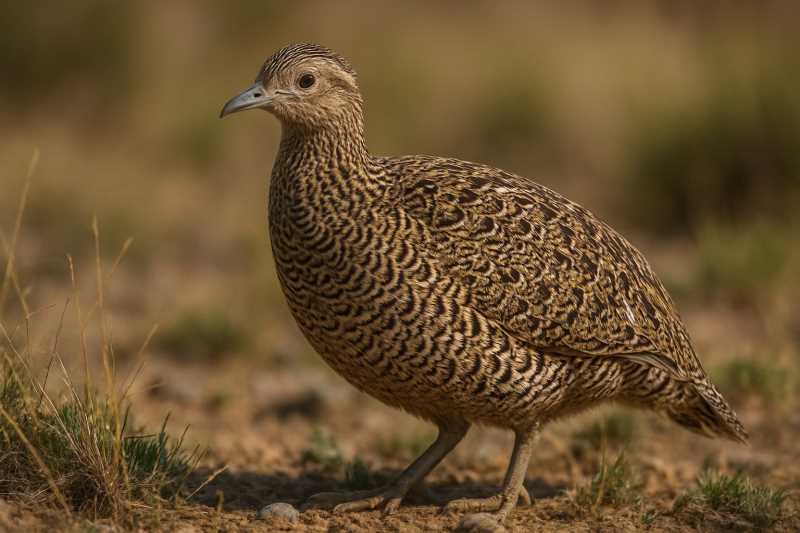
The Ornate Tinamou is a medium-sized bird, generally measuring about 30–35 cm in length and weighing approximately 450–760 g. Its plumage is predominantly mottled brown, buff, grey and black, providing effective camouflage among bunch grasses, rocky ground and low shrubs. The underparts are paler and finely patterned, while the back and wings are more strongly marked.
It has a compact body, a short tail largely concealed by the body feathers, a short stout bill and strong legs suited to running over uneven ground. The sexes are broadly similar in appearance, although individual variation and regional plumage differences occur. Young birds are more strongly streaked and cryptically patterned than adults, helping them remain concealed in vegetation.
Range and Habitat
The species is distributed through the Andes of southern Peru, western Bolivia, northern Chile and north-western Argentina. It is not regarded as a long-distance migrant. Radio-tracking in Bolivia found that adults remained within established home ranges throughout the year, although younger birds may move more widely before settling.
The Ornate Tinamou is associated mainly with high-altitude puna grassland, open slopes, bunch-grass communities, dry shrubland and semi-open areas with scattered rocks. It also uses fallow fields, small-scale agricultural land and other mosaics where natural grassland remains available. Recorded elevations extend broadly from about 2,500 to 4,800 metres, although the exact range varies geographically.
Several regional forms have been described, and taxonomic treatments differ in the number of recognised subspecies. These differences mainly concern plumage and distribution rather than major differences in ecology.
Behaviour and Diet
The Ornate Tinamou is primarily terrestrial and usually active during the day. It often walks quietly through dense grass or low vegetation, where its patterned plumage makes it difficult to detect. When approached closely, it may remain motionless until it suddenly runs or flies a short distance with rapid wingbeats before returning to cover.
Individuals are commonly encountered alone or in pairs rather than in large flocks. Adults appear largely resident, with overlapping home ranges recorded in an Andean agricultural landscape. The species communicates with whistles and other vocalisations, particularly during the breeding period, although it is more often detected by sound than by sight.
Its diet is opportunistic and includes seeds, grains, leaves, buds, flowers, berries, roots and other plant material, as well as insects and other small invertebrates. Crops such as potatoes and barley may also be taken where agricultural land overlaps its habitat.
Breeding information is incomplete, but the male performs the main incubation and care of the young, as is typical of many tinamous. The nest is a shallow ground depression concealed beneath grass or a low shrub. Clutches generally contain about four to nine eggs. Incubation lasts approximately 22–24 days, and the precocial chicks leave the nest soon after hatching while remaining under the male’s care.
Identification Tips
Look for the following combination of features:
- A medium-sized, compact, short-tailed bird of high Andean grassland.
- Mottled brown, buff and black upperparts that blend closely with dry grass and rocky ground.
- Paler, finely marked underparts.
- Strong legs and a mainly terrestrial manner, with sudden short flights when flushed.
- Occurrence in puna, open shrubland and high-elevation agricultural mosaics, often above the usual range of many similar-looking ground birds.
The Ornate Tinamou can be difficult to separate from other Andean tinamous in the field. Identification should therefore combine plumage pattern, elevation, habitat and vocalisations rather than relying on colour alone. The Andean Tinamou (Nothoprocta pentlandii) is a particularly relevant comparison in parts of the range, but its overall plumage and distribution should be checked carefully.
Conservation Status
The Ornate Tinamou is currently assessed as Least Concern on the IUCN Red List. A reliable global population estimate is not available, and the species is not considered free from conservation pressures.
The principal concerns are habitat conversion and degradation, agricultural expansion, overgrazing, hunting and other forms of overexploitation. Mining-related pollution may also be locally relevant in parts of the Andes. Because adults can remain within relatively localised home ranges, intensive hunting or severe habitat degradation may have strong effects at a local scale.
Conservation priorities include retaining native puna grassland and open shrubland, maintaining habitat within agricultural mosaics, managing hunting sustainably, protecting important Andean sites and improving monitoring of population trends and local threats.
Frequently Asked Questions
Where does the Ornate Tinamou live?
It occurs in the Andes of Peru, Bolivia, Chile and north-western Argentina, mainly in high-elevation puna grassland, open shrubland, bunch-grass communities and semi-open agricultural landscapes.
How large is an Ornate Tinamou?
Adults are generally about 30–35 cm long and weigh approximately 450–760 g, although measurements vary between individuals and regions.
Can the Ornate Tinamou fly?
Yes. It can fly, but it is mainly a ground-dwelling bird. When disturbed, it usually runs first and then makes a short, powerful flight into nearby cover.
What does the Ornate Tinamou eat?
Its diet includes seeds, grains, leaves, buds, flowers, berries, roots and other plant material, supplemented by insects and other small invertebrates.
Does the male Ornate Tinamou incubate the eggs?
Yes. The male carries out the main incubation and cares for the chicks after they hatch. A typical clutch contains about four to nine eggs, and incubation lasts roughly 22–24 days.
Is the Ornate Tinamou endangered?
It is currently listed as Least Concern globally. Nevertheless, habitat loss, degradation, hunting and overexploitation can threaten local populations, particularly where suitable grassland is being converted or heavily disturbed.
References
- BirdLife International. n.d. Ornate Tinamou Nothoprocta ornata Species Factsheet. BirdLife DataZone. Available at: https://datazone.birdlife.org/species/factsheet/ornate-tinamou-nothoprocta-ornata. Accessed 8 September 2026.
- Garitano-Zavala, A., Chura, Z., Cotín, J., Ferrer, X. & Nadal, J. 2013. Home range extension and overlap of the Ornate Tinamou (Nothoprocta ornata) in an Andean agro-ecosystem. The Wilson Journal of Ornithology, 125(3), 491–501. https://doi.org/10.1676/12-151.1
- Gomes, V. 2020. Ornate Tinamou (Nothoprocta ornata), version 1.0. In T. S. Schulenberg (ed.), Birds of the World. Cornell Lab of Ornithology, Ithaca, New York. https://doi.org/10.2173/bow.orntin1.01
- Gill, F., Donsker, D. & Rasmussen, P. (eds). 2026. IOC World Bird List, version 15.2. International Ornithologists’ Union. Available at: https://www.worldbirdnames.org/. Accessed 8 September 2026.
- Sistema de Información de Biodiversidad, Administración de Parques Nacionales, Argentina. n.d. Nothoprocta ornata, Inambú Serrano, Ornate Tinamou. Available at: https://sib.gob.ar/especies/Nothoprocta-ornata. Accessed 8 September 2026.
Related posts