Introduction
The Okarito Kiwi, also known as the rowi or Okarito brown kiwi, is a flightless bird endemic to New Zealand. Its accepted scientific name is Apteryx rowi. It is one of the rarest kiwi species and survives naturally in a restricted area of lowland forest near Ōkārito on the South Island’s West Coast. Translocated birds also occur on predator-free islands in the Marlborough Sounds.
Physical Description
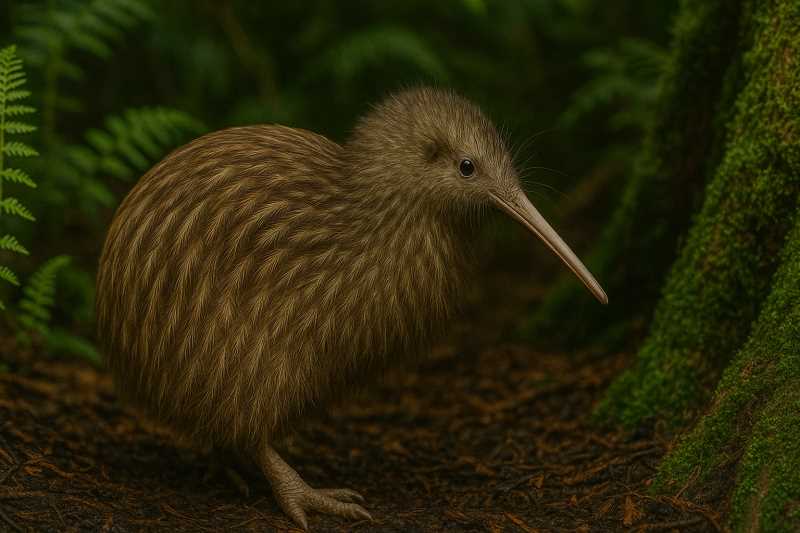
The rowi is a relatively large brown kiwi, measuring about 40 cm in length. Males weigh approximately 1.9 kg, while females are heavier at about 2.6 kg. This difference in body mass is one of the clearest forms of sexual dimorphism in the species.
Its plumage is soft and hair-like, usually pale greyish brown with longitudinal streaks of darker brown and black. Some individuals have conspicuous white feathers around the face. The species has a long, pale bill, short pale legs, strong toes and claws, tiny vestigial wings and no external tail.
As in other kiwi, the nostrils are positioned near the tip of the bill. This unusual arrangement helps the bird locate prey by smell as it probes soil, leaf litter and decaying wood. Juveniles are generally similar in appearance to adults but may appear softer-plumaged and less robust.
Range and Habitat
The Okarito Kiwi is endemic to New Zealand. Its only natural population occurs in and around Ōkārito Forest in South Westland, on the western side of New Zealand’s South Island. The species occupies lowland native forest, including areas with dense undergrowth, leaf litter, fallen timber and damp soils rich in invertebrates.
Rowi have also been translocated to predator-free islands, including Mana, Motuara and Blumine islands. These island populations support conservation breeding and provide safer habitat for juveniles and established birds.
The species formerly had a much wider distribution, extending through parts of the northern South Island and into the southern North Island. Habitat loss, introduced predators and the loss of breeding adults caused a severe historical contraction. Today, the remaining natural range is highly restricted and conservation dependent.
Behaviour and Diet
Rowi are nocturnal and usually rest during the day in burrows, hollow tree bases, hollow logs or dense vegetation. They emerge soon after nightfall and move slowly through the forest while searching for food.
They feed mainly on small invertebrates, including earthworms, insect larvae, beetles, cicadas, moths, centipedes, spiders, crickets and wētā. Freshwater crayfish, fallen fruit and some leaves are also eaten. A rowi typically taps or probes the ground and leaf litter with its bill, using smell and touch to locate prey.
Pairs are generally monogamous and territorial. Birds call to advertise territories and maintain contact, and pairs may respond to one another in nocturnal duets. The male gives a repeated, high-pitched ascending whistle, while the female gives a deeper, harsher or throaty call. Rowi may defend themselves or their territories with their powerful claws.
Breeding usually occurs from July to January. A nest may be placed in a burrow, hollow tree base or hollow log. The usual clutch is a single large, pale-green egg. Incubation lasts approximately 70 to 80 days and is shared by both sexes, although the male commonly performs more incubation during the day. Kiwi chicks are self-sufficient soon after hatching, but young rowi may remain associated with their family group for several years.
Identification Tips
- Look for a large, flightless kiwi with pale greyish-brown, soft, streaked plumage.
- The long, pale bill, short pale legs and absence of a visible tail are distinctive.
- White facial feathers are common in some rowi and can be a useful supporting feature, although they are not present on every bird.
- Rowi are nocturnal, so they are more often detected by their calls than seen clearly.
- The male’s call is a repeated, high-pitched ascending whistle. The female’s call is lower, deeper and more guttural.
- Southern brown kiwi, or tokoeka, are generally darker or redder and may be larger. Wekas can produce somewhat similar vocalisations, but their calls are usually shorter, two-syllable notes and they have a visible tail and more conventional bird-like proportions.
Conservation Status
The Okarito Kiwi is listed as Nationally Endangered under New Zealand’s conservation classification. The 2017 IUCN Red List reassessment placed the species in the Vulnerable category, following increases resulting from intensive conservation management. Its population trend has improved under protection, but the species remains highly vulnerable because its natural range is small and most birds depend on ongoing management.
The principal threat is predation by introduced mammals, especially stoats, which kill eggs, chicks and juveniles. Dogs can also kill adult kiwi, while habitat loss, fragmentation and other human-related pressures have contributed to the species’ historical decline.
Key conservation measures include predator control, protection of the Ōkārito Kiwi Sanctuary, monitoring, translocations and Operation Nest Egg. Under this programme, eggs are collected from wild nests, incubated under controlled conditions and the chicks are raised in captivity or predator-free crèche habitat until they are large enough to have a better chance of surviving in the wild. Continued predator management and community involvement remain essential to the species’ recovery.
Frequently Asked Questions
Where does the Okarito Kiwi live?
The species’ only natural population lives in lowland native forest in and around Ōkārito Forest in South Westland, on New Zealand’s South Island. Translocated populations also occur on predator-free islands in the Marlborough Sounds.
Is the Okarito Kiwi a different species from the brown kiwi?
Yes. The rowi was recognised as a distinct species and formally described as Apteryx rowi in 2003. It is closely related to other brown kiwi but differs in genetics, distribution and several physical characteristics.
What does the Okarito Kiwi eat?
Its diet consists mainly of earthworms and other soil-dwelling invertebrates, including insect larvae, beetles, spiders, centipedes, crickets and wētā. It also eats freshwater crayfish, fallen fruit and some leaves.
Why are Okarito Kiwi difficult to see?
Rowi are nocturnal and spend daylight hours concealed in burrows, hollow logs or dense vegetation. They are more often located by their distinctive calls than observed in the open.
How does Operation Nest Egg help rowi?
Operation Nest Egg removes eggs from nests at risk from predators, hatches them safely and raises the chicks until they reach a size at which they are more capable of defending themselves. The young birds are then returned to protected habitat.
How many eggs does a rowi usually lay?
A female normally lays one very large, pale-green egg. Incubation lasts about 70 to 80 days and is shared by the male and female, with the male commonly doing more daytime incubation.
References
- Colbourne, R. M. 2002. Incubation behaviour and egg physiology of kiwi (Apteryx spp.) in natural habitats. New Zealand Journal of Ecology 26: 129–138. https://newzealandecology.org/nzje/2602/colbourne.pdf
- Department of Conservation. n.d. Rowi: Kiwi. New Zealand Department of Conservation. Accessed 8 September 2026. https://www.doc.govt.nz/nature/native-animals/birds/birds-a-z/kiwi/rowi/
- Department of Conservation. n.d. Facts about kiwi: New Zealand native birds. New Zealand Department of Conservation. Accessed 8 September 2026. https://www.doc.govt.nz/nature/native-animals/birds/birds-a-z/kiwi/facts
- Gill, F., Donsker, D. and Rasmussen, P., eds. 2026. IOC World Bird List, version 15.2. International Ornithologists’ Union. Accessed 8 September 2026. https://www.worldbirdnames.org/
- IUCN. 2017. Kiwi species reclassified following conservation successes. IUCN Red List news release, 5 December 2017. International Union for Conservation of Nature. Accessed 8 September 2026. https://iucn.org/news/species/201712/unsustainable-food-systems-threaten-wild-crop-and-dolphin-species-iucn-red-list
- Robertson, H. A. 2013, updated 2022. Rowi | Okarito brown kiwi. In Miskelly, C. M., ed., New Zealand Birds Online. Birds New Zealand, Department of Conservation and Museum of New Zealand Te Papa Tongarewa. Accessed 8 September 2026. https://www.nzbirdsonline.org.nz/species/okarito-brown-kiwi
- Robertson, H. A., Baird, K., Elliott, G. P., Hitchmough, R. A., McArthur, N. J., Makan, T., Miskelly, C. M., O’Donnell, C. F. J., Sagar, P. M., Scofield, R. P., Taylor, G. A. and Michel, P. 2021. Conservation status of birds in Aotearoa New Zealand, 2021. New Zealand Threat Classification Series 36. Department of Conservation, Wellington. https://www.doc.govt.nz/globalassets/documents/science-and-technical/nztcs36entire.pdf
- Robertson, H. A. and de Monchy, P. J. M. 2012. Varied success from the landscape-scale management of kiwi Apteryx spp. in five sanctuaries in New Zealand. Bird Conservation International 22: 429–444. https://doi.org/10.1017/S0959270912000044
- Tennyson, A. J. D., Palma, R. L., Robertson, H. A., Worthy, T. H. and Gill, B. J. 2003. A new species of kiwi (Aves, Apterygiformes) from Okarito, New Zealand. Records of the Auckland Museum 40: 55–64. https://www.aucklandmuseum.com/discover/research/publications/records-of-the-auckland-museum/volume-40/55
Related posts