Koepcke’s Screech Owl: An Enigmatic Avian Resident of the Andean Forests
Nestled within the lush and diverse landscapes of the Peruvian Andes, Koepcke’s Screech Owl (Megascops koepckeae) is a captivating yet elusive bird species that holds a special place in ornithological studies. Named in honor of the renowned German ornithologist Maria Koepcke, this small owl has intrigued researchers and bird enthusiasts alike due to its unique vocalizations, distinct habitat preferences, and its role within the intricate ecosystems it inhabits.
Habitat and Distribution
Koepcke’s Screech Owl is predominantly found in the montane forests of central Peru, inhabiting elevations ranging from 1,200 to 2,500 meters above sea level. The species thrives in humid, subtropical or tropical moist montane forests, where it can find ample cover and diverse prey. The owl’s distribution is relatively localized, with its range primarily confined to a narrow strip of Andean forests, making it a species of particular interest for conservationists focused on preserving the biodiversity of the region.
Physical Characteristics
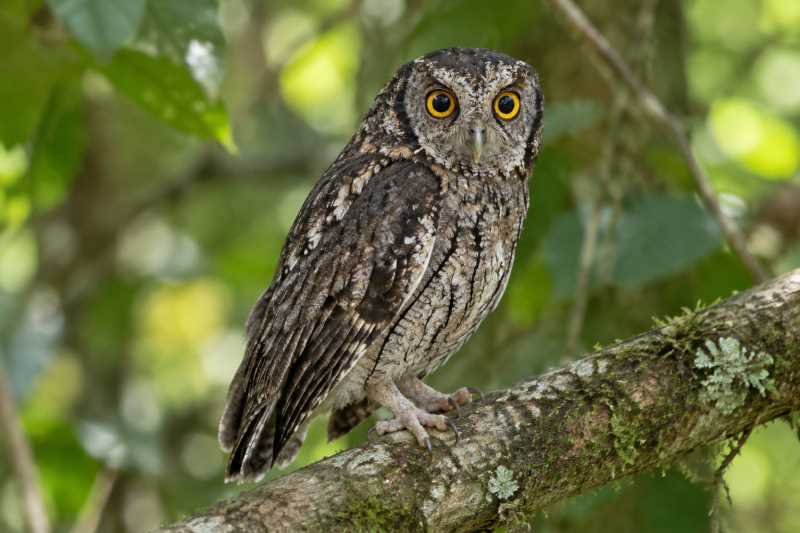
This small owl measures about 22 to 25 centimeters in length, with a wingspan that stretches approximately 50 to 55 centimeters. Its plumage is predominantly a mix of brown and gray, which provides excellent camouflage against the bark of trees, aiding in its nocturnal lifestyle. The facial disc of Koepcke’s Screech Owl is a significant feature, marked by a subtle but distinct rufous coloration that aids in sound collection, enhancing its auditory capabilities—a crucial adaptation for hunting in low-light conditions.
Vocalizations and Behavior
One of the most distinctive aspects of Koepcke’s Screech Owl is its vocal repertoire. The owl’s calls are characterized by a series of soft, hooting notes that are often repeated in a rhythmic pattern. These calls serve multiple purposes, including territory establishment, mate attraction, and communication between mated pairs. The vocalizations are especially vital during the breeding season, which typically occurs from March to June.
Behaviorally, Koepcke’s Screech Owl is predominantly nocturnal, spending daylight hours roosting in dense foliage or tree cavities. At night, it becomes an active hunter, preying on a diet that primarily consists of insects, small mammals, and occasionally other small birds. Its hunting strategy involves a combination of perching silently and short, swift flights to capture unsuspecting prey.
Conservation Status and Challenges
Currently, Koepcke’s Screech Owl is classified as Near Threatened by the International Union for Conservation of Nature (IUCN). The primary threat to its survival is habitat loss due to deforestation, driven by agricultural expansion, logging, and infrastructure development. The owl’s restricted range further exacerbates its vulnerability, as any significant alteration to its habitat can have profound impacts on its population.
Conservation efforts for Koepcke’s Screech Owl focus on habitat preservation and the establishment of protected areas within its range. Additionally, raising public awareness about the ecological importance of this species and the broader Andean forest ecosystems is crucial. Collaborative efforts involving local communities, conservation organizations, and government agencies are essential to ensure the long-term survival of this unique avian species.
Research and Observation
Research on Koepcke’s Screech Owl is ongoing, with ornithologists utilizing various methods to study its habits, population dynamics, and ecological role. Field studies often involve the use of bioacoustic monitoring to document and analyze the owl’s calls, which provides insights into its behavior and territory use. Banding and tagging initiatives are also employed to track movements and gather data on life history traits.
Observing Koepcke’s Screech Owl in its natural habitat is a rewarding experience for birdwatchers and researchers alike. However, due to its elusive nature and preference for dense forest cover, sightings are relatively rare. Those fortunate enough to encounter this owl often describe the experience as a highlight of their ornithological endeavors.
Conclusion
Koepcke’s Screech Owl stands as a symbol of the rich biodiversity found within the Andean forests of Peru. Its presence highlights the need for concerted conservation efforts to protect these vital ecosystems and the myriad of species they support. As research continues to unveil more about this enigmatic owl, it serves as a reminder of the delicate balance within nature and the responsibility to preserve it for future generations.
By understanding and appreciating the unique characteristics and ecological significance of Koepcke’s Screech Owl, we take an important step toward ensuring the preservation of not only this species but the broader biodiversity of the Andean region.
Related posts