Hume’s Boobook: The Enigmatic Owl of the Indo-Malayan Region
Among the myriad of avian wonders that grace the dense forests of the Indo-Malayan region, Hume’s Boobook (Ninox obscura) stands out as a particularly intriguing species. Named after the British ornithologist Allan Octavian Hume, this elusive owl continues to captivate the interest of ornithologists and bird enthusiasts alike. Its unique characteristics and the challenges it faces in its natural habitat make it a subject of both fascination and concern.
Taxonomy and Physical Description
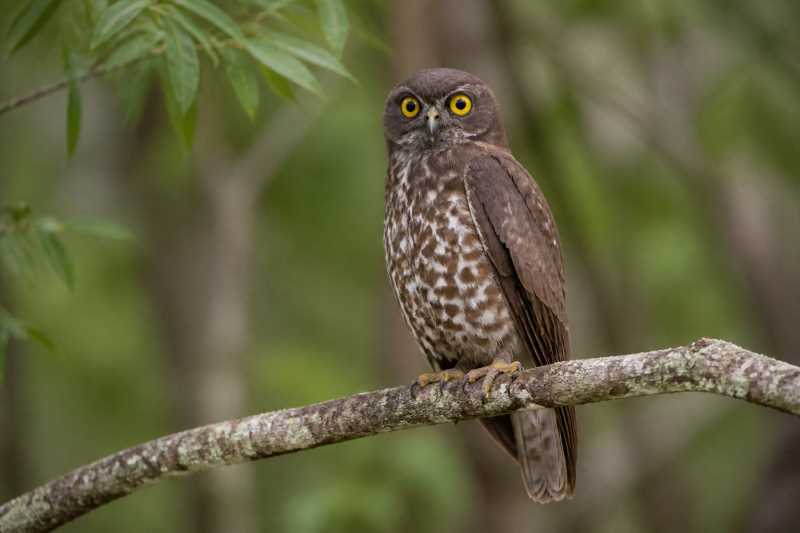
Hume’s Boobook belongs to the family Strigidae, also known as typical owls. It is closely related to other species in the genus Ninox, which are commonly referred to as boobooks or hawk owls. This particular species, Ninox obscura, is characterized by its medium size, typically measuring between 25 to 30 centimeters in length with a wingspan of roughly 60 centimeters.
The plumage of Hume’s Boobook is a rich dark brown, adorned with intricate patterns of white and buff spots that provide exceptional camouflage against the bark of trees in its forested environment. Its eyes are a striking yellow, set within a facial disc that helps to funnel sound to its ears, enhancing its nocturnal hunting abilities. The bird’s call, a series of low, resonant hoots, is a distinctive feature that aids in territory establishment and mating.
Habitat and Distribution
Hume’s Boobook is predominantly found in the subtropical and tropical moist lowland forests of the Indo-Malayan region, including parts of India, Bangladesh, and Myanmar. These owls prefer dense, undisturbed forest areas where they can utilize their superior hunting skills to prey on small mammals, insects, and occasionally small birds.
The species’ reliance on forested habitats makes it particularly vulnerable to deforestation and habitat fragmentation. As human activities continue to encroach on these areas, the availability of suitable nesting and hunting grounds for Hume’s Boobook is increasingly threatened.
Behavior and Ecology
As a nocturnal predator, Hume’s Boobook is most active during the night. It is an adept hunter, using its silent flight and acute hearing to locate prey. Its diet primarily consists of small mammals such as rodents, but it is also known to feed on large insects and other small vertebrates.
Breeding for Hume’s Boobook typically occurs during the dry season, when the availability of prey is at its peak. The species exhibits a high degree of parental care, with both males and females participating in the rearing of young. Nests are usually located in tree hollows, providing protection from predators and environmental elements.
Conservation Status
The International Union for Conservation of Nature (IUCN) currently lists Hume’s Boobook as a species of Least Concern, though it acknowledges that ongoing habitat destruction could pose significant threats in the future. Conservation efforts are crucial to ensure that this species does not move towards a more threatened status.
Efforts to conserve Hume’s Boobook must focus on habitat preservation and restoration. Protecting large swathes of forest from deforestation is vital to maintaining the ecological balance necessary for the survival of this and many other species. Public awareness campaigns and local community involvement are essential components of successful conservation strategies.
The Role of Research and Citizen Science
Research plays a pivotal role in understanding the ecology and behavior of Hume’s Boobook. Detailed studies on its breeding habits, diet, and migratory patterns are essential for developing effective conservation strategies. Additionally, citizen science initiatives, where local communities and bird enthusiasts contribute to data collection, can provide valuable insights into population dynamics and distribution changes over time.
Technological advancements have also bolstered research efforts, with satellite tracking and bioacoustic monitoring providing new ways to study these elusive birds. Such methods allow for the collection of data with minimal disturbance to the owls’ natural behaviors and habitats.
Conclusion
Hume’s Boobook is a testament to the rich biodiversity of the Indo-Malayan region. Its presence serves as an indicator of forest health and ecological balance. As human pressures on natural habitats continue to mount, it is imperative that concerted efforts are made to conserve not only this enigmatic owl but the broader ecosystems it inhabits. Through a combination of scientific research, conservation initiatives, and community engagement, there is hope for safeguarding the future of Hume’s Boobook and the rich tapestry of life it represents.
Preserving the mysterious allure of Hume’s Boobook is not just about saving a single species, but about maintaining the integrity of our planet’s delicate ecosystems for generations to come.
Related posts