Introduction
The Horned Sungem (Heliactin bilophus) is a small South American hummingbird and the only species in the genus Heliactin. It is best known for the male’s brilliant crown tufts, which resemble small horns. The species occurs mainly in open and semi-open habitats across Brazil, with additional populations in Bolivia and Suriname.
Physical Description
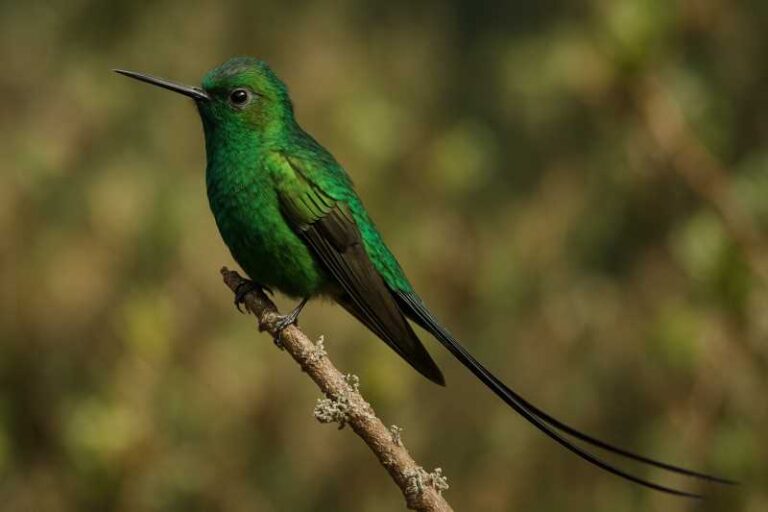
The Horned Sungem measures approximately 9.5–11 centimetres in length and weighs about 2–3 grams. It has a compact body, a relatively short, straight black bill and a long, pointed tail. The upperparts are metallic green or bronzy green, while the underparts are largely pale, with white along the belly and sides of the neck. The tail shows a distinctive dark pattern when viewed from below.
The sexes are strongly dimorphic. The adult male has a glossy blue crown, black throat and upper breast, and two narrow feather tufts above the eyes. These tufts are brightly coloured red, gold and green, producing the horn-like appearance that gives the species its name. The female lacks the ornamental crown tufts and black throat, and is generally plainer, with greenish upperparts and a pale or buff-coloured throat.
Immature birds are less brightly marked than adult males and may resemble females until the adult male crown and throat pattern develop. The long, pointed tail and short black bill remain useful identification features in all plumages.
Range and Habitat
The Horned Sungem is distributed across much of central and eastern Brazil, with parts of its range extending into eastern Bolivia and southern Suriname. It is associated with the Cerrado and other open or semi-open environments, including savanna, grassland, dry woodland, scrub, forest edges and gallery-forest margins. It may also visit rural gardens and other human-modified habitats where flowering plants are available.
The species is generally found from low elevations to approximately 1,000 metres. It is considered a full migrant in current conservation assessments, although its movements are better described as seasonal and nomadic in some areas, with birds responding to flowering conditions and food availability. Distribution and abundance can therefore vary between seasons and localities.
Where to See This Species
Chapada dos Veadeiros National Park, Goiás, Brazil
Horned Sungems have been documented in the park’s Cerrado habitats, including campo sujo and campo rupestre. Field research recorded the species visiting flowering plants during the rainy season, making open areas with abundant blooms productive places to search. The nearby town of Alto Paraíso de Goiás is the main visitor base.
Nearby accommodation: Alto Paraíso de Goiás offers pousadas, guest houses, small hotels, cabins and self-catering accommodation suited to visits into the park and surrounding reserves.
Chapada dos Guimarães National Park, Mato Grosso, Brazil
The species is included in the park’s bird records and is associated with the region’s Cerrado, open woodland and forest-edge habitats. It is most likely to be found around flowering vegetation in open areas and along suitable trails. The town of Chapada dos Guimarães provides the most practical base for visiting the park.
Nearby accommodation: Chapada dos Guimarães has guest houses, small hotels, lodges and self-catering accommodation, with camping also available in the wider region.
Chapada Diamantina National Park, Bahia, Brazil
The Horned Sungem is listed among the emblematic birds of this protected area, which includes Cerrado, campo rupestre, dry vegetation and gallery forest. The species is particularly relevant to birdwatchers exploring flowering habitats and upland open vegetation. Lençóis and Palmeiras are recognised gateway towns for different parts of the park.
Nearby accommodation: Lençóis and Palmeiras offer pousadas, guest houses, hotels, lodges and other small-scale accommodation for visitors exploring the national park.
Behaviour and Diet
The Horned Sungem is highly agile and can hover while taking nectar from flowers. It usually forages in the lower and middle vegetation layers, moving between flowering shrubs, herbs and small trees. It may defend a productive feeding site and chase other hummingbirds or intruders, particularly where flowers are concentrated.
Nectar is the principal food, but the species also captures small insects and other arthropods, which provide protein and other nutrients. It has been observed taking nectar from a relatively small selection of abundant flowering plants in some Cerrado habitats. The bird may also use nectar-robbing behaviour, taking nectar through openings at the base of flowers when the floral structure is difficult to exploit directly.
Breeding information remains limited, but studies in the Brazilian Cerrado indicate that the female alone builds the small cup-shaped nest, incubates the eggs and cares for the young. Nests are attached to forked branches of shrubs, and clutches contain two white eggs. Breeding activity has been recorded during both dry and wet-season periods, with timing varying by locality.
Identification Tips
- Look for a tiny hummingbird with a short black bill, pale underparts, metallic green upperparts and a long, pointed tail.
- An adult male is unmistakable when seen well: the blue crown, black throat and paired red-and-gold crown tufts create a distinctive head pattern.
- Females and immature birds are much plainer and lack the male’s crown ornaments and black throat.
- In flight, the pointed tail and dark markings contrasting with the pale underside can help separate the species from other small hummingbirds.
- Search flowering shrubs and herbs in open Cerrado, grassland, scrub and woodland edges rather than concentrating only on dense forest.
Conservation Status
The Horned Sungem is currently assessed as Least Concern on the IUCN Red List. Its global population has not been quantified, but the population trend is considered decreasing. The species has a very large geographic range and can use some modified habitats, which helps explain its current status.
The principal concerns are habitat loss and degradation caused by agricultural expansion, deforestation, development and changes to native vegetation. The loss of flowering plants may also reduce local feeding opportunities. Protection of Cerrado, savanna and dry-forest habitats, together with careful management of protected areas and sustainable land use, remains important for the species.
Frequently Asked Questions
Where does the Horned Sungem live?
The Horned Sungem lives mainly in central and eastern Brazil, with additional populations in eastern Bolivia and southern Suriname. It uses savanna, grassland, open woodland, scrub, forest edges and gallery-forest margins.
How can you identify a male Horned Sungem?
The adult male has a glossy blue crown, black throat and upper breast, and two colourful feather tufts above the eyes. The tufts are red, gold and green and give the bird its horned appearance.
What does the Horned Sungem eat?
It feeds mainly on nectar from flowering plants and supplements this diet with small insects and other arthropods. It may rob nectar from flowers that are difficult to access with its short bill.
Is the Horned Sungem migratory?
Current conservation assessments classify the species as a full migrant. In practical field observations, movements may be seasonal or nomadic, with birds tracking flowering and food availability across their range.
Where is the best place to see a Horned Sungem?
Reliable viewing opportunities include Chapada dos Veadeiros National Park, Chapada dos Guimarães National Park and Chapada Diamantina National Park in Brazil. Open flowering vegetation and Cerrado habitats are generally more promising than dense forest.
Is the Horned Sungem endangered?
No. The species is currently classified as Least Concern, although its population is considered to be decreasing and habitat loss remains an important threat.
References
- BirdLife International
- Biotemas
- Instituto Chico Mendes de Conservação da Biodiversidade
Related posts