The Remarkable Harris’s Hawk: A Pinnacle of Avian Adaptation
The Harris’s Hawk (Parabuteo unicinctus) is a fascinating bird of prey that stands out among raptors for its unique social behavior and adaptive hunting strategies. Native to the Americas, this species has captivated ornithologists and bird enthusiasts alike with its cooperative hunting techniques and striking appearance. This article delves into the biology, behavior, and conservation of the Harris’s Hawk, offering insights into what makes this raptor a remarkable member of the avian world.
Physical Characteristics
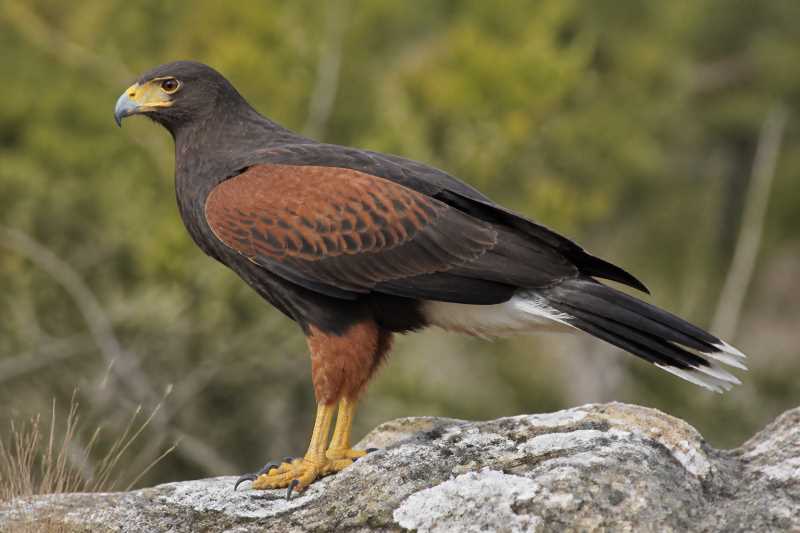
Harris’s Hawks are medium-sized raptors, with females typically larger than males, a common trait among birds of prey. Adults exhibit a distinctive plumage with dark brown feathers covering most of their bodies, contrasted by rich chestnut shoulders and thighs, and a white-tipped tail. These features provide a stark yet elegant appearance, enhancing their visibility in the wild.
Their wingspan ranges from 103 to 120 centimeters, facilitating agile flight. Their strong, hooked beaks and sharp talons are perfectly adapted for capturing and dismembering prey, making them formidable hunters. The combination of strength and agility allows Harris’s Hawks to thrive in diverse environments, showcasing their adaptability.
Geographical Distribution and Habitat
The Harris’s Hawk is predominantly found in the arid and semi-arid regions of the Americas, ranging from the southwestern United States through Central America and into parts of South America. They prefer open habitats such as deserts, savannas, and scrublands, where they can easily spot and pursue prey.
Despite their preference for arid climates, Harris’s Hawks demonstrate a remarkable ability to adapt to various environments, including urban areas. In recent years, these hawks have been observed thriving in cities, utilizing tall buildings as perches to hunt for pigeons and other urban wildlife.
Social Behavior and Cooperative Hunting
One of the most intriguing aspects of Harris’s Hawks is their social structure and cooperative hunting techniques, which are rare among raptors. Unlike most birds of prey that hunt alone, Harris’s Hawks often hunt in groups, a behavior known as "cooperative hunting." This strategy involves multiple birds working together to flush out, pursue, and capture prey, often increasing their hunting success rate.
Typically, a group, or "cast," consists of three to seven individuals, usually including a dominant female, several males, and juveniles from previous broods. The cooperative hunting strategy allows them to tackle larger prey than they could manage individually, such as rabbits and larger birds. This social structure not only enhances their hunting efficiency but also aids in defense against predators and territorial disputes.
Reproduction and Lifespan
Harris’s Hawks exhibit a complex social breeding system, often involving polyandry, where multiple males mate with a single female. This system may help ensure the survival of the offspring by providing more resources and protection.
Nesting typically occurs in spring, with pairs using large trees or cacti to build their nests. The female lays two to four eggs, which are incubated for about 33 to 36 days. Both parents, along with other group members, participate in feeding and protecting the chicks. The young fledge approximately 40 to 50 days after hatching but often remain with the group for an extended period, learning hunting skills and social behaviors.
In the wild, Harris’s Hawks can live up to 15 years, though many factors such as predation, environmental conditions, and human interference can impact their lifespan.
Conservation Status
Currently, the Harris’s Hawk is classified as a species of Least Concern by the International Union for Conservation of Nature (IUCN). However, like many wildlife species, they face threats from habitat destruction, climate change, and human activities such as illegal hunting and trapping.
Conservation efforts focus on habitat preservation and public education to reduce human-wildlife conflict. Encouragingly, Harris’s Hawks have shown resilience by adapting to urban environments, which may buffer them against some habitat loss. Nevertheless, continued monitoring and conservation initiatives remain crucial to ensure their populations remain stable.
Conclusion
The Harris’s Hawk is a remarkable example of avian adaptation and social behavior. Their cooperative hunting techniques, adaptability to varied environments, and complex social structures distinguish them as a unique species among birds of prey. As urbanization and climate change continue to alter natural landscapes, understanding and conserving these adaptable raptors becomes increasingly important.
For bird enthusiasts and researchers, the Harris’s Hawk offers a fascinating case study in the evolutionary benefits of social cooperation and adaptation. Protecting this species ensures that future generations can continue to marvel at their remarkable prowess and adaptability in the wild.
Related posts