Introduction
The Grey-rumped Treeswift (Hemiprocne longipennis) is an arboreal insect-eating bird of Southeast Asia. It belongs to the small family Hemiprocnidae, which is closely related to the true swifts, but treeswifts are adapted to perch regularly in trees. The species is recognised for its long, narrow wings, forked tail, prominent crest and pale grey rump.
Physical Description
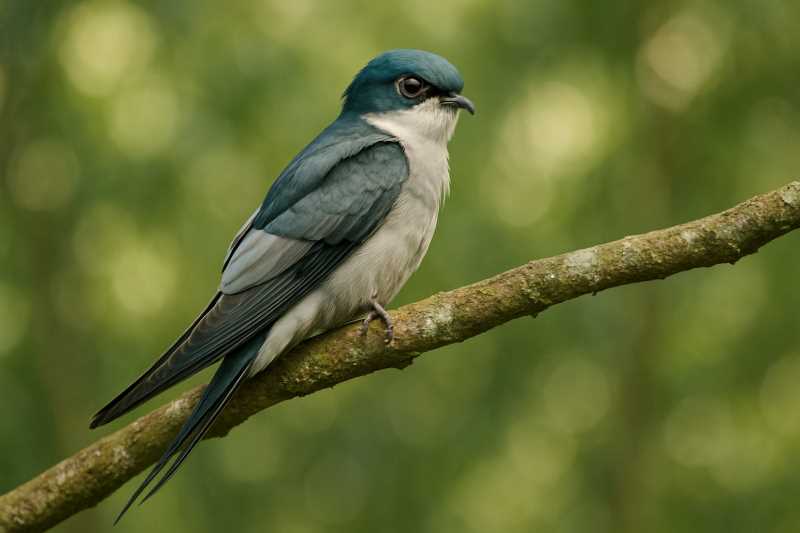
The Grey-rumped Treeswift is a medium-sized bird, measuring approximately 21–25 cm in length. It has a glossy greenish-grey crown, crest, mantle and wings, with a contrasting pale grey rump. The throat and breast are greyish, becoming paler towards the whitish belly and vent. The wings are exceptionally long, and their tips cross over the tail when the bird is perched.
The sexes are similar overall, but the male usually has dark chestnut or rufous ear-coverts, while the female has blackish ear-coverts. Juveniles are duller and more brown-marked, with pale edges and barring on the upperparts and underparts. The bill is short and dark, suited to catching insects in flight.
Range and Habitat
The species is distributed across mainland and island Southeast Asia. Its range includes southern Myanmar and Thailand, the Malay Peninsula, Singapore, Sumatra, Java, Borneo and parts of Sulawesi and the Lesser Sunda region, depending on the taxonomic treatment of local forms.
Grey-rumped Treeswifts are associated mainly with lowland evergreen forest, forest edges, clearings, open woodland, mangroves and mature gardens with tall trees. They may also occur in lightly modified landscapes where suitable perches and flying insects are available. The species is generally resident rather than migratory, although local movements may occur.
Where to See This Species
Singapore Botanic Gardens, Singapore
The species is documented at the Singapore Botanic Gardens, where it has been recorded in the gardens’ mature trees and primary-rainforest areas. Tall trees provide suitable perches and aerial feeding space, and the species has also been recorded breeding at the site. Look high above open lawns, forest edges and large trees, particularly during the warmer parts of the day.
Nearby accommodation: Singapore offers a wide range of hotels, guest houses, serviced apartments and other accommodation throughout the city, with convenient access to the Gardens.
Taman Negara National Park, Pahang, Malaysia
Grey-rumped Treeswifts have been recorded around the park headquarters, river trails and nearby clearings. The combination of tall lowland rainforest, open river margins and elevated perches makes the Kuala Tahan area a practical base for searching. Scan the canopy and open sky during daylight, especially along forest edges and riverside trails.
Nearby accommodation: Kuala Tahan is the main gateway settlement and provides lodges, guest houses, small hotels and campsites.
Danum Valley Conservation Area, Sabah, Malaysia
The species is documented from Danum Valley in Sabah, where extensive lowland rainforest and emergent trees provide suitable habitat. It may be seen flying above the canopy or perched conspicuously on exposed branches and dead snags. Visits are normally arranged through the conservation area’s designated access and accommodation system.
Nearby accommodation: Lahad Datu is the principal gateway town, with hotels and guest houses, while conservation-area accommodation and rainforest lodges are available through approved arrangements.
Behaviour and Diet
Grey-rumped Treeswifts spend much of the day hunting flying insects from exposed perches. They launch into the air to take insects such as ants, beetles, bees, wasps, flies and other small arthropods, then often return to the same or a nearby perch. Their flight is fast and agile, but they also spend considerable time sitting quietly high in trees.
They are commonly seen alone, in pairs or in small groups. The long wing tips crossing over the tail are particularly noticeable when a bird is perched. Vocalisations include high-pitched calls used for contact and communication between members of a pair or group.
Breeding pairs build a very small half-saucer nest on the side or upper surface of a slender branch. The nest is made from plant material, feathers, bark flakes and moss bound together with hardened saliva. A single white egg is laid. Both adults participate in nest construction and parental care, and the adults straddle the nest from the branch because it is too small and delicate to support their full weight.
Identification Tips
- Look for a swift-like bird with a noticeable forehead crest and a pale grey rump.
- When perched, the very long wing tips usually cross over the shorter, deeply forked tail.
- The upperparts are glossy greenish-grey, while the belly is distinctly paler.
- A male often shows chestnut or rufous ear-coverts; the female’s ear-coverts are generally blackish.
- The species is more likely to perch openly than a true swift, often choosing a high branch, dead snag or other exposed lookout.
- The Crested Treeswift can be similar, but Grey-rumped Treeswift is distinguished by its grey rump and generally lacks the Crested Treeswift’s prominent white eyebrow pattern.
Conservation Status
The Grey-rumped Treeswift is currently assessed globally as Least Concern. Its broad distribution and use of a range of wooded habitats reduce its immediate global extinction risk, although detailed population information is limited.
The main potential threats are the loss, degradation and fragmentation of lowland forest through logging, agricultural expansion and development. Protecting remaining forests, mature trees, forest edges and connected habitat is important for maintaining local populations. In Singapore, the species has a more precautionary local assessment of Near Threatened, reflecting the limited extent of suitable natural habitat in the country.
Frequently Asked Questions
Where is the Grey-rumped Treeswift found?
It occurs in parts of mainland and island Southeast Asia, including southern Myanmar, Thailand, Peninsular Malaysia, Singapore, Sumatra, Java, Borneo and nearby islands.
Is the Grey-rumped Treeswift a true swift?
No. It is a treeswift in the family Hemiprocnidae. Treeswifts are closely related to true swifts but regularly perch in trees, whereas many true swifts spend most of their lives in flight.
What does the Grey-rumped Treeswift eat?
It feeds mainly on flying insects and other small arthropods, including ants, beetles, flies, bees and wasps, which it catches in the air.
How can the species be identified when perched?
The most useful clues are the pale grey rump, forehead crest, long wing tips crossing over the forked tail and pale belly. The male’s chestnut ear-coverts can also help with sex identification.
How does the Grey-rumped Treeswift build its nest?
Both adults construct a tiny half-saucer nest from feathers, bark flakes, moss and other plant material cemented with saliva. It is attached to a slender branch and usually holds a single egg.
Is the Grey-rumped Treeswift endangered?
It is globally classified as Least Concern, although habitat loss and forest fragmentation may affect local populations. Conservation of lowland forest and mature trees remains important.
References
- BirdLife International
- IUCN Red List of Threatened Species
- National Parks Board, Singapore
Related posts