Introduction
The Grey Francolin, Ortygornis pondicerianus, is a ground-dwelling member of the pheasant family, Phasianidae. Also known as the Grey or Indian Grey Francolin, it is widely distributed across the drier parts of South Asia and is locally called teetar. The species is resident rather than migratory and is recognised for its strongly barred plumage, loud repetitive calls and ability to use both natural and agricultural landscapes.
Physical Description
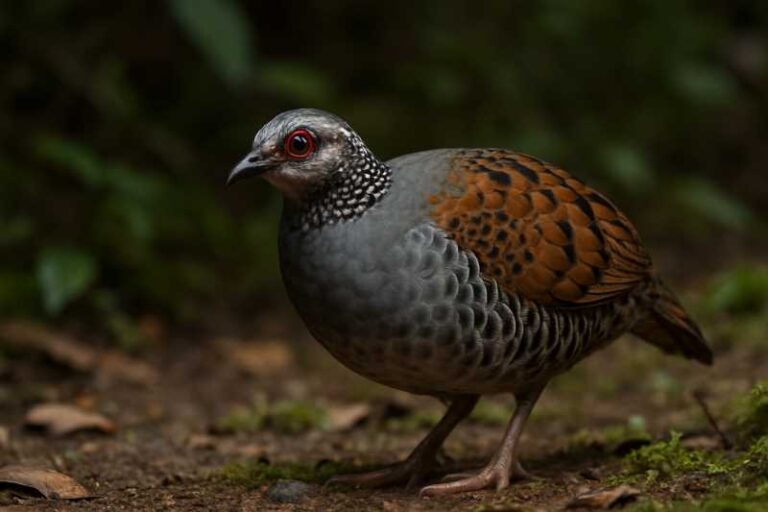
The Grey Francolin is a compact, chicken-like gamebird measuring approximately 30–35 centimetres in length and weighing about 255–418 grams. Its upperparts are brownish and chestnut with bold pale barring, while the underparts are buffy white with fine dark bars. A dark necklace-like band separates the buff throat from the barred breast.
The face and crown are orangish, and the bill is short and curved. Males and females are broadly similar in plumage, although males are generally larger and may be distinguished by a metatarsal spur. Birds from southern India and Sri Lanka can show more orange on the throat than northern forms. Juveniles are generally duller and less sharply marked than adults.
Range and Habitat
The native range extends from southern Iran through Pakistan and across much of India to Nepal, Bangladesh and northern Sri Lanka. The species has also been introduced to several islands and parts of the Arabian Peninsula, including Hawai‘i, where it occupies dry lowland habitats. It is not considered migratory.
Grey Francolins favour open, dry and semi-dry habitats, including grasslands, thorn scrub, savanna, scrubby woodland margins, dry-season croplands and field edges. They generally occur at low elevations, usually below 500 metres, although records from Pakistan reach approximately 1,200 metres. The species does not normally depend on forest and can tolerate moderately modified agricultural environments when cover and food remain available.
Geographic variation occurs across the range, and several subspecies have been recognised. Taxonomic treatments have differed, but the genus Ortygornis is used by the IOC World Bird List for the Grey Francolin.
Behaviour and Diet
Grey Francolins are primarily terrestrial. They usually walk or run through cover and fly only when disturbed or when moving between nearby patches of habitat. Outside the breeding season, they commonly occur in small family groups or coveys of roughly four to eight birds. Activity is greatest during the cooler parts of the day, particularly in the early morning and late afternoon.
The species feeds mainly on seeds, grains and other plant material, supplemented by insects and their larvae. It may also consume buds, flowers, leaves, shoots, fruits, berries and, occasionally, small reptiles. Birds forage by scratching and probing the ground in scrub, grassland and cultivated fields. Insects are especially important in the diet of growing chicks.
Grey Francolins are generally monogamous. Breeding dates vary geographically and may be influenced by rainfall, with nesting commonly occurring during spring or around the monsoon period. The nest is a shallow scrape on the ground, usually concealed beneath grass, crops, thorny bushes or other dense vegetation. Clutch size varies, but commonly reported clutches contain about 4–10 eggs, with larger clutches recorded locally. Incubation periods reported from Pakistan have ranged from approximately 13 to 20 days, so the often-cited figure of 18–21 days should not be treated as universal.
The female is commonly reported to undertake most or all incubation, while both adults care for the precocial young. Chicks can move and feed soon after hatching but remain with their parents for an extended period.
Identification Tips
Look for a small, stocky, chicken-like bird in dry grassland, thorn scrub or fields. The most useful field marks are:
- An orangish face and crown.
- A buffy-white throat bordered below by a dark necklace-like band.
- Fine, extensive barring on the underparts.
- Brown and chestnut upperparts with strong pale barring.
- A loud, repeated call often rendered as “kateetar-kateetar”.
- A tendency to travel in pairs or small groups and to run through cover rather than remain in flight.
The Grey Francolin can be confused with other francolins and partridges in parts of its range. It is generally separated from the Black Francolin by its buff throat, grey-brown barred appearance and lack of the Black Francolin’s predominantly black male plumage and contrasting rufous collar. Calls, habitat and behaviour are useful supporting clues, especially when views are brief.
Conservation Status
The Grey Francolin is assessed as Least Concern on the IUCN Red List. BirdLife International reports that the global population has not been quantified, but the species has an extremely large range, is common in much of it and is suspected to have a stable overall population trend.
Local populations may nevertheless be affected by habitat loss, agricultural intensification, pesticide use, disturbance and hunting. These pressures can be particularly important where scrub, grass margins and nesting cover are removed. Conservation measures include retaining patches of natural vegetation, maintaining uncultivated field margins, using pesticides responsibly and managing hunting in accordance with local wildlife regulations. The species occurs in protected areas across parts of its range, but its wider conservation depends largely on maintaining suitable habitat in working agricultural landscapes.
Frequently Asked Questions
Where does the Grey Francolin live?
It is native to the drier parts of South Asia, from southern Iran and Pakistan across India to Nepal, Bangladesh and northern Sri Lanka. It has also been introduced to Hawai‘i and several other regions.
Is the Grey Francolin migratory?
No. The Grey Francolin is generally resident, although local movements may occur in response to food availability, rainfall or disturbance.
What does the Grey Francolin eat?
Its diet consists mainly of seeds, grains and other plant material, together with insects and their larvae. It may also eat buds, fruits, berries and small reptiles.
How can the Grey Francolin be identified?
Look for a compact, barred gamebird with an orangish face, a buff throat, a dark necklace-like band and brown-chestnut upperparts. Its loud repetitive call is often the first indication of its presence.
Where does the Grey Francolin nest?
It nests on the ground, usually in a shallow scrape hidden beneath grass, crops, thorn scrub or other dense vegetation.
Is the Grey Francolin endangered?
No. It is currently classified as Least Concern, although local populations can be harmed by habitat loss, intensive agriculture, pesticides and hunting.
References
- BirdLife International. 2018. Grey Francolin Ortygornis pondicerianus Species Factsheet. BirdLife DataZone. IUCN Red List assessment, accessed 8 September 2026. https://datazone.birdlife.org/species/factsheet/grey-francolin-ortygornis-pondicerianus
- Gill, F., Donsker, D. and Rasmussen, P., eds. 2026. IOC World Bird List, version 15.2. International Ornithologists’ Committee, accessed 8 September 2026. https://www.worldbirdnames.org/
- Islam, K. 2021. Gray Francolin (Ortygornis pondicerianus), version 1.1. In S. M. Billerman, ed., Birds of the World. Cornell Lab of Ornithology. https://doi.org/10.2173/bow.gryfra.01.1
- Cornell Lab of Ornithology. n.d. Gray Francolin: Identification and Life History. All About Birds, accessed 8 September 2026. https://www.allaboutbirds.org/guide/Gray_Francolin/
- Khalil, S., Anwar, M. and Hussain, I. 2016. Breeding Biology of Grey Francolin (Francolinus pondicerianus) in Salt Range, Pakistan. Pakistan Journal of Zoology 48(1): 115–123. https://zsp.com.pk/pdf48/115-123%20(14)%20PJZ-1474-13%205-11-15%20%20BREEDING%20BIOLOGY%20OF%20GREY%20FRANCOLIN%20MANUSCRIPT.pdf
- Pyle, R. L. and Pyle, P. 2017. The Birds of the Hawaiian Islands: Occurrence, History, Distribution, and Status. Bishop Museum, Honolulu, version 2, accessed 8 September 2026. http://hbs.bishopmuseum.org/birds/rlp-monograph/
- del Hoyo, J., Collar, N. J., Christie, D. A., Elliott, A. and Fishpool, L. D. C. 2014. HBW and BirdLife International Illustrated Checklist of the Birds of the World, Volume 1: Non-passerines. Lynx Edicions and BirdLife International, Barcelona and Cambridge.
Related posts