Introduction
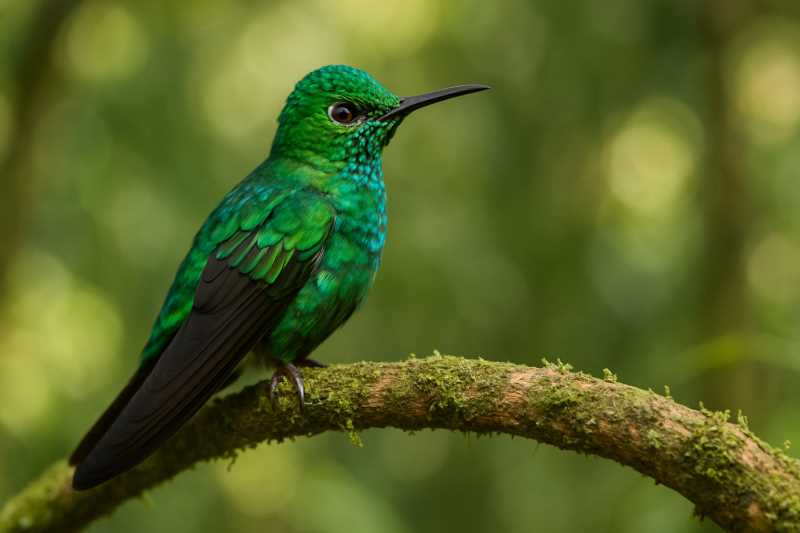
The Green-crowned Brilliant (Heliodoxa jacula) is a fairly large hummingbird of humid mountain forests, forest edges, clearings and mature secondary growth. Its range extends from Costa Rica and Panama through Colombia to western Ecuador. The species is named for the male’s brilliant green crown and belongs to the hummingbird family Trochilidae.
Physical Description
The Green-crowned Brilliant is approximately 12–14 cm long, with a relatively long, shallowly forked tail and a straight, moderately long black bill. Both sexes have a conspicuous white spot behind the eye.
The adult male is predominantly metallic emerald green, with a brilliant green crown, darker blue-black tail and a small violet-blue or blue-green patch on the upper throat. The lower belly and undertail area may appear paler, with white around the vent and thighs.
The adult female is less glossy. She has a greenish head, a short white malar stripe, whitish underparts heavily spotted with green and a darker, less deeply forked tail with pale tips on the outer feathers. Immature birds are duller and may show buff on the chin and face, while young males gradually develop the adult male’s metallic plumage.
Range and Habitat
The species occurs in Costa Rica, Panama, Colombia and western Ecuador. Three geographical forms are generally recognised: H. j. henryi in Costa Rica and western Panama, the nominate H. j. jacula in eastern Panama and the Andes of Colombia, and H. j. jamersoni in south-western Colombia and western Ecuador.
Green-crowned Brilliants inhabit humid subtropical and tropical forest, especially montane and submontane forest, forest margins, clearings, mature secondary woodland and gardens near forest. Elevation varies across its range. It is commonly found between about 500 and 2,200 metres, although lower-elevation records occur locally. The species is considered resident rather than a long-distance migrant, but local movements may follow flowering and food availability.
Where to See This Species
Monteverde Cloud Forest Reserve, Puntarenas, Costa Rica
Monteverde’s cool, humid cloud forest and forest edges provide suitable habitat, and the Green-crowned Brilliant is included on local bird checklists. It may be encountered along forest trails, in clearings and around flowering plants, particularly where hummingbird activity is concentrated.
Nearby accommodation: Monteverde and Santa Elena offer guest houses, hotels, lodges, cabins and self-catering accommodation.
Bosque de Paz Biological Reserve, Alajuela, Costa Rica
Bosque de Paz protects humid montane forest and is a recognised birdwatching site where Green-crowned Brilliants have been recorded. Forest trails, flowering gardens and feeding areas provide realistic opportunities to look for this large hummingbird.
Nearby accommodation: The reserve itself provides lodge-style accommodation, while the nearby communities around Bajos del Toro offer additional lodges, guest houses and cabins.
Mount Totumas Cloud Forest Reserve, Chiriquí, Panama
Mount Totumas lies in the Chiriquí highlands near the La Amistad region. The species has been recorded around the reserve’s cloud-forest trails, gardens and hummingbird feeders, making this one of the more reliable birdwatching locations in Panama for observing Green-crowned Brilliants.
Nearby accommodation: Visitors can stay at the reserve’s lodge or use guest houses, cabins and small hotels in the nearby highland settlement of Nueva California and around Volcán.
Behaviour and Diet
Green-crowned Brilliants are active by day and usually forage alone. Males may defend productive flowers or feeders from other hummingbirds, using fast chases and repeated aerial attacks to exclude intruders. They often perch between feeding bouts, which can make them easier to observe than some smaller hummingbird species.
Nectar forms the main part of the diet. The birds visit a variety of tubular or bracted flowers, including plants associated with cloud forest and montane habitats. They also take small insects and spiders, particularly when breeding, to obtain additional protein. By carrying pollen between flowers, they contribute to the pollination of native plants.
Breeding information is less complete than for many widespread hummingbirds. The female builds the small cup-shaped nest and undertakes incubation and chick-rearing alone. Recorded nests are made from fine plant material and spider silk and may be placed on a sheltered branch or other protected support. A documented clutch contained two eggs, and the young remain dependent on the female until they are fully feathered and able to fly.
Identification Tips
- Look for a fairly large, long-tailed hummingbird with a straight bill.
- The male is mostly metallic green, with a particularly bright crown and a small blue or violet-blue throat patch.
- Both sexes show a distinct white spot behind the eye.
- The female has a white malar stripe and strongly green-spotted whitish underparts.
- The long, dark, shallowly forked tail helps separate it from shorter-tailed hummingbirds.
- Do not confuse the female with other spotted-breasted hummingbirds without checking the white eye spot, white malar stripe, body size and tail shape.
- In poor light, the male’s metallic colours may look plain green or dark, so the crown and blue throat patch are most useful when viewed in direct light.
Conservation Status
The Green-crowned Brilliant is currently assessed as Least Concern on the IUCN Red List. A precise global population estimate is not available, and the overall population trend is not well quantified. The species shows some tolerance of forest edges, secondary growth and gardens, but the clearance and fragmentation of humid mountain forest can cause local declines.
Protection of cloud forests, montane woodland and forest corridors is important. Maintaining native flowering plants and limiting further conversion of forest to intensive agriculture can also preserve feeding and breeding habitat.
Frequently Asked Questions
Where can the Green-crowned Brilliant be found?
It occurs from Costa Rica and Panama south through Colombia to western Ecuador, mainly in humid montane and submontane habitats.
What does the Green-crowned Brilliant look like?
It is a fairly large hummingbird with a straight bill, long shallowly forked tail and a white spot behind the eye. Males are brilliant green with a small blue or violet-blue throat patch, while females have whitish, green-spotted underparts.
What does the Green-crowned Brilliant eat?
It feeds mainly on nectar from flowering plants and supplements this diet with small insects and spiders.
Is the Green-crowned Brilliant migratory?
It is generally regarded as a resident species. Local movements may occur when birds follow changes in flowering, food availability or seasonal conditions.
Where is the best place to see this hummingbird?
Cloud-forest sites in Costa Rica and Panama are among the most practical places to look. Monteverde Cloud Forest Reserve, Bosque de Paz Biological Reserve and Mount Totumas Cloud Forest Reserve all have documented records and suitable habitat.
How can male and female Green-crowned Brilliants be distinguished?
The male is more vividly metallic, especially on the crown and throat. The female is duller, with a white malar stripe and heavily green-spotted whitish underparts.
References
- BirdLife International
- Cornell Lab of Ornithology, Birds of the World
- Ornitología Neotropical
Related posts