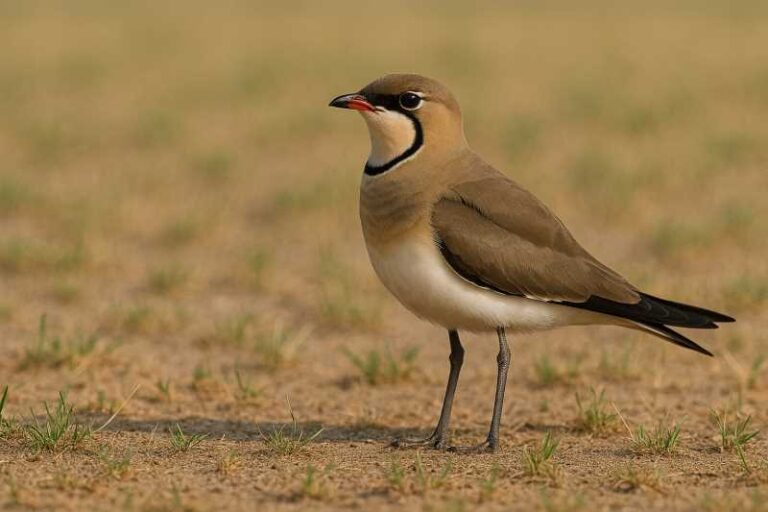
The Greater Sand-Plover, scientifically known as Charadrius leschenaultii, is a captivating bird species that belongs to the family Charadriidae. This wader bird is renowned for its remarkable migratory patterns and is found across a wide geographical range spanning from Southeast Europe to the shores of Australia. The species is divided into three subspecies, each occupying distinct habitats ranging from coastal mudflats to inland wetlands.
The physical appearance of the Greater Sand-Plover is characterized by its relatively large size for a plover, measuring approximately 22 to 25 cm in length. It exhibits a distinctive breeding plumage; males display a striking combination of a bright chestnut breast band and a white face with a black forehead. Females and non-breeding individuals, however, possess more subdued tones of brown, which aid in camouflage against sandy and muddy environments.
One of the most fascinating aspects of the Greater Sand-Plover is its migratory behavior. These birds are long-distance migrants, breeding in the temperate regions of Central Asia and migrating to tropical coastlines for the winter. The migration journey is a testament to their resilience and navigational prowess, covering thousands of kilometers and crossing diverse ecological landscapes. Notably, they are known to undertake non-stop flights across vast stretches of ocean, relying on favorable winds and fat reserves accumulated during the breeding season.
Breeding occurs from May to July, primarily in the arid and semi-arid steppe regions. The nesting sites are typically shallow scrapes on open ground, often lined with small stones or vegetation. During this period, males engage in elaborate courtship displays to attract mates, consisting of vocalizations and aerial maneuvers. The female lays a clutch of two to three eggs, which are incubated by both parents for about 25 to 27 days. Once hatched, the chicks are precocial and leave the nest shortly after, following their parents in search of food.
The diet of the Greater Sand-Plover mainly consists of invertebrates such as insects, crustaceans, and worms. Their foraging behavior is adapted to their habitat, utilizing their keen eyesight to spot prey on mudflats and sandy beaches. They often feed in flocks, employing a methodical approach by moving in unison along the shoreline, probing the substrate with their bills.
Conservation status of the Greater Sand-Plover has been a subject of interest due to habitat loss and environmental changes affecting their migratory routes. While currently classified as ‘Least Concern’ by the International Union for Conservation of Nature (IUCN), ongoing threats such as coastal development, pollution, and climate change pose significant risks. Conservation efforts are crucial in preserving their habitats and ensuring the sustainability of their migratory pathways.
In conclusion, the Greater Sand-Plover is an exemplary species that highlights the intricate balance between adaptation and survival in diverse environments. Their migratory journeys connect continents, serving as a reminder of the interconnectedness of global ecosystems. Observing these birds offers valuable insights into the challenges faced by migratory species and underscores the importance of international cooperation in conservation initiatives. As we continue to study and protect the Greater Sand-Plover, we not only preserve a remarkable species but also contribute to the broader understanding of avian biodiversity.
Related posts