Introduction
The Giant Hummingbird, Patagona gigas, is more precisely known in recent taxonomic treatments as the Southern Giant Hummingbird. It is one of the largest hummingbirds in the world and is associated with the Andes and adjacent dry valleys of South America. Unlike the small, rapidly beating hummingbirds familiar in many gardens, this species has a powerful flight style, a relatively slow wingbeat and a conspicuous gliding habit.
The name Patagona gigas was formerly used more broadly for both giant hummingbird forms. Recent research recognises the northern form as the separate Northern Giant Hummingbird, Patagona peruviana. This distinction is important when interpreting older distribution and identification information.
Physical Description
The Southern Giant Hummingbird is a large, long-winged hummingbird measuring approximately 20 to 23 centimetres in length and weighing roughly 18 to 24 grams. It has a compact but powerful body, a long straight bill and broad wings suited to sustained flight over open country.
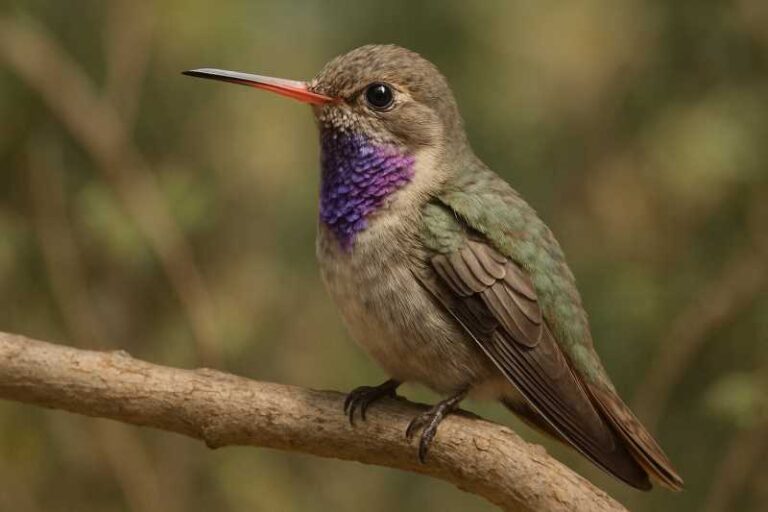
The upperparts are generally olive-green to brown, while the underparts are paler and often washed with grey, buff or warm cinnamon tones. The throat and breast may show brownish or cinnamon colouring, although the intensity varies between individuals. A pale rump patch can be visible in flight, and the relatively long tail contributes to its distinctive silhouette.
The sexes are broadly similar in colour, with females generally smaller. Juveniles are usually duller and less sharply marked than adults, although age-related differences can be subtle in the field. Colour and pattern can also vary geographically, so identification should not rely on plumage alone.
Range and Habitat
Patagona gigas occurs in central Chile, central and north-western Argentina, Bolivia and parts of Peru, particularly during the non-breeding season. Its range and seasonal movements have been revised following the recognition of Patagona peruviana as a separate species. The two species overlap in parts of Peru, where identification may require close attention to plumage, voice, location and season.
Southern Giant Hummingbirds breed from near sea level to about 2,000 metres in Chile, generally above about 2,500 metres in Argentina, and from approximately 2,100 to 4,150 metres in Bolivia. Populations from central Chile undertake seasonal movements towards higher Andean and Peruvian areas after breeding. The precise movements of some Argentine populations remain incompletely understood.
Typical habitats include arid and semi-arid scrub, open mountain valleys, rocky slopes, dry woodland, agricultural areas with flowering hedgerows and high-elevation grassland. The species is often associated with flowering plants such as cacti, agaves and other tubular-flowered species, as well as streams, ravines and sheltered valley vegetation.
Where to See This Species
Parque Nacional Los Cardones, Salta, Argentina
The Argentine biodiversity information system records the Southern Giant Hummingbird regularly in Parque Nacional Los Cardones. The park protects high-Andean, Monte and intermontane environments with extensive cardón cactus vegetation, open slopes and flowering plants that provide suitable feeding habitat. Public trails, viewpoints and road-accessible areas make it a practical place to search, particularly around flowering scrub and cactus-rich habitats.
Nearby accommodation: Payogasta and Cachi provide guest houses, small hotels, hostels and other visitor accommodation suitable for exploring the park.
Parque Nacional El Leoncito, San Juan, Argentina
Parque Nacional El Leoncito is a documented site for the species and protects Altos Andes, Puna and Monte de Sierras y Bolsones habitats. Look around open valleys, stream margins, flowering scrub and other sheltered areas within the park. The species may be encountered while birdwatching along public roads and walking routes, although sightings are not guaranteed.
Nearby accommodation: Barreal and the wider Calingasta area offer campsites, cabins, guest houses, inns and small hotels. The park also has an agreste camping area, and limited accommodation is available at the CASLEO observatory by prior arrangement.
Parque Nacional Aconquija, Tucumán, Argentina
Parque Nacional Aconquija is another protected area where the species has been recorded. Its large altitudinal range includes Yungas forest, montane habitats and high-Andean environments. The most suitable areas to investigate are open mountain slopes, forest edges, upper valleys and flowering vegetation, especially where the habitat grades into drier high-elevation country.
Nearby accommodation: Concepción is the main practical gateway, with hotels, guest houses and other basic visitor services. Alpachiri is a smaller nearby settlement used for access to some park entrances and may offer limited local accommodation and transport services.
Behaviour and Diet
The Southern Giant Hummingbird is usually seen alone while feeding, although several individuals may gather where flowers are abundant. It is territorial around particularly productive flowers and may defend feeding areas from other hummingbirds. Its flight is powerful and direct, with regular hovering interspersed with short glides. The broad wings produce a slower, more deliberate wingbeat than that of smaller hummingbird species.
Nectar forms the main part of the diet. The bird visits a wide range of flowering plants, including cacti and other species with tubular flowers, and can be an important pollinator. It also captures small insects and other arthropods, particularly when additional protein is needed. Calcium-rich mineral sources, including ash or other mineral material, have also been recorded as being deliberately consumed.
Breeding is seasonal and is linked to local food availability. The female builds the small cup-shaped nest, using plant fibres, moss, lichens and spider silk or similar binding material. Two white eggs are typically laid. The female undertakes incubation and cares for the young after hatching, while the male does not normally take part in nest construction or chick rearing.
Identification Tips
- Look for a very large hummingbird, roughly the size of a small thrush or swift in overall impression, with a long bill and broad wings.
- The flight is distinctive, combining strong wingbeats with short glides rather than the rapid, continuous hovering typical of many smaller hummingbirds.
- Olive-green to brown upperparts, a pale or greyish underside and a possible pale rump patch are useful field marks.
- The bird often favours open valleys, scrub, cactus-rich slopes, flowering hedgerows and stream margins rather than dense forest.
- In Peru, take care when identifying giant hummingbirds because the Southern Giant Hummingbird overlaps seasonally with the Northern Giant Hummingbird, Patagona peruviana. Voice, season, location and subtle plumage details may all be important.
Conservation Status
The Southern Giant Hummingbird is currently assessed as Least Concern on the IUCN Red List. It has a broad distribution and is recorded in several protected areas, but a global population estimate is not given here because reliable range-wide figures are unavailable.
Potential pressures include the clearance and degradation of native scrub, agricultural expansion, grazing, changes to streamside vegetation and the loss of flowering plants. Seasonal movements may also make the species dependent on a connected chain of suitable habitats across different elevations. Protecting native flowering vegetation, maintaining habitat corridors and improving monitoring of migration and non-breeding areas are important conservation measures.
Frequently Asked Questions
Where is the Giant Hummingbird found?
The Southern Giant Hummingbird, Patagona gigas, is found mainly in central Chile, central and north-western Argentina, Bolivia and parts of Peru. Its distribution changes seasonally, and some populations migrate between lower breeding areas and higher Andean regions.
Is the Giant Hummingbird the largest hummingbird?
It is one of the largest hummingbirds and was historically treated as the largest. Following the recognition of the Northern Giant Hummingbird, Patagona peruviana, as a separate species, P. gigas is more accurately described as one of the two giant hummingbirds rather than unambiguously the largest.
What does the Giant Hummingbird eat?
Its diet is based mainly on nectar from flowering plants, including cacti and other tubular-flowered species. It also takes small insects and other arthropods, and mineral-rich material has occasionally been recorded in the diet.
Does the Giant Hummingbird migrate?
Many Southern Giant Hummingbirds migrate seasonally. Birds breeding in central Chile move towards Peru and other Andean areas after the breeding season, while the movements of some populations from north-western Argentina are less well understood.
How can the Giant Hummingbird be identified?
Its large size, long bill, broad wings, olive-brown upperparts, pale to cinnamon underparts and distinctive gliding flight are useful clues. In areas where it overlaps with Patagona peruviana, identification may require careful attention to voice, season, geography and subtle plumage differences.
Is the Giant Hummingbird endangered?
No. The species is currently classified as Least Concern, but local habitat loss, degradation of flowering vegetation and disruption of seasonal movement routes may affect some populations.
References
- Williamson et al., Proceedings of the National Academy of Sciences
- IUCN Red List of Threatened Species
- Administración de Parques Nacionales and Sistema de Información de Biodiversidad, Argentina
Related posts