Introduction
The Four-banded Sandgrouse (Pterocles quadricinctus) is a medium-sized, ground-dwelling bird of the sandgrouse family, Pteroclidae. It occurs across the savanna and scrub zones of sub-Saharan Africa, especially in the western Sahel. Its cryptic plumage, rapid flight, flocking behaviour and dependence on scattered water sources reflect its adaptation to hot, seasonally dry environments.
Physical Description
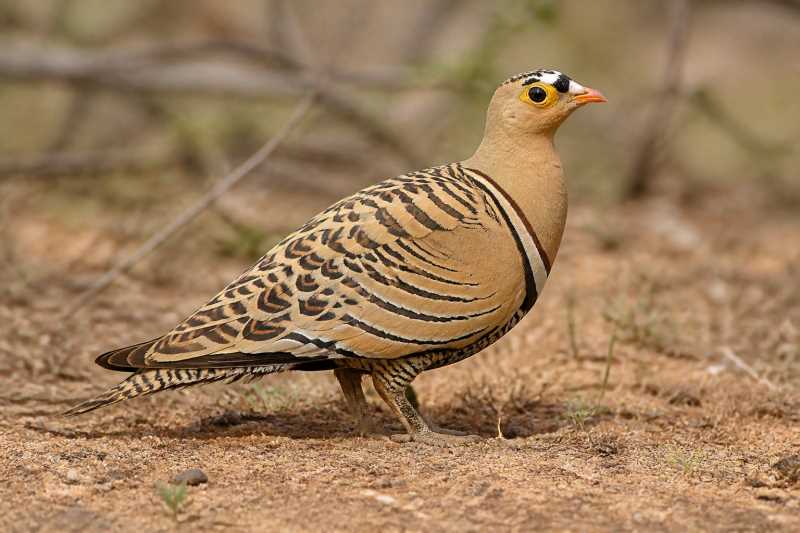
The Four-banded Sandgrouse measures approximately 25–28 centimetres in length. It has a compact, pigeon-like body, a small head, long pointed wings, a short tail and a fast, direct flight.
Adult males are the most distinctive. They have yellowish-green to sandy upperparts marked with brown, black-and-white bands on the forehead, and a striking series of contrasting bands across the breast. The belly is heavily barred. Females lack the strong forehead and breast bands and are generally more uniformly camouflaged, with dense barring across the back, flanks and underparts.
Juveniles are expected to resemble females and other immature sandgrouse, with subdued, barred plumage rather than the bold patterning of adult males. The species is best identified by its compact shape, heavily patterned underparts and the male’s contrasting facial and breast bands.
Range and Habitat
The Four-banded Sandgrouse occupies a broad belt of Africa extending from Mauritania and Senegal eastwards through the Sahel and Sudanian savannas to Sudan and Uganda, with records across several countries in between. It is more frequently encountered in the western part of its range.
It inhabits dry, open savanna, thorn scrub, bushy grassland, sparse woodland and some lightly cultivated areas. It generally favours open ground with scattered trees or shrubs rather than true desert or dense forest. Local movements are influenced by rainfall, seed availability and access to drinking water. Some populations are partly seasonal or nomadic, and birds may move northwards or congregate in suitable areas during and after the rains.
Where to See This Species
Mole National Park, Savannah Region, Ghana
Mole National Park supports suitable Sudanian savanna and open woodland habitat. Four-banded Sandgrouse has been recorded in the park, with birds reported flying around at dusk. Look over open savanna, tracks and nearby water sources, particularly during the wetter season and around evening drinking movements.
Nearby accommodation: Mole and Larabanga provide access to park lodges, guest houses and other safari-oriented accommodation.
Tanji Bird Reserve, West Coast Region, The Gambia
Tanji Bird Reserve contains a mixture of coastal scrub, open woodland, lagoons and grassland, and the species has been recorded there. The reserve is a practical site for birdwatchers based on the Gambian coast. Search quiet open areas and scrub edges, especially in the cooler parts of the day and around dusk.
Nearby accommodation: The Tanji, Brufut, Kololi and coastal resort areas offer hotels, guest houses, lodges and self-catering accommodation.
Niokolo-Koba National Park, Tambacounda Region, Senegal
Niokolo-Koba contains extensive savanna, woodland and open grassland within the species’ West African range. Four-banded Sandgrouse has been recorded in the park and around the Wassadou access area. Sightings are likely to be brief, so scanning open ground and listening for flocks near water during the late afternoon and evening is advisable.
Nearby accommodation: Wassadou and Tambacounda are the main practical bases, with lodges, camps and guest-house accommodation available according to seasonal access.
Behaviour and Diet
The species is sociable and may gather in flocks, particularly when travelling to water. It feeds mainly on seeds and grains collected from the ground, including seeds from grasses and other herbaceous plants. Small invertebrates may occasionally be taken, but the diet is principally granivorous.
Four-banded Sandgrouse often forages during the cooler parts of the day. Flocks may fly swiftly and directly between feeding areas, resting sites and drinking places. Waterholes can become important observation points, particularly in dry weather, although the birds may arrive late in the day and depart quickly.
Breeding is associated with seasonal rainfall and the resulting increase in food. The nest is a shallow scrape on the ground, usually in open, sparsely vegetated terrain. A clutch normally contains two or three well-camouflaged eggs, and both sexes share incubation. The chicks are precocial, leaving the nest soon after hatching and following the adults while learning to feed.
As in other sandgrouse, adults can transport water in specially adapted breast feathers for their young. This behaviour helps chicks obtain water in landscapes where drinking sites may be distant from the nest.
Identification Tips
- Look for a compact, pigeon-sized bird with long pointed wings and a short tail.
- In flight, note the fast, direct wingbeats and greyish flight surfaces.
- Adult males show conspicuous black-and-white facial markings and several contrasting bands across the breast.
- Females are more cryptic and heavily barred, lacking the male’s bold forehead and breast pattern.
- Search open savanna, dry scrub, sparsely wooded grassland and bare ground rather than dense vegetation.
- Flocks may be easier to detect near water in the late afternoon or at dusk, when their calls and rapid flight draw attention.
- Do not confuse the species with other sandgrouse solely from a distant view. Confirm the combination of the barred underparts, compact shape and, for males, the strongly banded head and breast.
Conservation Status
The Four-banded Sandgrouse is currently listed as Least Concern on the IUCN Red List. Its broad distribution and apparently substantial population mean that it is not presently considered globally threatened, although reliable population estimates and detailed trend information are limited.
Potential pressures include the conversion and degradation of open savanna and scrub, agricultural expansion, drought, changing rainfall patterns and hunting in parts of its range. Protecting remaining savanna and scrub, maintaining access to water and improving monitoring across West and East Africa are important conservation measures.
Frequently Asked Questions
Where does the Four-banded Sandgrouse live?
It lives in open savanna, dry scrub, bushy grassland, sparse woodland and some lightly cultivated areas across a broad belt of sub-Saharan Africa from Mauritania and Senegal eastwards to Sudan and Uganda.
Is the Four-banded Sandgrouse migratory?
It is not regarded as a fully migratory species. Some populations make seasonal or nomadic movements in response to rainfall, food supplies and the availability of water.
What does the Four-banded Sandgrouse eat?
Its diet consists mainly of seeds and grains gathered from the ground. Small invertebrates may occasionally be eaten, but plant material forms the principal part of its diet.
How many eggs does it lay?
A typical clutch contains two or three eggs. The eggs are laid in a shallow ground scrape and are well camouflaged against the surrounding soil and vegetation.
When is the best time to look for this species?
The cooler parts of the day are generally most productive. Late afternoon and dusk can be especially useful because flocks may move towards water and become easier to detect in flight.
How can the sexes be distinguished?
Adult males have bold black-and-white markings on the forehead and several contrasting breast bands. Females lack these strong bands and are more heavily barred and cryptic overall.
References
- BirdLife International
- IUCN Red List of Threatened Species
- IOC World Bird List
Related posts