Introduction
The Flame-throated Sunangel, also known as the Little Sunangel, is a small hummingbird of the eastern Andes. Its accepted scientific name is Heliangelus micraster. It occurs in Ecuador and Peru, where it inhabits humid montane forest, forest edges and shrubby openings at high elevations.
Physical Description
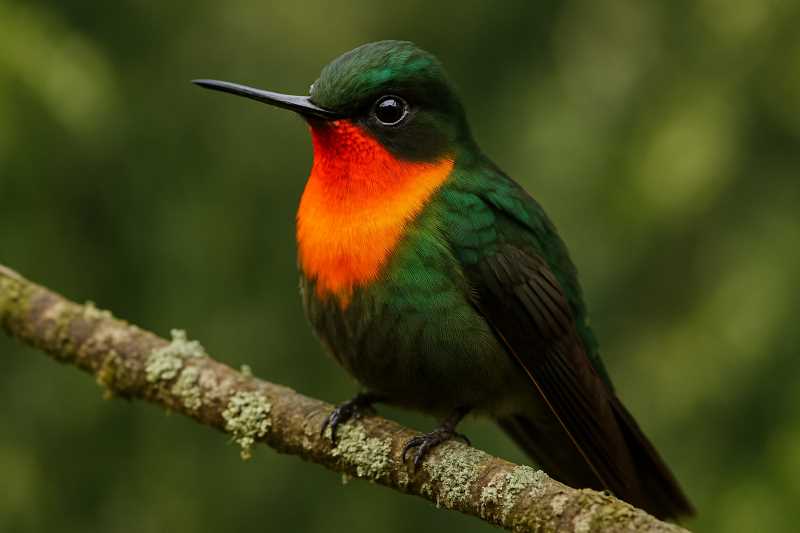
The Flame-throated Sunangel is a small hummingbird measuring about 9–11 centimetres in length. It has dark metallic green upperparts, a short, straight black bill, a deeply forked dark tail and conspicuous white undertail coverts.
The adult male has an iridescent green frontlet above the bill, a dark bluish or purplish chin and a brilliant fiery orange to orange-red gorget. The female is less brightly marked, with a whitish throat variably spotted with green and orange, while the lower throat may retain some orange iridescence. Juveniles resemble females but have less developed adult throat markings.
Plumage colour can appear different as the bird moves through changing light. The combination of its small size, deeply forked tail, white undertail coverts and orange throat is particularly useful for identification.
Range and Habitat
The species is found on the eastern Andean slope of southeastern Ecuador and northern Peru. Two subspecies are generally recognised: the nominate H. m. micraster, which occurs from southern Ecuador into adjacent northern Peru, and H. m. cutervensis, associated with the Cajamarca region of northern Peru.
It is mainly recorded between approximately 2,200 and 3,100 metres above sea level, although local records may extend beyond this range. It favours humid montane forest, mossy understorey, woodland borders and shrubby vegetation. The species is resident rather than a long-distance migrant, but some local or seasonal movements along elevational gradients may occur.
Where to See This Species
Podocarpus National Park, Loja and Zamora-Chinchipe, Ecuador
The Flame-throated Sunangel is documented in Podocarpus National Park, including the high-elevation Cajanuma sector. Its humid cloud forest, forest edges and shrubby areas provide suitable habitat, and birdwatchers have reported the species along access roads and trails in the upper park.
Nearby accommodation: Loja is the most practical base, with hotels, guest houses and self-catering accommodation. Basic refuges or cabins may also be available in or near some park sectors, subject to local arrangements.
Tapichalaca Reserve, Zamora-Chinchipe, Ecuador
Tapichalaca is a recognised site for the species, which has been recorded in the reserve’s high Andean forest. The reserve’s trails and forest edges offer opportunities to search for the bird around flowering plants and mossy vegetation. Published observations from Tapichalaca also include a documented nest of the species.
Nearby accommodation: Casa Simpson is located within the reserve. Valladolid is the nearest recognised gateway settlement, with additional guest-house and small-hotel accommodation in the wider area.
Behaviour and Diet
The Flame-throated Sunangel is active during the day and usually forages alone. Like other hummingbirds, it feeds mainly on nectar from flowering plants, visiting suitable flowers in the forest understorey, at edges and in open patches. It also takes small insects and other arthropods, which provide protein and other nutrients.
Individuals commonly perch between feeding visits. Males may defend productive feeding areas from other hummingbirds through rapid chases and aerial displays. The species is generally more conspicuous when visiting flowering shrubs or exposed forest-edge vegetation than when moving through dense undergrowth.
Breeding information remains limited. The female builds and attends the nest, and published observations from Tapichalaca document a small moss-and-fibre nest containing two young. As in other hummingbirds, the young are dependent on the female for feeding and care after hatching.
Identification Tips
- Look for a small, dark green hummingbird with a deeply forked tail.
- The adult male’s fiery orange or orange-red gorget is the most distinctive feature.
- White undertail coverts contrast with the dark tail and are useful when the bird is perched or turning in flight.
- Females have a paler, more mottled throat, often showing white, green and some orange rather than the male’s solid-looking gorget.
- The short, straight bill and small size help separate it from larger sunangels and other high-Andean hummingbirds.
- The Amethyst-throated Sunangel can occur in similar montane habitats. Compare the throat colour carefully, as that species usually shows a purple or amethyst gorget rather than the Flame-throated Sunangel’s fiery orange one.
Conservation Status
The Flame-throated Sunangel is currently assessed as Least Concern. A reliable global population estimate and population trend are not available.
The principal long-term concern is the loss and fragmentation of humid montane forest through agricultural expansion, logging, infrastructure development and other land-use changes. Protection of remaining cloud forest, maintenance of forest corridors and responsible management of reserves are important conservation measures. The species also benefits from the protection of flowering forest-edge and understorey habitats within established protected areas.
Frequently Asked Questions
What is the scientific name of the Flame-throated Sunangel?
Its scientific name is Heliangelus micraster. The species is also widely known as the Little Sunangel.
Where does the Flame-throated Sunangel live?
It lives on the eastern slope of the Andes in southeastern Ecuador and northern Peru, mainly in humid montane forest, forest edges and shrubby vegetation at roughly 2,200–3,100 metres above sea level.
What does the Flame-throated Sunangel eat?
It feeds mainly on nectar from flowers and supplements its diet with small insects and other arthropods.
How can the Flame-throated Sunangel be identified?
The key field marks are its small size, dark metallic green plumage, deeply forked tail, white undertail coverts and, in adult males, a brilliant fiery orange throat patch.
Is the Flame-throated Sunangel endangered?
No. It is currently classified as Least Concern, although habitat loss and fragmentation remain important threats across the Andean forests where it occurs.
Can the Flame-throated Sunangel be seen in protected areas?
Yes. It has been documented in Podocarpus National Park and Tapichalaca Reserve in Ecuador, both of which protect suitable high-elevation Andean forest.
References
- BirdLife International
- Cornell Lab of Ornithology, Birds of the World
- Fundación Jocotoco
Related posts