Fan-tailed Warbler: A Detailed Exploration of a Charming Avian Species
The Fan-tailed Warbler, scientifically known as Basileuterus lachrymosus, is a captivating songbird that inhabits the lush forested regions of Central America, spanning from Mexico to Panama. Known for its distinctive tail movements and melodious song, this bird has captured the interest of ornithologists and birdwatchers alike.
Habitat and Distribution
Primarily found in subtropical and tropical moist lowland forests, the Fan-tailed Warbler thrives in environments that offer dense foliage and abundant insect life. These birds are often spotted in the undergrowth, flitting from branch to branch in search of food. They are particularly prevalent in regions that provide a mix of primary and secondary forests, which offer the dense cover they prefer.
Geographically, the Fan-tailed Warbler has a range that extends from the southern regions of Mexico down through Central America to the western parts of Panama. This distribution allows for a variety of local adaptations, although the species maintains consistent characteristics across its range.
Physical Characteristics
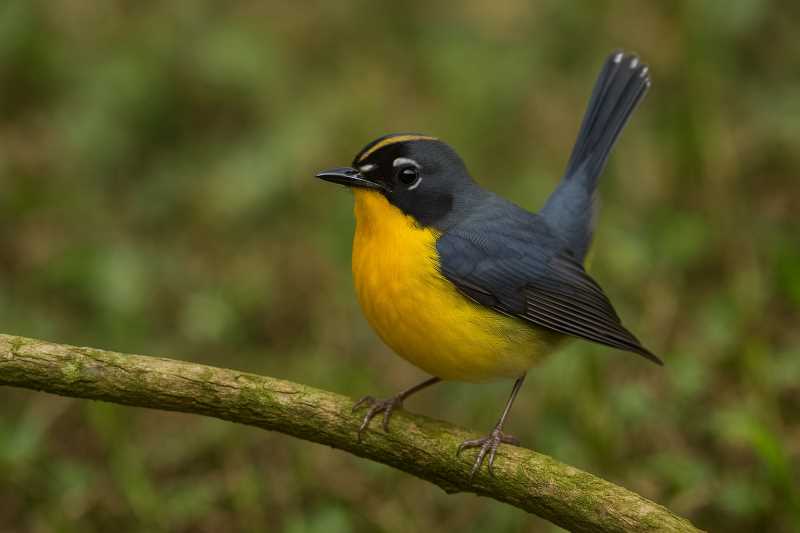
The Fan-tailed Warbler is a small bird, typically measuring around 13 to 15 centimeters in length. It is easily recognizable due to its fan-shaped tail, which it often flicks and spreads, a behavior that likely helps in communication and display. The plumage is predominantly olive green, providing excellent camouflage against the forest backdrop. The bird’s underparts are a lighter, more muted yellow, while a striking black eye stripe adds a dramatic touch to its appearance.
Diet and Foraging Behavior
As insectivores, Fan-tailed Warblers primarily feed on a diet of insects and other small arthropods. They display agile foraging techniques, often seen gleaning insects from leaves and branches or snatching them mid-air with remarkable precision. This diet not only supports their energetic lifestyle but also plays a role in controlling insect populations within their ecosystem.
The bird’s foraging behavior is a fascinating aspect of its daily routine. It often forages alone or in pairs, moving methodically through the foliage, examining every nook and cranny for potential prey. This meticulous approach, combined with their acute vision, makes them highly effective hunters.
Breeding and Nesting
The breeding season for the Fan-tailed Warbler typically occurs during the wetter months, when food resources are abundant. During this time, males engage in elaborate displays to attract mates, showcasing their vibrant plumage and vocal talents. Once paired, the female constructs a cup-shaped nest, often hidden away in dense vegetation to protect against predators.
Clutch sizes generally consist of two to four eggs, with both parents involved in feeding and caring for the chicks. This cooperative parenting ensures a higher survival rate for the offspring, contributing to the stability of the population.
Conservation Status
Currently, the Fan-tailed Warbler is classified as a species of Least Concern by the International Union for Conservation of Nature (IUCN). Despite this relatively secure status, habitat loss due to deforestation and agricultural expansion poses significant threats. Conservation efforts aimed at preserving forest habitats are crucial to ensuring the long-term survival of this species.
Conclusion
The Fan-tailed Warbler is a remarkable bird that combines beauty, agility, and ecological significance. Its presence in the forests of Central America highlights the rich biodiversity of the region and underscores the importance of conservation efforts. For bird enthusiasts and researchers alike, the Fan-tailed Warbler represents a fascinating subject of study and a symbol of the natural world’s intricate interconnectedness.
The Fan-tailed Warbler, through its unique behaviors and adaptability, continues to captivate those who are fortunate enough to observe it in its natural habitat. Its story is a testament to the resilience of nature and the ongoing need to protect and appreciate the diverse forms of life that inhabit our planet.
Related posts