Introduction
The Fan-tailed Cuckoo (Cacomantis flabelliformis) is a slender cuckoo of forests, woodlands and dense vegetation across Australia and parts of Melanesia. It is best known for its long, barred tail, yellow eye-ring, plaintive calls and brood-parasitic breeding strategy, in which it lays its eggs in the nests of other birds.
Physical Description
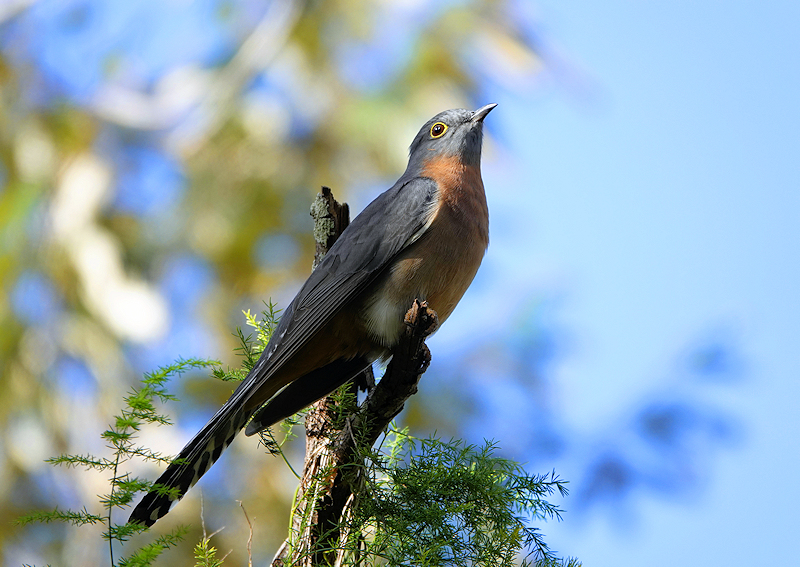
The Fan-tailed Cuckoo measures approximately 25–27 centimetres in length. Adults have a slate-grey head, back and wings, with rufous-brown on the throat, breast and upper belly. The lower underparts are paler, and the long tail is dark above with conspicuous black-and-white barring on the underside and outer feathers. A yellow eye-ring and small white shoulder patch are useful identification features.
There is some sexual variation in plumage. Males generally have richer rufous underparts, while females are often paler, with more finely barred lower breast and belly. Juveniles are duller brown, with mottled or streaked plumage and pale edges to the feathers. Young birds acquire more adult-like plumage during their first year.
Range and Habitat
The species occurs widely across eastern, southern and south-western Australia, including Tasmania, and also occurs in parts of New Guinea and the south-west Pacific. Australian birds use a broad range of habitats, including wet and dry forests, eucalypt woodland, dense understorey, heathland, scrub and well-vegetated urban reserves.
Fan-tailed Cuckoos are partly migratory rather than uniformly resident. In particular, birds from Tasmania move to mainland Australia during the non-breeding season. Seasonal movements also occur in parts of mainland Australia, although the timing and extent vary between regions.
Where to See This Species
Westgate Park, Victoria, Australia
Parks Victoria includes the Fan-tailed Cuckoo among the species recorded at Westgate Park. The reserve’s planted woodland, scrub and wetland margins provide suitable habitat, especially where dense vegetation meets more open areas. Listen for the species’ descending call and check quiet perches along paths and vegetated edges.
Nearby accommodation: Melbourne provides the nearest practical base, with hotels, guest houses, serviced apartments and other accommodation throughout the metropolitan area.
Coombabah Lakelands Conservation Area, Queensland, Australia
The Fan-tailed Cuckoo is documented on the area’s bird checklist. Coombabah combines eucalypt woodland, wetlands, grassland and dense edge vegetation, creating suitable habitat for a secretive cuckoo that may forage on the ground or sit quietly in cover. Local sightings are possible throughout the year, but careful searching is often necessary.
Nearby accommodation: The Gold Coast is the main accommodation base, offering hotels, apartments, guest houses, holiday parks and camping options in the surrounding area.
Woowookarung Regional Park, Victoria, Australia
A Parks Victoria natural-values assessment records the Fan-tailed Cuckoo at Woowookarung Regional Park. The park’s forest and woodland habitats are appropriate for the species, particularly areas with a dense understorey and sheltered clearings. Spring and summer are useful seasons for listening for calling birds, although sightings are not guaranteed.
Nearby accommodation: Ballarat is the nearest major accommodation centre, with hotels, motels, guest houses, cabins and camping facilities available in and around the city.
Behaviour and Diet
Fan-tailed Cuckoos are generally solitary and secretive. They often remain still in dense foliage, but may sit on an exposed branch when calling. Males are more likely to call persistently from a visible perch, while females may stay low in thickets and respond with quieter calls.
The diet consists mainly of insects and their larvae, which are taken from vegetation, the ground or in short aerial pursuits. Other small prey may occasionally be taken. The species is usually most active during daylight hours.
Fan-tailed Cuckoos are brood parasites. The female lays a single egg in the nest of a suitable host, including thornbills, scrubwrens and fairy-wrens. Brown Thornbills and White-browed Scrubwrens are among the documented hosts. The female may remove a host egg when laying, and the cuckoo chick can hatch before the host young and monopolise the foster parents’ food. The precise outcome varies with the host species and the timing of parasitism.
Identification Tips
Look for the following combination of features:
- Slate-grey head, back and wings.
- Rufous-brown throat and breast, often more strongly coloured in males.
- Bright yellow eye-ring.
- Long tail with strong black-and-white barring, particularly visible from below.
- Small white patch on the shoulder or wing.
- Plaintive, descending call from woodland or forest edges.
The Sahul Brush Cuckoo (Cacomantis variolosus) is a potential confusion species in northern and eastern Australia. The Fan-tailed Cuckoo is generally larger, has a longer tail and shows a more obvious yellow eye-ring. The tail pattern and rufous breast are also useful when the bird is seen well.
Juveniles are more difficult to identify because they are browner and more heavily mottled. The long, patterned tail and overall cuckoo shape remain useful clues, but the yellow eye-ring may be less conspicuous than in adults.
Conservation Status
The Fan-tailed Cuckoo is assessed globally as Least Concern. Its broad distribution, use of several habitat types and occurrence across a large geographic range mean that it is not currently considered globally threatened.
Local pressures may still affect the species, particularly the clearing and fragmentation of forest and woodland habitat, the loss of dense understorey and the decline of suitable host populations. Protecting native vegetation, retaining habitat corridors and maintaining healthy woodland and forest edges are important conservation measures.
Frequently Asked Questions
Where does the Fan-tailed Cuckoo live?
It occurs across much of eastern, southern and south-western Australia, including Tasmania, and also in parts of New Guinea and the south-west Pacific. It uses forests, woodlands, scrub, heathland and other habitats with dense vegetation.
Is the Fan-tailed Cuckoo migratory?
It is partly migratory. Tasmanian birds commonly move to mainland Australia during the non-breeding season, while other populations may make shorter seasonal movements.
What does the Fan-tailed Cuckoo eat?
Its diet consists mainly of insects and their larvae. It may catch prey in vegetation, on the ground or in short flights, and can occasionally take other small prey.
Which birds raise Fan-tailed Cuckoo chicks?
Documented hosts include Brown Thornbills, White-browed Scrubwrens and other thornbills, scrubwrens and fairy-wrens. The range of hosts varies between regions.
How can the Fan-tailed Cuckoo be identified?
Look for a slate-grey back, rufous breast, yellow eye-ring, long black-and-white barred tail and small white shoulder patch. Its distinctive descending call can also reveal its presence before the bird is seen.
Is the Fan-tailed Cuckoo endangered?
No. The species is currently assessed as Least Concern globally, although habitat loss and fragmentation can create local problems.
References
- BirdLife International
- Museums Victoria
- Parks Victoria
Related posts