Introduction
The Crested Pigeon (Ocyphaps lophotes) is a native Australian pigeon recognised by its fine black crest, grey-brown plumage and distinctive whistling flight. It is widespread across mainland Australia and is especially familiar in open country, lightly wooded grasslands, farms, parks and urban areas.
Physical Description
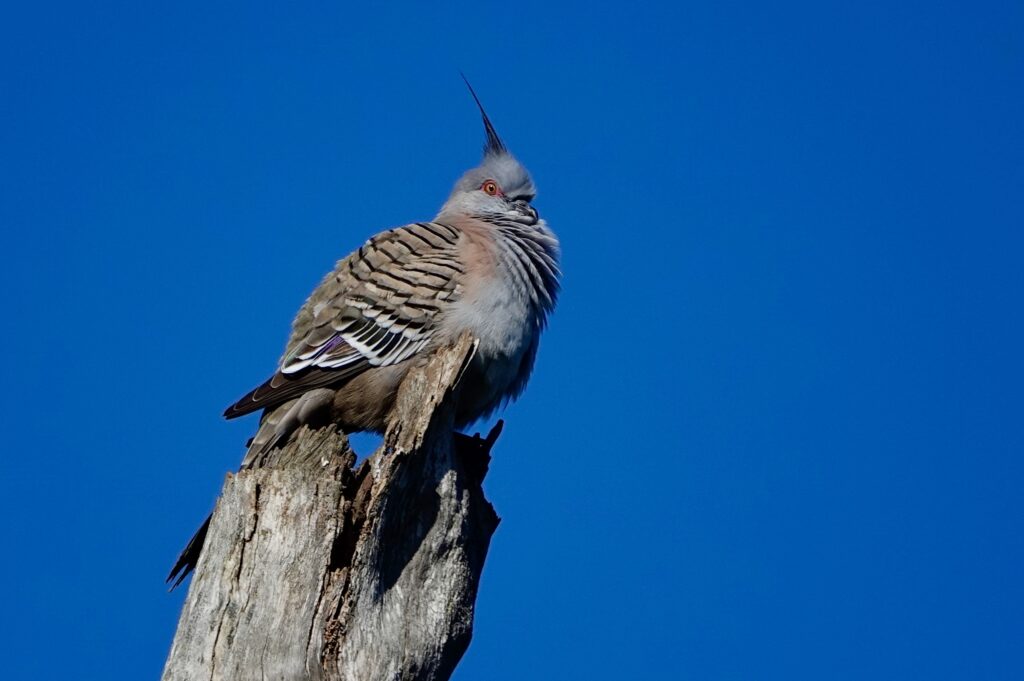
The Crested Pigeon is a stocky pigeon measuring approximately 30–35 cm in length. Its body is mainly grey-brown, with pinkish tones on the underparts and a darker tail. The head is grey and marked by a narrow, upright black crest. A pinkish-red eye-ring is visible at close range.
The wings have dark barring and glossy green and purple areas that become more noticeable in good light or during flight. The sexes are broadly similar in appearance, so reliable field identification is usually based on the species’ overall pattern rather than subtle differences between males and females. Juveniles are generally less sharply marked than adults, with a less prominent crest.
Range and Habitat
Crested Pigeons are native to Australia and occur across most of the mainland, although they are uncommon or absent from the densest forests, the driest desert areas and much of the far northern tropical region. They are non-migratory, but may make local movements in response to water and food availability.
The species favours lightly wooded grasslands, open woodland, farmland, roadside vegetation, gardens and urban parks. It is usually associated with accessible water because it drinks regularly and often gathers in groups near waterholes, dams and other reliable sources.
Where to See This Species
Sherwood Arboretum, Queensland, Australia
Crested Pigeons have been recorded at Sherwood Arboretum, a publicly accessible Brisbane park with open lawns, mature trees, wetlands and a well-documented bird community. Look around grassy clearings, park edges and open areas near water, particularly during the cooler parts of the day.
Nearby accommodation: Brisbane provides a wide range of hotels, guest houses, serviced apartments, hostels and self-catering accommodation, with Sherwood and surrounding western suburbs offering practical access to the arboretum.
Adelaide Park Lands, South Australia, Australia
The Crested Pigeon is a common and widespread bird in the Adelaide Park Lands, where open grassed areas, planted trees and water sources provide suitable habitat. Bonython Park, Victoria Park, Possum Park and Lefevre Park are among the documented local areas where observers may look for the species.
Nearby accommodation: Adelaide city centre offers hotels, serviced apartments, hostels and self-catering accommodation within easy reach of the Park Lands.
Kyabram Fauna Park, Victoria, Australia
Crested Pigeons have been recorded at Kyabram Fauna Park, which contains open woodland, grassed areas and wetlands in the surrounding Goulburn Valley landscape. The species may be encountered on open paths and around grassy habitat, especially during morning or late-afternoon birding.
Nearby accommodation: Kyabram is the nearest practical gateway town, with hotels, motels, guest houses, cabins and other self-catering accommodation available in the surrounding area.
Behaviour and Diet
Crested Pigeons are active during the day and are often seen alone, in pairs or in small to large groups. They spend much of their time feeding on the ground and may gather at water sources before descending from nearby trees to drink.
The diet consists mainly of seeds from native and introduced grasses, herbs, crops and weeds. Leaves and small invertebrates, including insects, may also be eaten. Feeding is often most noticeable in the morning and late afternoon, although the birds may forage at any time.
When startled, a Crested Pigeon launches rapidly into the air. A modified primary feather on each wing produces a characteristic whistle as air passes over it. In flight, the bird may glide with its wings held downwards. After landing, it often raises or swings its tail conspicuously.
Breeding can occur at any time of year, although activity is commonly reported from spring to early autumn. The nest is a simple platform of twigs placed in a tree or dense shrub. Both parents share incubation and care for the young. The usual clutch is two eggs, with incubation and the nestling period each lasting about three weeks.
Identification Tips
- Look for a slim, upright black crest on a stocky grey-brown pigeon.
- Check for a pinkish-red eye-ring and pinkish underparts.
- In good light, the wings show dark barring with glossy green and purple areas.
- A sudden, distinctive wing whistle is a useful clue when the bird takes flight.
- Crested Pigeons commonly feed on the ground in open grassy places and often occur in groups.
- Do not confuse this species with the much larger Topknot Pigeon, which has a different shape, habitat preference and distribution. The introduced Rock Dove is also generally heavier-looking and lacks the Crested Pigeon’s fine black crest and iridescent wing pattern.
Conservation Status
The Crested Pigeon is currently assessed as Least Concern. It remains widespread and common across much of mainland Australia, and its ability to use modified habitats, including farmland, suburban areas and urban parks, has helped it persist as landscapes have changed.
The species is not considered to face a major immediate threat at the global level. Nevertheless, local populations may be affected by the loss of open habitat, severe drought, reduced access to water, persecution or other changes in land management. Maintaining suitable grassland, open woodland and dependable water sources benefits Crested Pigeons and many other Australian birds.
Frequently Asked Questions
Where does the Crested Pigeon live?
The Crested Pigeon lives across most of mainland Australia. It favours open woodland, lightly wooded grassland, farmland, roadside vegetation, gardens and urban parks, and is usually found near water.
Is the Crested Pigeon native to Australia?
Yes. The Crested Pigeon is a native Australian species and is not the same bird as the introduced Rock Dove, commonly known as the feral pigeon.
What does the Crested Pigeon eat?
It feeds mainly on seeds from grasses, herbs, crops and weeds. Leaves and small insects may also form part of its diet.
Why does the Crested Pigeon make a whistling sound when it flies?
The sound is produced by air passing over a modified primary wing feather. It is especially noticeable when the bird is startled and takes off quickly.
Does the Crested Pigeon migrate?
No. It is generally non-migratory, although individuals may make local movements when searching for food or reliable water.
Where can I see Crested Pigeons in parks?
They can be seen in suitable open habitat at places including Sherwood Arboretum in Brisbane, the Adelaide Park Lands and Kyabram Fauna Park. Look on lawns, along woodland edges and near water during morning or late-afternoon activity periods.
References
- Australian Museum
- IUCN Red List of Threatened Species
- IOC World Bird List
Related posts