Crested Kingfisher (Megaceryle lugubris): A Majestic Avian Predator of Asian Waterways
The Crested Kingfisher (Megaceryle lugubris) is a remarkable bird species that captures the admiration of bird enthusiasts and ornithologists alike. Known for its striking appearance and dynamic hunting skills, this kingfisher is a fascinating subject of study and appreciation. Found primarily in the riparian zones of East and South Asia, the Crested Kingfisher is a vital component of its ecosystem, playing a crucial role in maintaining the balance of aquatic life.
Habitat and Distribution
The Crested Kingfisher predominantly inhabits the freshwater ecosystems of Asia, with its range spanning across countries such as China, India, Japan, and Korea. Preferring the fast-flowing streams and rivers in mountainous and hilly regions, this bird thrives where there is ample fish supply. Its presence is often an indicator of healthy water bodies, as it relies heavily on aquatic environments for hunting and nesting.
The bird’s adaptability to various climates within its range is noteworthy. From the temperate zones of the Himalayan foothills to the subtropical regions of Southern China, the Crested Kingfisher exhibits a broad ecological tolerance. This adaptability ensures its survival amidst diverse environmental conditions, although habitat destruction and pollution pose significant threats to its populations.
Physical Characteristics
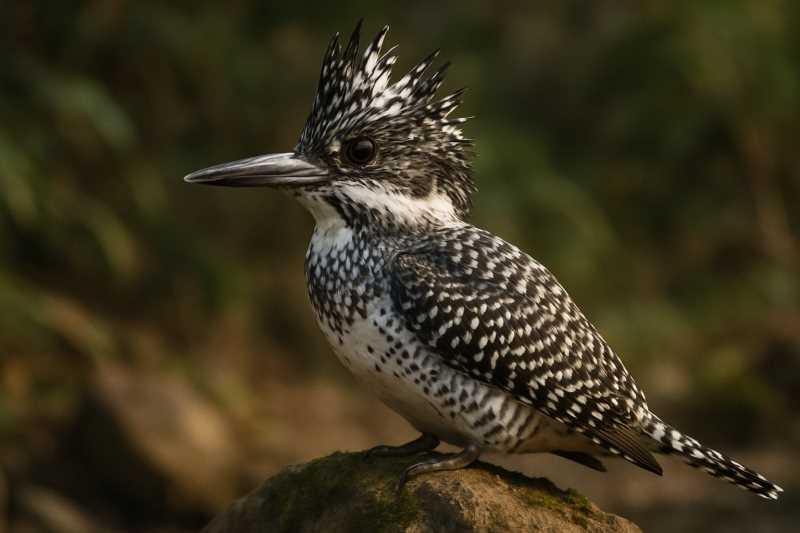
One of the most distinctive features of the Crested Kingfisher is its impressive crest, which forms a prominent part of its identity. The bird is one of the largest kingfishers, measuring up to 41 centimeters in length, with a wingspan that can reach up to 65 centimeters. Its plumage is predominantly black and white, providing excellent camouflage against the rocky and watery surroundings of its habitat.
The bold, checkerboard pattern of its feathers is complemented by a robust, dagger-like bill, perfectly adapted for catching fish. The bird’s sharp eyesight ensures it can spot prey from considerable distances, making it a formidable hunter in its aquatic domain. Sexual dimorphism is minimal, with males and females appearing quite similar, though females may exhibit a slightly browner tinge on their underparts.
Behavior and Diet
The Crested Kingfisher is a solitary bird, often seen perched quietly on branches overhanging water bodies, scanning the surface for fish. Its diet mainly consists of fish, which it catches with remarkable precision. The bird dives headfirst into the water, using its powerful wings to propel itself as it captures its prey with its strong bill.
Apart from fish, its diet can occasionally include aquatic insects and small amphibians, showcasing its versatility as a predator. The Crested Kingfisher is known for its remarkable energy and agility, often covering vast distances in search of food, especially during the breeding season when the demand for food increases.
Breeding and Nesting
The breeding season for the Crested Kingfisher typically occurs between March and June, coinciding with the abundance of food in its habitat. These birds are cavity nesters, excavating burrows in riverbanks using their strong bills and feet. The burrow can be quite deep, sometimes extending up to two meters into the bank, providing a safe haven for the eggs and chicks.
A typical clutch consists of 4 to 7 eggs, with both parents sharing the responsibility of incubation and feeding the chicks. The young are altricial, hatching blind and featherless, requiring significant parental care. The devotion of the Crested Kingfisher to its offspring is a testament to its role as a dedicated and nurturing parent.
Conservation and Challenges
While the Crested Kingfisher is not currently listed as endangered, it faces several challenges that could impact its future. Habitat destruction due to deforestation, dam construction, and water pollution are significant threats. As rivers are dammed and forests are cleared, the bird loses vital breeding sites and food sources.
Conservation efforts are essential to ensure the survival of this species. Protecting riverine habitats, regulating pollution, and raising awareness about the ecological importance of the Crested Kingfisher are critical steps in preserving its populations. Additionally, international cooperation among the countries within its range can aid in creating effective conservation strategies.
Conclusion
The Crested Kingfisher is more than just a beautiful bird; it is a vital component of its ecosystem and a symbol of the biodiversity found in Asia’s waterways. Its presence signifies the health of aquatic environments, and its survival is intertwined with the preservation of these critical habitats. As we continue to study and admire the Crested Kingfisher, it is imperative to take action to protect it and the ecosystems it inhabits, ensuring that future generations can also experience the wonder of this majestic avian predator.
Related posts