The Enigmatic Beauty of the Crescent-chested Puffbird: Malacoptila striata
The natural world is replete with avian wonders, and among them, the Crescent-chested Puffbird (Malacoptila striata) stands out as a unique marvel. This bird, belonging to the Bucconidae family, captivates ornithologists and bird enthusiasts alike with its distinctive plumage and intriguing behaviors. Found primarily in the dense forests of Brazil, the Crescent-chested Puffbird is a testament to the diversity and complexity of avian life.
Taxonomy and Distribution
The Crescent-chested Puffbird is scientifically classified under the genus Malacoptila, which comprises several species of puffbirds. Though the exact range of this bird is somewhat limited compared to other avian species, it is predominantly found in the southeastern regions of Brazil. Its habitat spans the Atlantic Forest, a biodiversity hotspot known for its high levels of endemism and ecological importance. The bird’s presence in these forests highlights the rich tapestry of life supported by this critical ecosystem.
Physical Characteristics
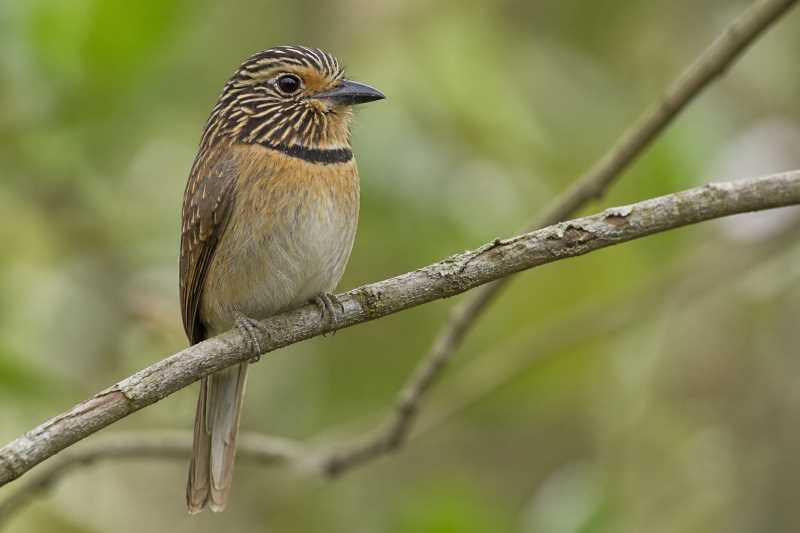
One of the most striking features of the Crescent-chested Puffbird is its appearance. The bird measures approximately 18 to 21 centimeters in length, making it a medium-sized puffbird. Its plumage is primarily a soft brown, providing excellent camouflage against the forest backdrop. The bird’s namesake, the crescent-shaped marking on its chest, is a distinctive white band that contrasts beautifully with its otherwise muted coloration. This crescent-shaped marking is not only a key identification feature but also adds a touch of elegance to the bird’s overall appearance.
The Crescent-chested Puffbird has a robust body with a large head and a characteristically short tail. Its beak is strong and slightly hooked, adapted for its insectivorous diet. Its eyes, dark and expressive, are set against a facial pattern that accentuates its inquisitive look, often described as one of the bird’s most charming traits.
Behavior and Ecology
Despite its striking appearance, the Crescent-chested Puffbird is often elusive, preferring the dense undergrowth and middle strata of forests. It is primarily a sedentary bird, rarely seen engaging in long flights. Instead, it perches quietly, often remaining motionless for extended periods, a behavior that aids in avoiding predators.
The bird is known for its solitary nature, usually observed alone or in pairs rather than in flocks. Its diet consists mainly of insects and small invertebrates, which it captures using a technique known as "sit-and-wait". This hunting strategy involves the bird remaining still on a perch until a prey item comes within striking distance, at which point it swiftly darts out to capture it with its strong beak.
Vocalizations of the Crescent-chested Puffbird are relatively simple but distinctive, consisting of a series of low, whistling notes. These calls are often used to establish territory and communicate with mates, especially during the breeding season.
Conservation Status
The Crescent-chested Puffbird is currently classified as Least Concern by the International Union for Conservation of Nature (IUCN). However, like many species inhabiting the Atlantic Forest, it faces the ongoing threat of habitat loss due to deforestation and human encroachment. Conservation efforts aimed at preserving the Atlantic Forest are crucial for the continued survival of this species, as the loss of habitat can lead to significant declines in population numbers.
Efforts to protect the Crescent-chested Puffbird and its habitat are ongoing, with numerous organizations working to conserve the Atlantic Forest’s biodiversity. These efforts include reforestation projects, protected area designations, and community engagement initiatives aimed at promoting sustainable land use practices.
The Role of Citizen Science
Citizen science has emerged as a valuable tool in the study and conservation of the Crescent-chested Puffbird. Bird watchers and amateur ornithologists play a crucial role in gathering data on the distribution and behavior of this species. Platforms like eBird enable the collection and analysis of sighting data, helping researchers track population trends and assess the impacts of environmental changes.
Through citizen science initiatives, individuals can contribute to a greater understanding of the Crescent-chested Puffbird and its ecological requirements. Such participation not only aids in conservation efforts but also fosters a deeper appreciation for the natural world among participants.
Conclusion
The Crescent-chested Puffbird is a remarkable example of the beauty and diversity found within the avian world. Its presence in the Atlantic Forest underscores the importance of conserving this unique ecosystem, not only for the puffbird itself but for the myriad of species that call it home. As conservation efforts continue, the Crescent-chested Puffbird serves as both a symbol of the challenges faced by wildlife and a testament to the resilience of nature.
In the face of environmental change, the Crescent-chested Puffbird reminds us of the delicate balance that exists within ecosystems and the responsibility we bear to protect it. Through ongoing research, conservation initiatives, and the involvement of citizen scientists, there is hope that this captivating bird will continue to grace the forests of Brazil for generations to come.
Related posts