Introduction
The Cinnamon-sided Hummingbird, Ramosomyia wagneri, is a small hummingbird endemic to Oaxaca, southern Mexico. It is treated as a full species by the International Ornithological Congress and BirdLife International, although some taxonomic checklists continue to treat it as the cinnamon-sided form of the Green-fronted Hummingbird, Ramosomyia viridifrons. Its restricted range and distinctive cinnamon flanks make it an important bird of Oaxaca’s dry forests and scrublands.
Physical Description
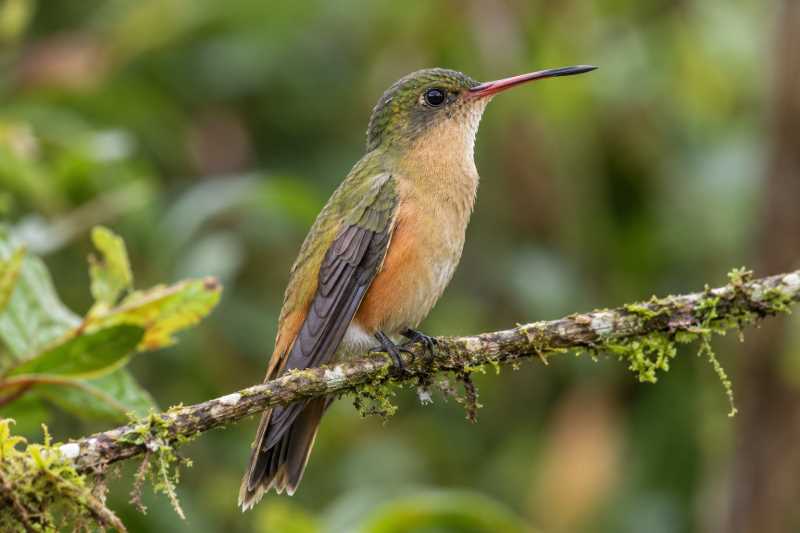
The Cinnamon-sided Hummingbird measures about 10 to 11.5 cm in length and weighs approximately 6.3 g. It has a red bill with a black tip, green upperparts and a mostly white underside. The cinnamon-coloured sides and flanks are its most distinctive feature, extending along the sides of the neck and body.
Adult males have a glittering bluish-green crown, an emerald to bronze-green back and a coppery or purplish tail with green edging. Females are similar but usually have a darker green crown and a more bronze or golden-green tail. Juvenile plumage is less well documented, and reliable species-specific information about age-related variation is limited.
Range and Habitat
The Cinnamon-sided Hummingbird is endemic to a narrow area of central and southern Oaxaca in southern Mexico. It is a resident species rather than a long-distance migrant. Its recorded elevation range is approximately 250 to 900 metres.
It occurs in deciduous forest, thorn forest, arid and semi-arid scrub, riparian or gallery woodland, and other semi-open habitats. Parks, gardens and cultivated areas may also be used where suitable flowering plants and cover are present. The species’ limited distribution makes the protection of remaining dry forest, thorn scrub and riparian corridors particularly important.
Where to See This Species
Monte Albán Archaeological Zone, Oaxaca Valley, Oaxaca, Mexico
The scrub and dry woodland around the publicly accessible Monte Albán archaeological zone have produced documented sightings of the Cinnamon-sided Hummingbird. Early morning visits are likely to be most productive, particularly around flowering shrubs and open areas bordering the archaeological complex. The bird may also be recorded under the alternative name Green-fronted Hummingbird, cinnamon-sided form, in checklists that follow a lumped taxonomy.
Nearby accommodation: Oaxaca City is the practical base, with a wide range of hotels, guest houses, hostels and self-catering accommodation.
Huatulco National Park, Oaxaca, Mexico
Huatulco National Park protects dry and semi-deciduous forest, thorny vegetation and riparian habitats on the Pacific coast of Oaxaca. The species has been documented in birding reports from the Huatulco area, making the park and its surrounding forest a realistic place to search, especially during the drier season when flowering plants and watercourses may concentrate bird activity.
Nearby accommodation: La Crucecita and Santa Cruz Huatulco provide hotels, guest houses, lodges and self-catering accommodation.
Behaviour and Diet
The Cinnamon-sided Hummingbird is diurnal and usually forages alone. Like other hummingbirds, it can hover while feeding and is capable of rapid, precise flight, including short backward movements. Males may defend productive feeding areas from other hummingbirds, although detailed observations of territorial behaviour in this species remain limited.
Its diet is expected to consist mainly of flower nectar, supplemented by small insects and other arthropods that provide protein. Species-specific information about preferred flowering plants and foraging techniques is still sparse.
The species is considered resident throughout its range. Breeding information is limited, and published details about nest placement, incubation, chick development and breeding timing are not sufficiently well established for confident generalisation. The original account of two white eggs and a 14 to 19 day incubation period should therefore be treated cautiously unless supported by further species-specific evidence.
Identification Tips
- Look for a small hummingbird with a red bill, black bill tip, green upperparts and a white underside.
- The cinnamon-coloured flanks and sides of the neck are the key field mark.
- Adult males may show a brighter bluish-green crown than females.
- In suitable parts of Oaxaca, compare it carefully with the Green-fronted Hummingbird, Ramosomyia viridifrons. The Cinnamon-sided Hummingbird has cinnamon rather than green on the sides of the neck and flanks.
- Taxonomic treatment varies, so local checklists may list the bird as Ramosomyia wagneri or as Ramosomyia viridifrons wagneri.
Conservation Status
The Cinnamon-sided Hummingbird is currently assessed as Least Concern by the IUCN. This classification does not mean that the species is free from risk. It has a small geographic range, its population size is not well known and the population is believed to be decreasing.
The principal concerns are the loss and fragmentation of deciduous forest, thorn forest, scrub and riparian woodland through agricultural expansion, urban growth, wood collection and other land-use changes. Conservation priorities include protecting remaining habitat, maintaining connected riparian corridors, restoring degraded dry forest and improving knowledge of the species’ population, breeding biology and distribution.
Frequently Asked Questions
Where is the Cinnamon-sided Hummingbird found?
It is endemic to central and southern Oaxaca in southern Mexico. It is not a Central American species, despite earlier descriptions that placed it broadly within Central American cloud-forest habitats.
Is the Cinnamon-sided Hummingbird a separate species?
Taxonomic authorities do not all agree. The IOC and BirdLife International treat Ramosomyia wagneri as a separate species, while some checklists treat it as a subspecies of the Green-fronted Hummingbird, Ramosomyia viridifrons.
What does the Cinnamon-sided Hummingbird look like?
It is a small green-and-white hummingbird with a red bill, black bill tip and conspicuous cinnamon-coloured flanks and sides of the neck. Males generally have a brighter bluish-green crown than females.
What habitat does it use?
It uses deciduous forest, thorn forest, arid and semi-arid scrub, riparian woodland and semi-open habitats, generally at elevations between about 250 and 900 metres. It may also occur in gardens and parks within its range.
What does the Cinnamon-sided Hummingbird eat?
Its diet is expected to be based mainly on nectar, supplemented by small insects and other arthropods. The exact plants and proportions of its diet have not been studied in detail.
When is the best time to look for it?
It can be sought throughout the year because it is considered resident. Early morning is usually the most suitable time for observing hummingbirds, particularly around flowering shrubs, woodland edges and riparian vegetation.
References
- IOC World Bird List
- IUCN Red List of Threatened Species
- Cornell Lab of Ornithology, Birds of the World
Related posts