The Chinese Grosbeak: A Detailed Exploration of Eophona migratoria
The Chinese Grosbeak, known scientifically as Eophona migratoria, is a remarkable avian species that continues to captivate bird enthusiasts and ornithologists alike. Revered for its striking appearance and melodious calls, this bird is a fascinating subject for study. In this article, we delve into the Chinese Grosbeak’s taxonomy, distribution, behavior, and conservation status, offering a comprehensive overview of this intriguing species.
Taxonomy and Classification
The Chinese Grosbeak belongs to the family Fringillidae, which is a diverse group of small to medium-sized passerine birds commonly known as finches. The genus Eophona is characterized by stout bills, which are perfectly adapted for cracking seeds. The Chinese Grosbeak is one of two species in this genus, the other being the Japanese Grosbeak (Eophona personata). The species name ‘migratoria’ hints at the bird’s migratory patterns, which play a significant role in its life cycle.
Physical Description
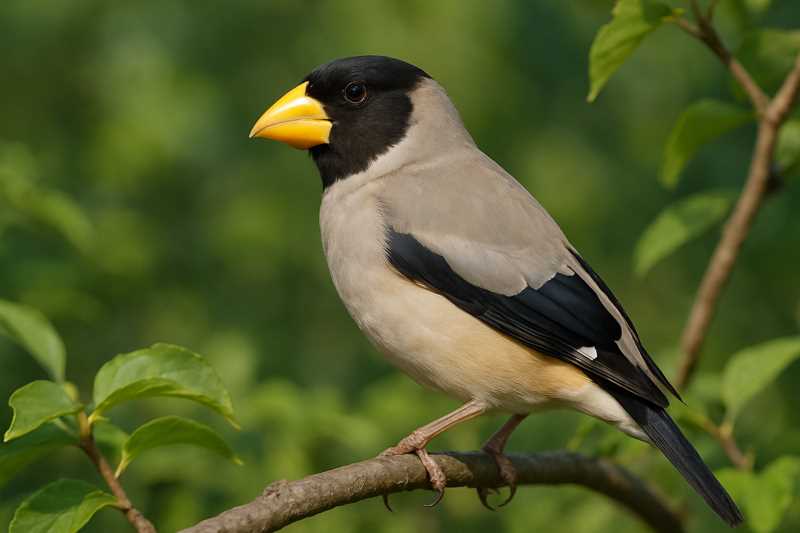
One of the most distinguishing features of the Chinese Grosbeak is its robust, conical bill, which is pale yellow and unusually large compared to other finches. This adaptation is not only aesthetically striking but also functionally significant, allowing the bird to efficiently crack open hard seeds. The plumage of the Chinese Grosbeak is equally remarkable. Adult birds display a blend of soft grays and browns, with a distinctive black crown and face mask that contrasts sharply with their lighter body. During the breeding season, males often exhibit a slightly more pronounced color differentiation, enhancing their visual appeal.
Distribution and Habitat
The Chinese Grosbeak is predominantly found across East Asia, with its range extending through China, Japan, Korea, and parts of Russia. It prefers temperate wooded areas, including deciduous and mixed forests. During the breeding season, these birds are typically found in dense woodland areas, where they can find ample food and suitable nesting sites. As the seasons change, the Chinese Grosbeak engages in partial migration, moving southward to avoid the harsh winters in its northernmost habitats.
Diet and Feeding Habits
As a granivore, the Chinese Grosbeak’s diet primarily consists of seeds, particularly those of various trees and shrubs. Its powerful beak is well-suited to cracking open hard seed coats, thus enabling access to the nutritious kernels inside. In addition to seeds, the Chinese Grosbeak may also consume insects, particularly during the breeding season when the demand for protein increases to support growing chicks. This dietary flexibility allows the bird to adapt to varying food availability across different seasons and habitats.
Behavior and Social Structure
Chinese Grosbeaks are known for their social behavior, often forming small flocks outside the breeding season. These flocks can be observed foraging together, providing safety in numbers against predators. During the breeding season, however, they become more territorial. Males are known to engage in song displays to establish territory and attract mates. Their calls are melodious, composed of a series of clear, flute-like notes that resonate through their forest habitats.
Breeding and Nesting
The breeding season for the Chinese Grosbeak typically occurs in late spring to early summer. During this time, pairs form monogamous bonds, and both parents participate in raising the young. Nests are usually constructed in the fork of a tree, using twigs, grass, and other plant materials. The female typically lays a clutch of 3 to 5 eggs, which are incubated for about two weeks. After hatching, both parents share the responsibility of feeding the chicks, which fledge approximately two weeks after hatching.
Conservation Status
Currently, the Chinese Grosbeak is listed as a species of Least Concern by the International Union for Conservation of Nature (IUCN). This status reflects its relatively stable population across its extensive range. However, like many bird species, the Chinese Grosbeak faces threats from habitat loss due to deforestation and urbanization. Conservation efforts aimed at preserving natural habitats are crucial for ensuring the long-term survival of this species.
Conclusion
The Chinese Grosbeak is a splendid example of avian adaptation and beauty. Its striking appearance, coupled with its fascinating behavioral patterns, makes it a favorite among bird watchers and researchers. Understanding the life of the Chinese Grosbeak not only enriches our appreciation for this particular species but also highlights the broader importance of conserving avian biodiversity in our rapidly changing world. As we continue to study and protect such species, we ensure that future generations can also experience the wonders of nature embodied by birds like the Chinese Grosbeak.
Related posts