Introduction
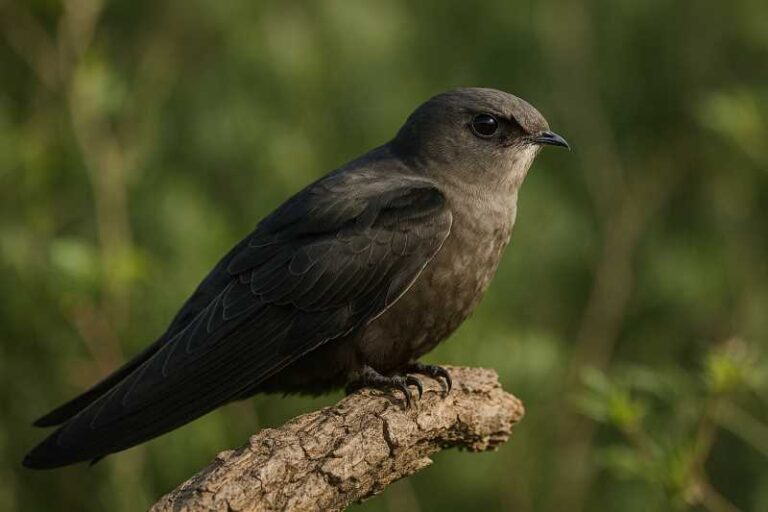
Chapman’s Swift, Chaetura chapmani, is a dark, compact swift of tropical Central and South America. It belongs to the family Apodidae and spends most of its life in fast, agile flight, where it catches small flying insects. The species was named after the American ornithologist Frank M. Chapman.
Physical Description
Chapman’s Swift is a medium-sized Chaetura swift, measuring approximately 13–14 centimetres in length. It has a compact body, a protruding head, long pointed wings and a short, square-ended tail. The upperparts are glossy blackish to dark brown, with a contrasting greyish rump and uppertail-coverts in the nominate form. The underparts are generally uniform dark brown, although the throat and breast may appear slightly paler in good light.
The sexes are alike in appearance. The species has the broad gape typical of aerial insectivores, while its short feet and stiff tail shafts help it cling to vertical surfaces. The southern form traditionally known as the Mato Grosso Swift, Chaetura viridipennis, is now generally treated by the IOC World Bird List as the subspecies Chaetura chapmani viridipennis. It is somewhat larger and usually shows less contrast between the rump and back.
Reliable information on juvenile plumage is limited, and young birds are not usually separable from adults with confidence in flight.
Range and Habitat
Chapman’s Swift has a wide but patchy distribution. The nominate form occurs from Panama through parts of Colombia and Venezuela, across the Guianas and into northern and north-eastern Brazil. It also occurs on Trinidad. The subspecies C. c. viridipennis occupies parts of eastern Peru, eastern Bolivia and western Amazonian Brazil.
The species is associated mainly with tropical lowland evergreen forest, but it also uses secondary forest, forest edges and degraded wooded habitats. It forages in open airspace above the forest canopy, rivers, clearings and other areas where flying insects accumulate. Records are concentrated in lowland and foothill regions, although the species may occur at higher elevations locally.
The nominate form is generally regarded as resident. The southern subspecies appears to make seasonal movements in parts of the southern Amazonian region, but the details of these movements remain incompletely known.
Where to See This Species
Iwokrama River Lodge, Iwokrama, Guyana
Chapman’s Swift has been recorded around Iwokrama River Lodge, where forest, river margins and open clearings provide suitable aerial-foraging habitat. Birding reports have recorded the species flying with other swifts, particularly in open areas near the lodge. It is most likely to be detected by scanning the sky during active feeding periods rather than by searching for a perched bird.
Nearby accommodation: Iwokrama River Lodge is the most practical accommodation base, with additional simple lodges and guesthouse-style accommodation available in the wider Iwokrama and Kurupukari area.
Behaviour and Diet
Chapman’s Swift is an aerial insectivore. It catches small flying insects in sustained flight, often making rapid twists, turns and changes of direction as it follows concentrations of prey. It may forage alone, but it is also seen in groups and with other swift species.
The species is usually observed high above the ground and rarely perches in the open. Its dark plumage and fast flight can make it difficult to study, particularly in poor light or when several similar swifts are present.
Breeding information is limited because nests are difficult to locate. Known nests are small, cup-like structures attached to vertical surfaces and made from plant material bound together with saliva. Nesting may occur in natural cavities or other sheltered structures, but the species’ breeding biology remains incompletely documented. Clutch size and incubation details should therefore be treated cautiously.
Identification Tips
Look for the following combination of features:
- A relatively large, compact Chaetura swift with a protruding head.
- Glossy blackish or dark brown upperparts.
- A greyish rump and uppertail-coverts in the nominate form, although the contrast may be weak in some birds.
- Uniformly dark underparts, sometimes with a subtly paler throat and breast.
- Long, pointed wings and a short, square tail.
- Fast, twisting flight over forest, rivers and clearings.
Chapman’s Swift can be confused with other dark Chaetura swifts. Band-rumped Swift usually shows a more obvious pale rump band, while Grey-rumped Swift generally has a more extensive grey rump. Short-tailed Swift has a shorter-looking tail and a different overall shape. Chimney Swift can overlap with Chapman’s Swift in parts of South America during migration, so location, season, rump contrast, body proportions and flight structure should all be considered. Identification from a brief distant view is often uncertain.
Conservation Status
Chapman’s Swift is currently assessed as Least Concern on the IUCN Red List. Its broad distribution and use of some secondary and degraded habitats support this assessment, although its population trend and breeding distribution are not well documented.
Forest clearance, agricultural expansion and urban development may reduce suitable habitat in some parts of its range. As an aerial insectivore, the species could also be affected by changes in insect abundance and pesticide use, but the scale of these effects has not been adequately quantified for Chapman’s Swift. Protecting tropical forest, maintaining wooded corridors and improving knowledge through carefully documented bird surveys are appropriate conservation measures.
Frequently Asked Questions
Where is Chapman’s Swift found?
It occurs from Panama through northern and eastern parts of South America, including Colombia, Venezuela, the Guianas, Brazil, Peru and Bolivia. It is also recorded on Trinidad.
What does Chapman’s Swift look like?
It is a dark, compact swift with long pointed wings, a short square tail, glossy blackish or brown upperparts and, in many birds, a greyish rump. The underparts are mostly dark.
What does Chapman’s Swift eat?
It feeds on small flying insects caught in the air. It often forages above forest canopies, rivers, clearings and other open spaces where insects are concentrated.
Is Chapman’s Swift migratory?
The nominate form is generally considered resident. The southern subspecies may make seasonal movements in parts of the Amazonian region, but its movements are not fully understood.
How can Chapman’s Swift be identified in flight?
Pay attention to its compact shape, protruding head, dark underparts, short square tail and greyish rump. It should be compared carefully with Band-rumped, Grey-rumped, Short-tailed and Chimney Swifts, particularly where their ranges overlap.
Is Chapman’s Swift endangered?
It is currently classified as Least Concern. Nevertheless, continued forest loss and possible reductions in flying-insect abundance warrant monitoring, especially because the species’ population trend and breeding biology remain poorly known.
References
- BirdLife International
- IUCN Red List of Threatened Species
- IOC World Bird List
Related posts