Brown-winged Schiffornis: A Comprehensive Insight into Schiffornis turdina
Introduction
The Brown-winged Schiffornis, scientifically known as Schiffornis turdina, is a fascinating bird species that captivates ornithologists and birdwatchers alike. Belonging to the family Tityridae, it is a bird that is often heard more than seen, known for its elusive nature and melodious calls. This article aims to provide an in-depth look at the Brown-winged Schiffornis, covering its habitat, physical characteristics, behavior, and conservation status.
Taxonomy and Nomenclature
The Brown-winged Schiffornis was initially classified under the family Pipridae but has since been reclassified to Tityridae based on molecular studies. The genus Schiffornis comprises several species, with S. turdina being one of the most widespread. The common name, Brown-winged Schiffornis, is derived from its distinct wing coloration that sets it apart from its relatives.
Habitat and Distribution
The Brown-winged Schiffornis is predominantly found in the neotropical regions of Central and South America. Its range extends from southern Mexico through Central America, reaching into northern South America, including Colombia, Venezuela, and the Amazon Basin. This bird favors humid lowland forests, often inhabiting the understory and mid-story layers of the forest.
These birds thrive in dense, mature forests with a rich canopy and are often found in areas with little human disturbance. However, they have also been observed in secondary forests, demonstrating some adaptability to habitat changes.
Physical Characteristics
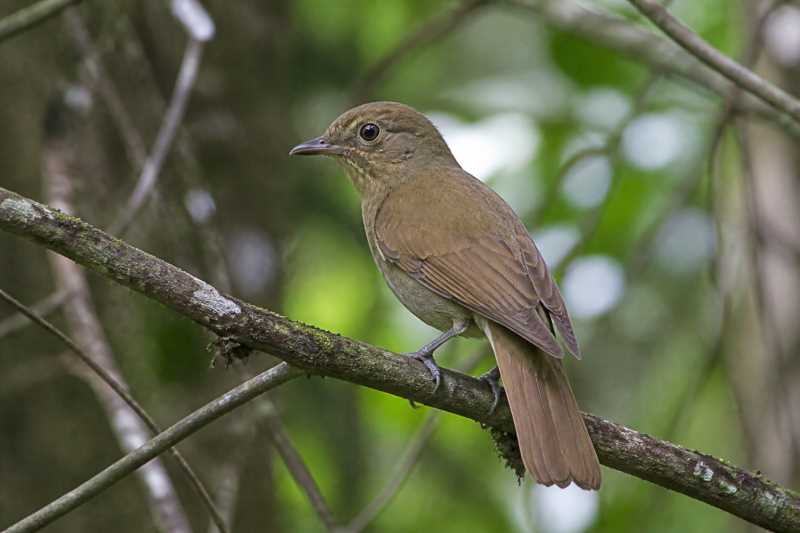
The Brown-winged Schiffornis exhibits a somewhat drab appearance, which helps it blend seamlessly into its forested environment. It measures approximately 20-23 cm in length and weighs around 50-60 grams. The plumage is primarily olive-brown, with darker brown wings that give the species its name. The underparts are paler, with a slight yellowish or buff tinge.
One of the most striking features of the Brown-winged Schiffornis is its large, dark eyes, which are well-adapted for low-light conditions found in dense forest habitats. The beak is stout and slightly hooked, suitable for its varied diet.
Behavior and Ecology
The Brown-winged Schiffornis is a solitary bird, often seen alone or in pairs rather than in flocks. It is a shy and elusive species, more often heard than seen. The call of the Brown-winged Schiffornis is a series of melodious whistles, often described as hauntingly beautiful, and can carry over long distances in the dense forest.
This bird is primarily insectivorous, feeding on a variety of insects and arthropods. However, it is also known to consume fruits and seeds, particularly during the non-breeding season when insects are less abundant. Foraging mainly occurs in the lower and mid-levels of the forest, where it skillfully navigates through dense foliage.
Breeding and Reproduction
The breeding season of the Brown-winged Schiffornis varies across its range but generally coincides with the rainy season when food resources are abundant. The nest is typically a simple cup-shaped structure built with leaves and twigs, positioned in the fork of a tree or shrub.
Females lay 2-3 eggs per clutch, which are incubated for about 18-20 days. Both parents participate in feeding the chicks, which fledge approximately two weeks after hatching. The breeding success of the Brown-winged Schiffornis is closely linked to habitat quality and availability.
Conservation Status
The Brown-winged Schiffornis is currently listed as Least Concern by the International Union for Conservation of Nature (IUCN). However, like many forest-dependent species, it faces threats from habitat loss and fragmentation due to deforestation and agricultural expansion.
Conservation efforts for this species focus on preserving large tracts of continuous forest and promoting sustainable land-use practices. Protected areas and reserves play a crucial role in safeguarding the habitats of the Brown-winged Schiffornis and other forest-dwelling species.
Conclusion
The Brown-winged Schiffornis, with its understated elegance and enchanting calls, is a testament to the rich biodiversity of neotropical forests. While it is not currently at immediate risk, continued efforts to preserve its habitat are essential for ensuring its long-term survival. For bird enthusiasts and conservationists alike, the Brown-winged Schiffornis serves as a reminder of the intricate beauty and complexity of forest ecosystems.
As we strive to understand and protect such species, the Brown-winged Schiffornis remains a symbol of the delicate balance within our natural world, deserving of admiration and conservation.
References
- BirdLife International. (2021). Schiffornis turdina. The IUCN Red List of Threatened Species 2021.
- Ohlson, J. I., Prum, R. O., & Ericson, P. G. P. (2007). A molecular phylogeny of the cotingas (Aves: Cotingidae). Molecular Phylogenetics and Evolution.
- Ridgely, R. S., & Tudor, G. (2009). Field Guide to the Songbirds of South America: The Passerines. University of Texas Press.
Related posts