Introduction
The Brown Tinamou (Crypturellus obsoletus) is a medium-sized, ground-dwelling bird in the tinamou family, Tinamidae, and the order Tinamiformes. It occurs across much of tropical and subtropical South America, especially in humid lowland, foothill and montane forests. It is usually detected by its distinctive whistled call rather than seen, because it moves quietly through dense vegetation. (worldbirdnames.com)
Physical Description
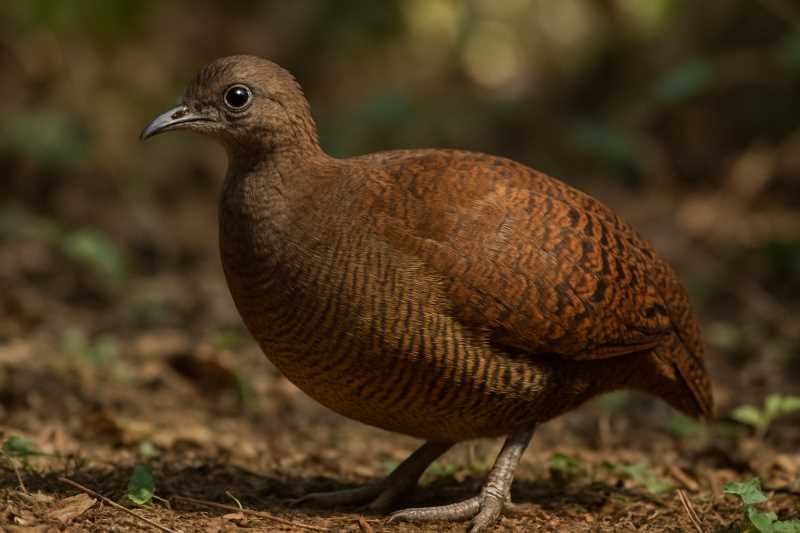
The Brown Tinamou is approximately 25–30 centimetres long. Its upperparts are generally brown, while the underparts are more rufous or reddish brown, becoming darker on the belly. The flanks and undertail-coverts may show darker barring, providing disruptive camouflage in leaf litter and shaded forest understorey. The bill is dark, and the legs are usually olive or dull greenish.
Plumage varies geographically, with recognised subspecies differing in the tone of the upperparts and underparts. Reliable sources do not indicate pronounced sexual dimorphism, so males and females are generally difficult to distinguish by appearance alone. Juveniles may be duller or more heavily patterned than adults, although age-related plumage descriptions are not equally well documented across the species’ range. (si.edu)
Range and Habitat
The Brown Tinamou is distributed from eastern Colombia and Venezuela through Ecuador, Peru, Bolivia, Brazil and Paraguay to northern Argentina. It is a resident species rather than a long-distance migrant, although local movements may occur in response to habitat conditions.
It occupies humid tropical and subtropical forests, including lowland rainforest, foothill forest, montane forest and cloud forest. In parts of the eastern Andes it is recorded mainly between about 900 and 2,500 metres, while elsewhere it occurs at lower elevations in lowland forest. It may use forest edges, secondary growth and disturbed woodland, but it remains strongly associated with ground cover and forest habitat. (birdsofbolivia.org)
Geographic variation is substantial enough that several subspecies are recognised by taxonomic authorities. Northern and Andean populations may differ noticeably in colour and pattern from birds in the Atlantic Forest and southern portions of the range. (itis.gov)
Behaviour and Diet
The Brown Tinamou is primarily terrestrial and usually forages alone or in pairs. It walks through leaf litter and low vegetation, turning over leaves with its bill while searching for food. The species is more often heard than seen, and its loud, repeated whistle is an important clue to its presence. Available field accounts describe it as sedentary, although detailed information on movement patterns remains limited. (birdsofbolivia.org)
Its diet includes seeds, fallen fruit and arthropods, including insects and other small invertebrates. The relative importance of plant and animal food probably varies with local availability. The original claim that the species deliberately uses a prolonged sit-and-wait strategy is not well supported by the sources consulted, so it is better described as an active ground forager.
Breeding takes place in a shallow depression or simple nest on the forest floor. As in other tinamous, the male incubates the eggs and cares for the young after hatching. Reported clutches commonly contain about four eggs, which are glossy and may be deep pink, reddish or brownish in colour. The chicks are precocial and can move soon after hatching, remaining under the male’s protection during early development. (birdsofbolivia.org)
Identification Tips
- Look for a compact, short-tailed bird about 25–30 centimetres long moving quietly on the forest floor.
- The overall impression is brown above and rufous below, with darker barring on the flanks and undertail area.
- The dark bill and olive-toned legs can help confirm an identification when the bird is visible.
- Listen for a clear, repeated whistle. A calling bird may remain hidden in dense undergrowth, so sound is often more useful than visual searching.
- In the eastern Andes, habitat and elevation are useful supporting clues. The Brown Tinamou is generally associated with humid forest, whereas superficially similar tinamous may have different patterns, leg colours or habitat preferences.
- Identification should be made cautiously where the range overlaps with other Crypturellus species, particularly in regions with several brown or rufous forest tinamous.
Conservation Status
The Brown Tinamou is currently assessed as Least Concern on the IUCN Red List. It has a broad geographic range and occurs in several major forest regions of South America, but detailed population estimates are not available. (datazone.birdlife.org)
Habitat loss, forest fragmentation, agricultural expansion, road building and other forms of forest degradation may affect local populations. These pressures are especially important in heavily cleared parts of the Atlantic Forest and the Andes. Conservation measures should therefore focus on retaining and restoring native forest, maintaining habitat connectivity and protecting large forest reserves. A Least Concern assessment does not mean that every regional population is secure, and local declines may occur where suitable forest is lost.
Frequently Asked Questions
Where does the Brown Tinamou live?
It occurs in tropical and subtropical South America, from eastern Colombia and Venezuela south through the Andes and Amazonian regions to Brazil, Bolivia, Paraguay and northern Argentina. It is mainly associated with humid forest, including foothill and montane forest.
How large is a Brown Tinamou?
An adult Brown Tinamou is approximately 25–30 centimetres long. Some regional sources give slightly different measurements, reflecting geographic variation and differences in measurement methods.
What does the Brown Tinamou eat?
Its diet includes seeds, fallen fruit, insects and other arthropods. It usually searches for food on the forest floor among leaf litter and low vegetation.
Is the Brown Tinamou migratory?
No. It is generally regarded as a resident, sedentary species. Local movements may occur, but it is not known for regular long-distance migration.
Does the male Brown Tinamou incubate the eggs?
Yes. The male incubates the eggs in a shallow ground nest and cares for the chicks after they hatch. The young are precocial and can move shortly after hatching.
What is the conservation status of the Brown Tinamou?
The species is listed as Least Concern by the IUCN. Nevertheless, deforestation and fragmentation can reduce habitat and may threaten local populations, particularly in regions where native forest has been extensively cleared.
References
- BirdLife International. n.d. Brown Tinamou Crypturellus obsoletus Species Factsheet. BirdLife DataZone. Accessed 8 September 2026.
- Gill, F., Donsker, D. and Rasmussen, P., eds. 2026. IOC World Bird List, version 15.2. International Ornithologists’ Union. Accessed 8 September 2026.
- Integrated Taxonomic Information System. n.d. Crypturellus obsoletus (Temminck, 1815), Brown Tinamou. ITIS Report. Accessed 8 September 2026.
- Restall, R., Rodner, C. and Lentino, M. 2006. Birds of Northern South America: An Identification Guide, Volume 2. Christopher Helm, London.
- Schunck, F., et al. 2017. When habitat matters: Habitat preferences can modulate co-occurrence patterns of similar sympatric Neotropical tinamous. PLOS ONE 12(7): e0182081. https://doi.org/10.1371/journal.pone.0182081.
- Maurício, G. N. and Dias, R. A. 2013. Review of the breeding status of birds in Rio Grande do Sul, Brazil. Iheringia, Série Zoologia 103(2): 163–184. Article PDF.
- Birds of Bolivia. n.d. Crypturellus obsoletus, Brown Tinamou. Accessed 8 September 2026.
- Peru Aves. n.d. Brown Tinamou Crypturellus obsoletus. Accessed 8 September 2026.
Related posts