Introduction
The Bronzy Hermit (Glaucis aeneus) is a small hummingbird of humid lowland forests and forest edges in Central and north-western South America. It is a resident species, with separate populations extending from eastern Honduras through Nicaragua, Costa Rica and western Panama, and from western Colombia into north-western Ecuador.
Physical Description
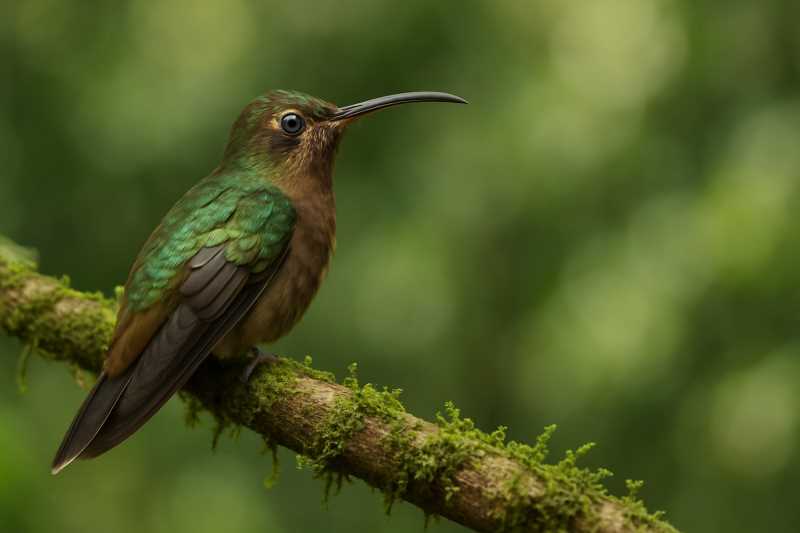
The Bronzy Hermit is about 9–10 centimetres long. It has bronze-green to coppery-green upperparts, a dusky face with a pale moustachial stripe, a buff or cinnamon-buff throat and breast, and a paler belly. The long bill is strongly decurved, a typical feature of hermit hummingbirds and an adaptation for probing tubular flowers.
The tail is relatively short and rounded compared with that of many Phaethornis hermits. Its feathers are greyish green above, with conspicuous pale or white tips. The sexes are broadly similar in plumage, although females may be slightly duller and have a more strongly curved bill. Juveniles generally appear less richly coloured, with buff edging or scaling on the upperparts and underparts.
Range and Habitat
The species occurs in two geographically separated areas. The Central American population ranges from eastern Honduras through eastern Nicaragua, Costa Rica and western Panama. The South American population extends from western Colombia into north-western Ecuador, including the western Andean foothills.
Bronzy Hermits favour humid lowland and foothill environments, usually from sea level to about 750–800 metres. They use disturbed primary forest, mature secondary forest, swamp forest, dense thickets, forest margins, streamside vegetation and other semi-open habitats with flowering plants. They are resident rather than long-distance migrants, although local movements may occur when flowering conditions change.
Where to See This Species
La Selva Biological Station, Heredia Province, Costa Rica
La Selva protects lowland tropical rainforest, secondary forest and regenerating habitats in the Sarapiquí lowlands. Bronzy Hermit is included in the station’s bird records, making its trails and forest edges a credible place to search, particularly around flowering heliconias and other dense understory vegetation. Visitor access is available through the station’s guided and educational programmes.
Nearby accommodation: Puerto Viejo de Sarapiquí is the nearest practical gateway, with lodges, guest houses, hotels and other nature-tourism accommodation.
Sendero Frutti Tour & Birdwatching, Pichincha, Ecuador
This birdwatching venue in Pichincha has documented Bronzy Hermit records and provides access to humid foothill vegetation in the species’ Ecuadorian range. Look along forest edges, flowering plants and shaded understory, where the bird may pass quickly and remain close to cover.
Nearby accommodation: Quito and the surrounding Pichincha valleys provide the broadest choice of hotels, guest houses, lodges and self-catering accommodation.
Behaviour and Diet
Bronzy Hermits are usually seen singly. They forage actively through dense vegetation and may defend feeding areas, although they do not normally gather in large flocks. Like other hermit hummingbirds, they may follow regular routes between dependable flowering plants, a behaviour known as traplining.
Nectar forms the main part of the diet, with flowers of heliconias and other tubular-flowered plants being important resources. Small insects and spiders are also taken, often by gleaning them from leaves, twigs or spider webs. These animal foods provide essential protein, especially during periods of breeding and chick-rearing.
Breeding information is incomplete and varies geographically. The female builds a small, cone-shaped cup from plant fibres and spider web, usually attaching it beneath a broad, drooping leaf such as a heliconia or banana leaf. A typical clutch consists of two white eggs. The female alone incubates the eggs and feeds the young, which remain dependent on her after hatching.
Identification Tips
- Look for a small hermit hummingbird with bronze-green upperparts and a buff or cinnamon-buff throat.
- The pale moustachial stripe contrasts with the dusky face.
- The strongly decurved bill and relatively short, pale-tipped tail are useful structural features.
- It usually stays in shaded understory, thickets, forest margins or streamside vegetation rather than hovering conspicuously in open gardens.
- Do not confuse it with the Rufous-breasted Hermit (Glaucis hirsutus). The two are closely related, but the Bronzy Hermit is generally associated with the Central American and western Colombian to north-western Ecuadorian range described above, while the Rufous-breasted Hermit has a much broader distribution farther south and east.
Conservation Status
The Bronzy Hermit is currently assessed as Least Concern. A reliable global population estimate and clearly established population trend are not available. Habitat loss through deforestation, agricultural expansion, drainage of wet forest and the gradual degradation of secondary forest remain potential pressures, especially where dense understory and flowering plants are removed.
Protection of lowland and foothill forest, maintenance of forest corridors and the retention of flowering plants in regenerating and agricultural landscapes can benefit this species. Its occurrence in protected areas and biological stations provides some security, but local habitat quality remains important.
Frequently Asked Questions
Where can the Bronzy Hermit be found?
It occurs from eastern Honduras through Nicaragua, Costa Rica and western Panama, and separately from western Colombia into north-western Ecuador.
Is the Bronzy Hermit migratory?
No. It is regarded as a resident species, although individuals may make local movements in response to flowering and other changes in food availability.
What does the Bronzy Hermit eat?
It feeds mainly on nectar from flowering plants, including heliconias, and supplements this diet with small insects and spiders.
How can the Bronzy Hermit be identified?
Key features include bronze-green upperparts, a buff throat and breast, a pale moustachial stripe, a strongly decurved bill and a relatively short tail with pale tips.
Where does the Bronzy Hermit build its nest?
The female usually attaches a small cup-shaped nest beneath a broad, drooping leaf or on sheltered vegetation. Plant fibres and spider web help bind the nest together.
Is the Bronzy Hermit threatened?
It is currently classified as Least Concern, but forest clearance, agricultural conversion and the loss of dense understory can reduce suitable habitat locally.
References
- IOC World Bird List
- IUCN Red List of Threatened Species
- Cornell Lab of Ornithology eBird
Related posts