Introduction
The Bornean Peacock-Pheasant (Polyplectron schleiermacheri) is an elusive, ground-dwelling pheasant endemic to the island of Borneo. It occurs in scattered localities across Indonesian and Malaysian Borneo and is regarded as one of the least-known peacock-pheasants. The species is closely related to the Malayan Peacock-Pheasant but is recognised as a separate species by current major bird taxonomies.
Physical Description
The Bornean Peacock-Pheasant is a medium-sized pheasant with marked sexual dimorphism. Published field descriptions give an adult male length of approximately 42–50 cm and an adult female length of about 36–38 cm.
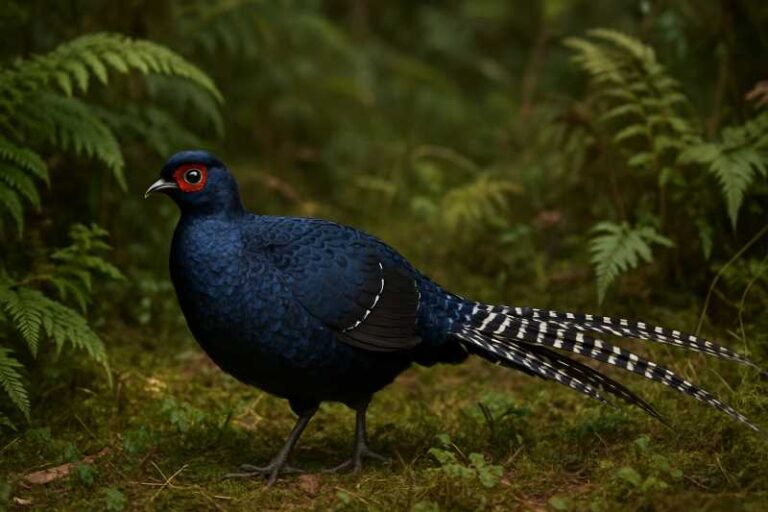
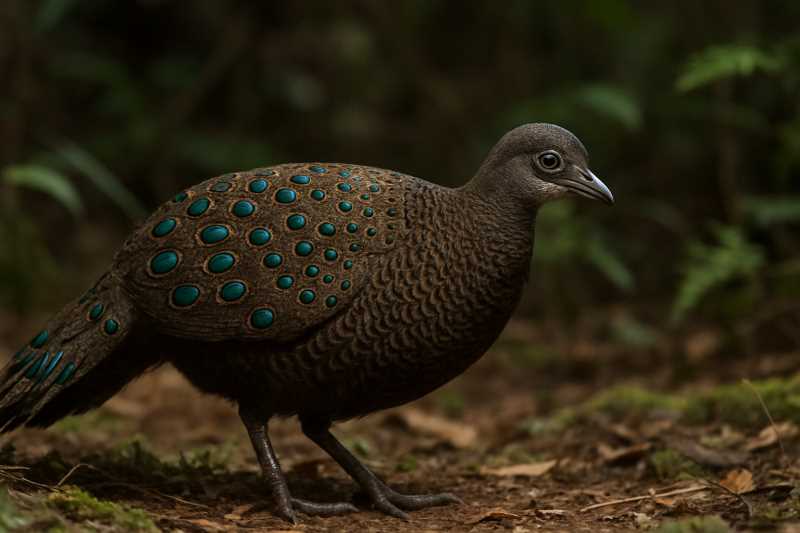
The male has rufous-brown upperparts with fine dark markings, a metallic green crest, an iridescent purplish-green breast and a white throat and central breast. Large blue-green or green ocelli, or eye-like spots, decorate the wings and tail. The bare skin around the eye is reddish or orange, the iris is blue, and the dark legs carry two spurs on each foot.
The female is smaller and duller, with darker brown or grey-brown plumage, less conspicuous ocelli and a shorter tail. She has a brown iris and lacks the male’s leg spurs. Juveniles resemble females but are generally plainer. Young birds may lack iridescent tail ocelli and show barred tails, brown upperparts and paler underparts.
Range and Habitat
The Bornean Peacock-Pheasant is endemic to Borneo, including Kalimantan in Indonesia and Sabah and Sarawak in Malaysia. Records are scattered across the island, with many historical observations from Central Kalimantan. The species is resident rather than migratory.
It is primarily associated with lowland and lower hill forest, especially primary dipterocarp forest and other humid, closed-canopy habitats. Records extend from near sea level to approximately 1,000–1,100 metres, although the species appears to occur mainly at lower elevations. It is often recorded near small rivers or streams and may avoid the wettest swamp and flooded forest. Most records are from intact or relatively mature forest, but camera-trap observations show that it can occasionally persist in degraded forest where suitable cover remains.
The exact distribution is still incompletely known. Its secretive behaviour, low apparent density and reliance on dense forest make conventional surveys difficult.
Behaviour and Diet
This is a shy and poorly known forest bird. It usually walks quietly on the ground during the day and is more likely to run into cover than fly when disturbed. It roosts in trees and may occur alone, in pairs or in small family groups. Its call has been described as a soft, melancholic double whistle.
The diet is not fully documented, but available observations and local reports indicate that it forages on the forest floor for fallen fruit, seeds and invertebrates, including ants and other small insects. It may feed along animal trails, near streams and among leaf litter. The original description of the species as an omnivore is therefore broadly appropriate, although detailed dietary studies are lacking.
Males use their wings and tail in courtship displays, showing the iridescent ocelli and contrasting breast pattern. However, there is no reliable evidence that the species maintains formal dancing grounds. Breeding behaviour in the wild remains poorly documented. Camera-trap records of juveniles provide evidence of successful breeding, while observations from related species and captivity suggest that clutches may be small, possibly consisting of a single egg. This should be treated as provisional for wild Bornean Peacock-Pheasants.
Identification Tips
Look for a secretive, medium-sized pheasant moving quietly through dense lowland forest rather than flying for long distances. The adult male is distinctive because of the combination of:
- A metallic green crest.
- A white throat and central breast.
- Purplish-green or green iridescence on the sides of the breast.
- Large blue-green ocelli on the wings and tail.
- Reddish facial skin, a blue iris and two leg spurs.
Females and juveniles are much less conspicuous. A dull brown pheasant with a shorter tail, brown iris and reduced or absent tail ocelli is more likely to be a female or immature Bornean Peacock-Pheasant than an adult male.
The closely related Malayan Peacock-Pheasant (Polyplectron malacense) is the most relevant comparison, although the two species have separate geographic ranges. Females can be difficult to distinguish on appearance alone, so location, habitat and careful examination of the tail and wing pattern are important. Sightings in Sumatra should be treated cautiously because reports from that island have been considered erroneous in the absence of confirmed specimens.
Conservation Status
The Bornean Peacock-Pheasant is classified as Endangered on the IUCN Red List. The principal threats are the loss, fragmentation and degradation of lowland forest through logging, agricultural expansion and plantation development. Hunting may add further pressure, particularly where forest clearance makes the birds easier to reach or concentrates them in smaller remnants.
The population size is uncertain, and reliable island-wide estimates should not be assumed. Available research indicates that the species is rare, locally distributed and likely declining in areas where suitable forest is being lost. Conservation priorities include protecting remaining lowland and lower hill forest, maintaining connections between forest blocks, controlling hunting, supporting field surveys and using camera traps to locate populations.
Protected forests, forest restoration projects and locally managed conservation sites can all contribute to the species’ survival. Community involvement is especially important where local residents provide knowledge of sightings, help manage forest access or participate in responsible wildlife tourism. Any observation-based tourism should avoid disturbance, feeding and disclosure of sensitive locations.
Frequently Asked Questions
Where does the Bornean Peacock-Pheasant live?
It lives on Borneo, including Kalimantan, Sabah and Sarawak. It is mainly associated with lowland and lower hill forest, usually in dense, humid habitats with substantial ground cover.
Is the Bornean Peacock-Pheasant endangered?
Yes. The species is classified as Endangered because of its restricted and fragmented distribution, continuing forest loss and additional pressure from hunting.
What does the Bornean Peacock-Pheasant eat?
Its documented and reported foods include fallen fruit, seeds and small invertebrates such as ants and other insects. Detailed studies of its diet are still limited.
How can the male be identified?
The adult male has a metallic green crest, a white throat and central breast, iridescent green or purple-green breast sides, large blue-green tail and wing ocelli, reddish facial skin and two spurs on each leg.
Are Bornean Peacock-Pheasants migratory?
No. The species is considered resident and endemic to Borneo. It does not undertake regular long-distance migration.
How is the species being studied?
Because it is difficult to observe, researchers use camera traps, field surveys, call records and local ecological knowledge. These methods have confirmed its presence in several otherwise difficult-to-survey forest areas and have provided evidence of breeding.
References
- BirdLife International. 2024. “Bornean Peacock-Pheasant Polyplectron schleiermacheri Species Factsheet.” BirdLife DataZone. Available at: https://datazone.birdlife.org/species/factsheet/bornean-peacock-pheasant-polyplectron-schleiermacheri. Accessed 8 September 2026.
- Gill, F., Donsker, D. and Rasmussen, P., eds. 2026. IOC World Bird List, version 15.2. International Ornithologists’ Union. Available at: https://www.worldbirdnames.org/. Accessed 8 September 2026.
- O’Brien, T. G., Winarni, N. L., Saanin, F. M., Kinnaird, M. F. and Jepson, P. 1998. “Distribution and conservation status of Bornean Peacock-pheasant Polyplectron schleiermacheri in Central Kalimantan, Indonesia.” Bird Conservation International 8(4): 373–385. https://doi.org/10.1017/S0959270900002136.
- Mohamed, A., Brickle, N. and Wilting, A. 2017. “A new record of Bornean Peacock Pheasant Polyplectron schleiermacheri from Sabah, Malaysia.” Forktail 33: 53–55. Available at: https://www.orientalbirdclub.org/s/Bornean-Peacock-Pheasant.pdf. Accessed 8 September 2026.
- Forest Department Sarawak. 2020. “Bornean Peacock-Pheasant (Polyplectron schleiermacheri).” Government of Sarawak. Available at: https://forestry.sarawak.gov.my/web/subpage/webpage_view/840. Accessed 8 September 2026.
- Malaysian Nature Society Bird Conservation Council. 2024. “Bornean Peacock-Pheasant.” Malaysian Bird Report, volume 3, pages 33–36. Available at: https://malaysianbird.report/wp-content/uploads/6-Bornean-Peacock-Pheasant-Malaysian-Bird-Report-Sept-2024-Final-02Oct2024.pdf. Accessed 8 September 2026.
- International Union for Conservation of Nature. 2012. IUCN Red List Categories and Criteria, Version 3.1, second edition. Gland, Switzerland and Cambridge, UK: IUCN. Available at: https://www.iucnredlist.org/resources/categories-and-criteria. Accessed 8 September 2026.
Related posts