Introduction
The Moorland Francolin, Scleroptila psilolaema, is a ground-dwelling member of the pheasant family, Phasianidae. It is endemic to the Ethiopian Highlands, where it occupies isolated Afroalpine and sub-Afroalpine habitats. The species was formerly treated as including populations now recognised as the separate Elgon Francolin, Scleroptila elgonensis, of Kenya and Uganda.
Physical Description
The Moorland Francolin is a medium-sized francolin, measuring approximately 32–35 cm in length. It has a compact, robust body, short graduated tail and strong legs suited to terrestrial movement. The sexes are broadly similar in plumage, although males are generally slightly larger and may show more prominent leg spurs.
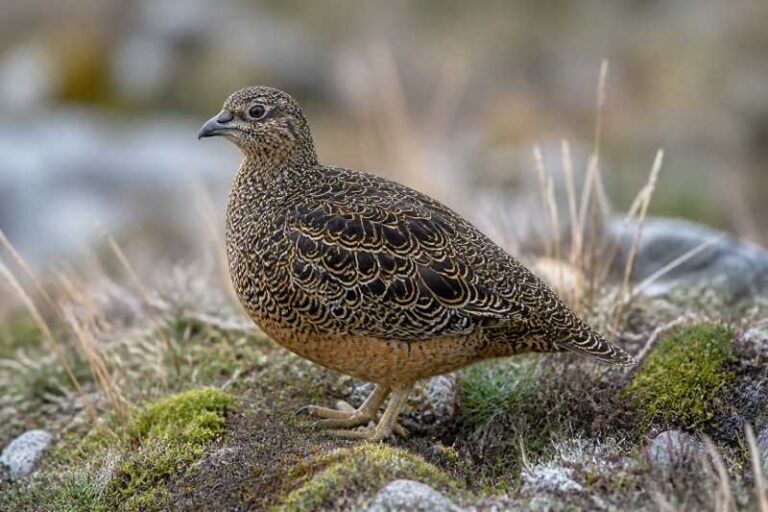
Adults have dark brown, finely patterned upperparts with buff and rufous markings. The head and neck are brownish and buff, with dark spotting, while the throat is buff and characteristically flecked with black. The breast and underparts are paler, with dark chevrons, fine barring and chestnut markings. The wings show rich rufous tones, and the outer primary feathers have dark bars near their tips. This combination of subdued colours and dense patterning provides effective camouflage among grasses, heaths and rocky moorland vegetation.
Reliable descriptions of juvenile plumage and age-related variation remain limited. Field observations indicate that males and females are difficult to distinguish without close views or behavioural clues.
Range and Habitat
The Moorland Francolin is endemic to Ethiopia. Its range is concentrated in the country’s central, eastern and southern highlands, including the Bale and Arsi mountain regions, the Guassa Community Conservation Area, the Entoto and Ankober-Debresina highlands, and other suitable high-elevation sites.
It occurs mainly in Afroalpine and sub-Afroalpine landscapes, including open moorland, tussock grassland, heathland and herb-rich montane vegetation. Records and ecological studies place it broadly at elevations from about 2,400 m to more than 4,000 m, although local habitat conditions are likely to influence its distribution.
The species is resident rather than migratory, but its populations are naturally fragmented because suitable habitat is confined to isolated mountain systems. It generally avoids dense forest and areas dominated by closed tree cover, favouring open habitats with sufficient ground vegetation for feeding and concealment.
Behaviour and Diet
Moorland Francolins are secretive, ground-dwelling birds. They usually walk or run through vegetation and tend to remain motionless, crouched or hidden when approached. When flushed, they can make a rapid, short flight before landing in cover. They may occur singly, in pairs or in small groups, although detailed information about their social organisation is still limited.
The species forages among grasses, herbs and damp ground. Its diet is thought to include seeds, shoots, roots, bulbs and small invertebrates, but the available dietary evidence remains incomplete. Camera-trap studies have found that habitat use is associated with herb-rich vegetation and that birds may use roadsides and trails for resting, hiding and movement. Activity and detectability can vary with precipitation and other weather conditions.
The breeding biology of the Moorland Francolin is poorly documented. It is believed to nest on the ground, as do many related francolins, but published evidence is insufficient to confirm the clutch size, incubation period and precise division of parental care given in some older accounts. Further field research is needed to clarify its breeding season, nest-site selection and chick development.
Identification Tips
When looking for a Moorland Francolin, concentrate on open highland moorlands, tussock grasslands and heath-covered slopes rather than forest. The species is often detected first by movement through cover or by a sudden flush rather than by a prolonged view.
Key field characters include:
- A compact, chicken-sized francolin with a short tail.
- Brown, buff and rufous plumage with dense vermiculated and barred patterning.
- A buff throat and upper breast marked with conspicuous black spots or chevrons.
- Rufous wings with dark barring near the tips of the primary feathers.
- A preference for open, high-elevation vegetation and a tendency to remain close to ground cover.
The most important current identification issue concerns the Elgon Francolin, Scleroptila elgonensis. That species is now generally treated as distinct and occurs in the highlands of Kenya and Uganda. Compared with the Moorland Francolin, it is typically more rufous and differs in throat patterning and vocal structure. Geographic location is therefore an essential part of identification.
Conservation Status
The Moorland Francolin is currently assessed as Near Threatened. Its population size is not well established, but available evidence indicates that its specialised highland habitat is fragmented and under continuing pressure.
Major threats include the conversion of moorland and grassland to agriculture, livestock grazing, settlement, roads, plantations and other forms of human disturbance. Habitat degradation may reduce the availability of herb-rich ground cover and increase fragmentation between mountain populations. Climate change is an additional concern because the species is restricted to cool, high-elevation environments. Recent distribution modelling predicts substantial reductions in suitable habitat under some future climate scenarios, although such projections are not themselves a revision of the current Red List category.
Important conservation measures include protecting remaining Afroalpine and sub-Afroalpine habitat, maintaining habitat connectivity between suitable areas, managing grazing and agricultural expansion, and supporting community-based conservation initiatives. Better monitoring is also needed to establish population trends, clarify the species’ full distribution and assess the effects of climate change.
Frequently Asked Questions
Where does the Moorland Francolin live?
It lives in the Ethiopian Highlands, mainly in open Afroalpine and sub-Afroalpine moorlands, tussock grasslands, heathlands and herb-rich montane habitats.
Is the Moorland Francolin found in Kenya or Tanzania?
The currently recognised Moorland Francolin is endemic to Ethiopia. Populations formerly included in the species from Kenya and Uganda are now generally treated as the separate Elgon Francolin, Scleroptila elgonensis. There is no reliable basis for listing Tanzania as part of the present range of Scleroptila psilolaema.
How can the species be identified in the field?
Look for a compact brown and rufous francolin with a buff, black-flecked throat, densely patterned underparts and rufous wings. It is usually encountered in open highland vegetation and often remains concealed until flushed.
What does the Moorland Francolin eat?
Its diet is thought to include seeds, shoots, roots, bulbs and small invertebrates. Detailed dietary studies are limited, but the species forages on or near the ground among grasses and herbs.
Is the Moorland Francolin endangered?
It is currently classified as Near Threatened, rather than Endangered. Its restricted highland range, habitat fragmentation and continuing habitat loss are concerns, and climate change may further reduce suitable habitat.
Does the Moorland Francolin migrate?
It is considered a resident species. Its distribution is naturally fragmented among Ethiopian mountain systems, but it is not known to undertake regular long-distance migration.
References
- Abrha, A. M., Gedeon, K., Podsiadlowski, L., Weldesilasie, D. M. & Töpfer, T. 2023. Occupancy of the Ethiopian endemic Moorland Francolin in pristine and degraded Afroalpine biome using a camera trap approach. Ecology and Evolution 13: e10551. https://doi.org/10.1002/ece3.10551
- Abrha, A. M., Rödder, D., Gedeon, K., Podsiadlowski, L. & Töpfer, T. 2025. Evaluating the impact of climate change on mountaintop endemic bird species in the Ethiopian highlands: insights from moorland francolin (Scleroptila psilolaema). Ornithology Research 33: 47. https://doi.org/10.1007/s43388-025-00252-1
- BirdLife International. 2024. Moorland Francolin Scleroptila psilolaema, species factsheet and Red List assessment. BirdLife International, Cambridge. https://datazone.birdlife.org/species/factsheet/moorland-francolin-scleroptila-psilolaema. Accessed 8 September 2026.
- Hunter, N., Mills, M. & Cohen, C. 2019. Elgon Francolin Scleroptila elgonensis should be treated as a species distinct from Moorland Francolin S. psilolaema. Bulletin of the African Bird Club 26(1): 92–100. https://www.eararities.org/downloads/Hunter%20et%20al.pdf
- IOC World Bird List. 2026. IOC World Bird List, version 15.2. International Ornithologists’ Union. https://www.worldbirdnames.org/. Accessed 8 September 2026.
- Mandiwana-Neudani, T. G., Little, R. M., Crowe, T. M. & Bowie, R. C. K. 2019. Taxonomy, phylogeny and biogeography of ‘true’ francolins: Galliformes, Phasianidae, Phasianinae, Gallini; Francolinus, Ortygornis, Afrocolinus gen. nov., Peliperdix and Scleroptila spp. Ostrich 90(3): 191–221. https://doi.org/10.2989/00306525.2019.1632954
Related posts