The Majestic Blyth’s Hawk-Eagle: An Ornithological Marvel
In the lush, verdant rainforests of Southeast Asia, a powerful predator soars through the canopies with grace and precision. With its striking appearance and formidable hunting prowess, Blyth’s Hawk-Eagle (Nisaetus alboniger) captivates ornithologists and birdwatchers alike. This article delves into the intriguing world of Blyth’s Hawk-Eagle, exploring its habitat, behavior, and conservation status.
A Regal Appearance
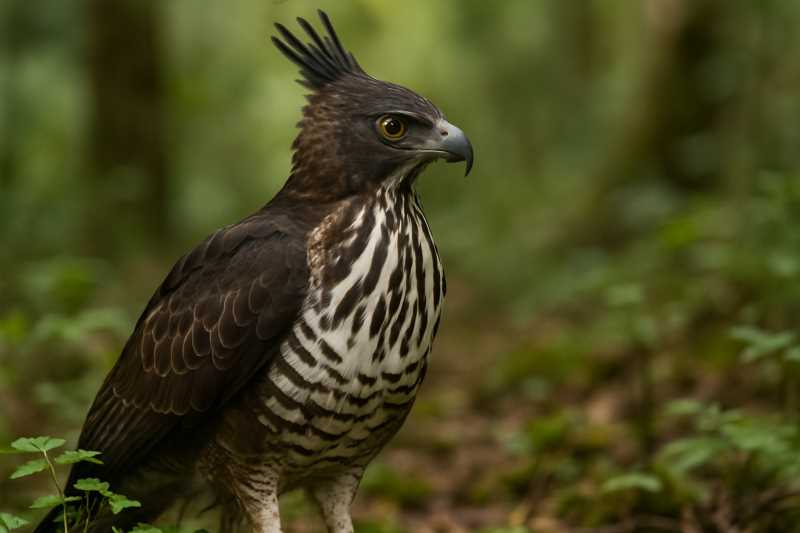
Blyth’s Hawk-Eagle is a medium-sized raptor, distinguished by its bold plumage and distinctive crest. Adults typically measure between 51 to 58 centimeters in length, with a wingspan ranging from 101 to 130 centimeters. Their upperparts are dark brown, providing effective camouflage in dense forests, while the underparts are white with striking black streaks. The impressive crest, often raised when the bird is alert or agitated, adds to its regal appearance and is a key identifying feature.
Juvenile Blyth’s Hawk-Eagles are paler, with streaked brown plumage that gradually darkens as they mature. Their eyes transition from a pale yellow to a deep amber, reflecting their predatory prowess. The bird’s powerful talons and hooked beak are designed for hunting, making it a formidable presence in its natural habitat.
Habitat and Range
Blyth’s Hawk-Eagle has a relatively limited distribution, primarily inhabiting the tropical and subtropical forests of the Malay Peninsula, Sumatra, and Borneo. These regions offer the dense foliage and high canopy that the eagle requires for hunting and nesting. While the species prefers lowland forests, it can also be found at elevations up to 1,500 meters.
The eagle’s reliance on forested habitats makes it particularly vulnerable to deforestation and habitat fragmentation. As Southeast Asia continues to experience significant land-use changes, the conservation of these critical habitats is essential for the survival of Blyth’s Hawk-Eagle.
Behavioral Traits
Blyth’s Hawk-Eagle is a solitary and territorial bird, often seen alone or in pairs. It is a diurnal hunter, employing exceptional eyesight to spot prey from great distances. Its diet consists primarily of small mammals, birds, and reptiles, which it captures with swift, calculated dives from the canopy.
The eagle’s hunting strategy is both fascinating and effective. It often perches quietly, scanning the forest floor and canopy for movement. Once it identifies potential prey, it launches into a rapid, silent descent, seizing its target with unmatched precision.
Breeding and Nesting
The breeding season for Blyth’s Hawk-Eagle typically occurs from December to June, although this can vary depending on the region. The species builds large stick nests high in the forest canopy, often reusing the same site for several years. These nests are meticulously constructed, lined with green leaves and twigs to provide a comfortable environment for the eggs and chicks.
A typical clutch consists of one or two eggs, with the female primarily responsible for incubation. During this period, the male provides food, ensuring the female and future offspring are adequately nourished. After hatching, the chicks are cared for by both parents, receiving regurgitated food until they are old enough to hunt independently.
Conservation Status
As of the latest assessments, Blyth’s Hawk-Eagle is classified as Near Threatened on the IUCN Red List. The primary threat to the species is habitat loss due to logging, agriculture, and infrastructure development. Forest degradation not only reduces the available hunting grounds but also limits suitable nesting sites.
Conservation efforts are crucial to preserving Blyth’s Hawk-Eagle populations. Initiatives aimed at protecting and restoring forest habitats, alongside community education and sustainable land-use practices, are essential components of these efforts. Additionally, research on the species’ ecology and behavior can inform conservation strategies, ensuring that this magnificent raptor continues to thrive in its natural environment.
The Role of Blyth’s Hawk-Eagle in Ecosystems
Beyond its captivating presence, Blyth’s Hawk-Eagle plays a vital role in maintaining the ecological balance within its habitat. As a top predator, it helps regulate populations of small mammals and birds, contributing to the health and diversity of forest ecosystems. The eagle’s presence is an indicator of a thriving, biodiverse environment, underscoring the importance of protecting these birds and their habitats.
Conclusion
Blyth’s Hawk-Eagle is a testament to the beauty and complexity of Southeast Asia’s avian life. Its striking appearance, impressive hunting skills, and ecological significance make it a subject of admiration and study. As we continue to understand and appreciate this remarkable bird, efforts to protect its habitat become all the more crucial. By championing conservation initiatives and fostering a deeper connection to nature, we can ensure that Blyth’s Hawk-Eagle remains a symbol of the wild, untamed beauty of the region.
Related posts