Introduction
The Blue-faced Malkoha (Phaenicophaeus viridirostris) is a resident, non-parasitic cuckoo of peninsular India and Sri Lanka. It is a shy bird of scrub, open woodland and secondary growth, recognised by its blue bare skin around the eye, green bill and long, white-tipped tail.
Physical Description
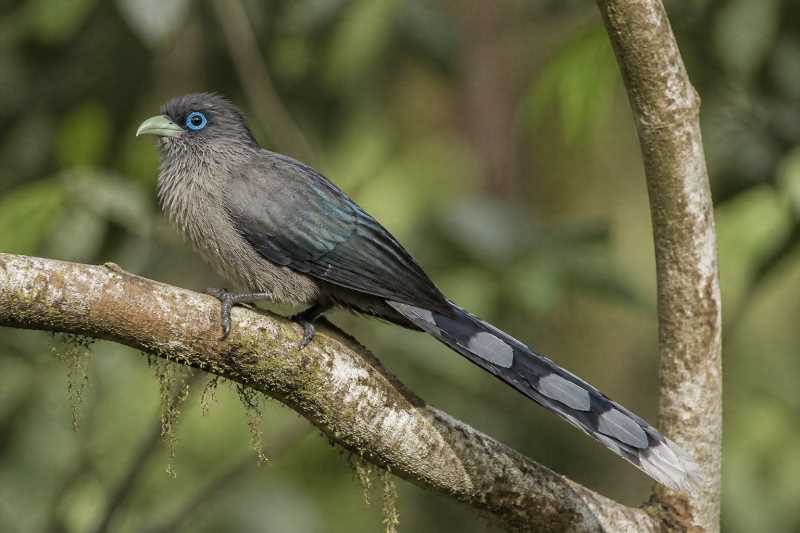
The Blue-faced Malkoha is a large, slender cuckoo measuring about 39 cm in length. Adults have greenish-grey to blue-grey upperparts, glossy blue-green wings and a long, graduated tail with conspicuous pale or white tips. The throat and breast are dark, while the lower belly is paler and may appear creamy or buff.
The bill is typically apple-green to greenish, and the bare skin surrounding the eye is bright blue. The iris may appear reddish, with a narrow pale margin. The sexes are similar in plumage, so males and females are not usually separable in the field by appearance alone. Young birds are generally duller and less glossy than adults, with less strongly contrasting facial markings.
Range and Habitat
The species occurs in southern and peninsular India and Sri Lanka. In India, its range extends through parts of the peninsula, including areas from the western and central regions southwards. In Sri Lanka, it is principally associated with the lowlands and foothills, although it has been recorded at higher elevations in suitable habitat.
The Blue-faced Malkoha favours dry deciduous woodland, thorn scrub, open forest, secondary growth, forest edges and other habitats with dense bushes and scattered trees. It may also occur in plantations, agricultural landscapes and gardens where sufficient cover remains. It is a resident species rather than a long-distance migrant.
Where to See This Species
Wilpattu National Park, North Western Province, Sri Lanka
The Blue-faced Malkoha is documented throughout Wilpattu National Park, where dry lowland forest, scrub, thickly vegetated park margins and areas around natural lakes provide suitable habitat. It is shy and often disappears quickly into dense foliage, but may be seen crossing park roads or perching briefly after rain.
Nearby accommodation: The Wilpattu gateway villages and the wider Anuradhapura area provide guest houses, small lodges, safari camps and other practical accommodation options.
Bannerghatta National Park, Karnataka, India
The species is included in the documented bird fauna of Bannerghatta National Park, south of Bengaluru. The park’s woodland, scrub and secondary forest habitats are appropriate for a bird that often keeps low in dense vegetation and along forest edges.
Nearby accommodation: Bengaluru is the main accommodation base, with hotels and guest houses, while local stays are also available in settlements around the park.
Cotigao Wildlife Sanctuary, Goa, India
Goa’s forest department records the Blue-faced Malkoha from Cotigao Wildlife Sanctuary and several other protected areas in the state. Cotigao’s thorny scrub, secondary growth and mixed woodland offer suitable habitat, particularly along quieter forest tracks and edges.
Nearby accommodation: Canacona and the wider Palolem and Agonda area provide guest houses, small hotels, self-catering accommodation and nature-oriented stays.
Behaviour and Diet
The Blue-faced Malkoha is usually quiet and skulking. It moves slowly through bushes and low woodland, using its long tail for balance as it searches among leaves and branches. When disturbed, it may make a short, direct flight before vanishing into thicker cover.
Its diet consists mainly of insects and other invertebrates, including caterpillars, grasshoppers, cicadas and beetles. It may also take small reptiles and other small vertebrates, as well as some fruit. The species can occasionally join mixed-species feeding groups, although it is more often encountered alone or in pairs.
Unlike many cuckoos, malkohas build their own nests rather than laying their eggs in the nests of other birds. The Blue-faced Malkoha is reported to construct a small platform of twigs in dense vegetation and usually lays a small clutch, commonly about two eggs. Detailed information about incubation and parental care remains limited.
Identification Tips
Look for the following combination of features:
- A large, long-tailed cuckoo with a slow, direct flight.
- Greenish-grey or blue-grey plumage with glossy blue-green wings.
- A long graduated tail with pale or white tips.
- Bright blue bare skin around the eye.
- A green bill and dark throat and breast.
- A preference for dense scrub and low woodland rather than exposed treetops.
The Blue-faced Malkoha can be confused with the Green-billed Malkoha (Phaenicophaeus tristis), where their ranges overlap. The blue facial skin around the eye is a useful distinction, while the Blue-faced Malkoha is generally associated with drier scrub and open woodland. The longer, strongly graduated tail and white tail tips are also helpful field marks.
Conservation Status
The Blue-faced Malkoha is currently classified as Least Concern. It remains reasonably widespread across its range, and available Indian monitoring data indicate a stable overall trend. Nevertheless, the species depends on woodland, scrub and secondary vegetation, so local populations may be affected by deforestation, agricultural expansion, clearance of scrub and the loss of habitat corridors.
Protecting remaining dry forests, scrublands and forest edges is important, particularly where these habitats connect larger protected areas. Maintaining vegetation around farms, plantations and village landscapes can also provide additional habitat.
Frequently Asked Questions
Where can the Blue-faced Malkoha be found?
It is found in peninsular India and Sri Lanka, mainly in dry woodland, scrub, secondary growth and forest-edge habitats.
Is the Blue-faced Malkoha migratory?
No. It is generally regarded as a resident species and does not undertake regular long-distance migration.
What does the Blue-faced Malkoha eat?
Its diet includes insects, caterpillars, grasshoppers, beetles and other invertebrates. It may also eat small reptiles, other small vertebrates and some fruit.
How can the Blue-faced Malkoha be identified?
The most useful features are its bright blue facial skin, green bill, dark throat, greenish-grey body and long tail with pale tips.
Does the Blue-faced Malkoha use other birds’ nests?
No. It is a non-parasitic cuckoo that builds its own nest, usually a small twig platform hidden in dense vegetation.
Is the Blue-faced Malkoha endangered?
It is currently assessed as Least Concern, although habitat loss and degradation can create local conservation problems.
References
- IOC World Bird List
- BirdLife International
- Government of Goa Forest Department
Related posts