The Black Stork: An Enigmatic Avian Wanderer
The Black Stork (Ciconia nigra) is a captivating bird species that has intrigued ornithologists and bird enthusiasts for centuries. Distinguished by its striking black plumage and contrasting white underparts, this bird is a master of flight and a symbol of wilderness. Its elusive nature and preference for remote habitats have contributed to its enigmatic reputation. This article delves into the life of the Black Stork, exploring its habitat, behavior, conservation status, and cultural significance.
Description and Identification
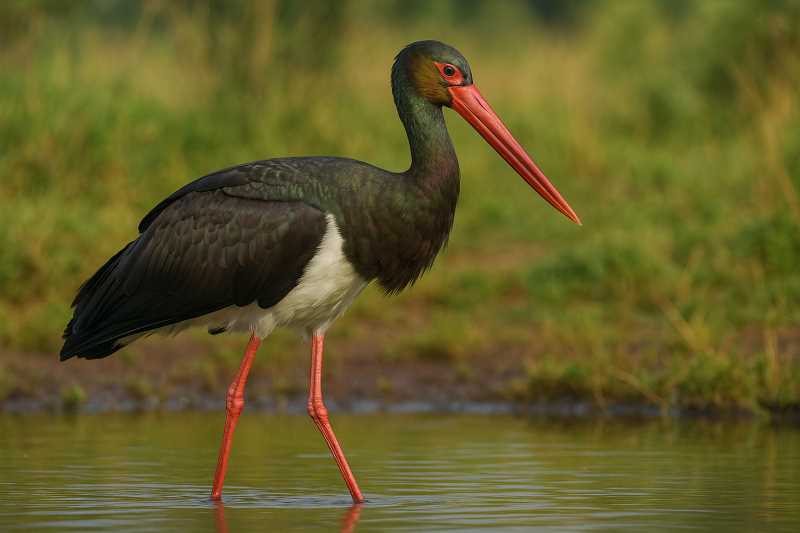
The Black Stork is a medium-sized bird measuring approximately 95–100 cm in length with a wingspan of 145–155 cm. Its plumage is predominantly black with a metallic sheen, which can appear iridescent in sunlight. The bird’s underparts are white, providing a stark contrast that aids in identification. Unlike its more gregarious relative, the White Stork (Ciconia ciconia), the Black Stork is solitary and secretive. Its long, red legs and beak add to its distinctive appearance, making it a striking sight for those fortunate enough to observe it.
Habitat and Distribution
Black Storks are distributed across Europe, Asia, and parts of Africa. They prefer secluded woodlands, wetlands, and river valleys, often nesting in tall trees or on cliffs. During the breeding season, they can be found in temperate regions of Europe and Asia, while African populations are primarily resident. The species is migratory, with European populations wintering in sub-Saharan Africa and Asian populations migrating to the Indian subcontinent.
The choice of habitat is critical for the Black Stork’s survival, as it relies on clean, unpolluted water sources for feeding. These birds are excellent fishers, using their long bills to catch fish, amphibians, and insects in shallow waters. The quality of their habitat directly impacts their food supply, making them highly sensitive to environmental changes.
Breeding and Behavior
Black Storks are monogamous, forming long-term pair bonds. They are known to return to the same nesting sites year after year, provided the sites remain undisturbed. The breeding season varies across their range but generally occurs between April and July. Nests are large and constructed from sticks, often lined with leaves and softer materials.
Both parents participate in incubating the eggs, which usually number between three to five. After hatching, the chicks are fed regurgitated food by both parents until they fledge, usually after about 10 weeks. The breeding success of Black Storks is influenced by several factors, including food availability and predation.
Black Storks are generally silent birds, but during the breeding season, they may engage in bill-clattering displays, a behavior shared with other stork species. Outside the breeding season, they are solitary and can be seen soaring gracefully in the sky, often covering great distances in search of suitable feeding grounds.
Conservation Status
The Black Stork is currently classified as a species of Least Concern by the International Union for Conservation of Nature (IUCN). However, certain populations are at risk due to habitat destruction, pollution, and disturbance from human activities. Deforestation and the drainage of wetlands pose significant threats to their breeding and foraging habitats.
In response to these challenges, conservation efforts have been implemented in various regions. Protected areas have been established to safeguard critical habitats, and international agreements aim to protect migratory routes. Monitoring programs and research initiatives are also crucial in understanding the species’ population dynamics and informing conservation strategies.
Cultural Significance
Throughout history, the Black Stork has been a symbol of mystery and wilderness in various cultures. In some traditions, it is considered a harbinger of good fortune, while in others, it is revered for its solitary and elusive nature.
In European folklore, the Black Stork is often associated with the untamed aspects of nature, embodying the spirit of unspoiled landscapes. Its presence is celebrated in art and literature, where it is depicted as a guardian of remote wilderness areas.
Conclusion
The Black Stork remains a fascinating subject for study and admiration. Its striking appearance, solitary behavior, and remarkable migratory journeys capture the imagination of all who encounter it. As conservation efforts continue, it is hoped that future generations will also have the opportunity to witness the beauty of the Black Stork in its natural habitat. Protecting this enigmatic bird requires a commitment to preserving the pristine environments it depends on, ensuring that the Black Stork can thrive for years to come.
This is one of the species covered in one of the books in our Kings Birds of the world series, Storks Of The World.

Related posts