Introduction
The Black Cuckoo, Cuculus clamosus, is a medium-sized African cuckoo recognised by its dark plumage, repetitive call and secretive habits. It is a brood parasite, laying its eggs mainly in the nests of bushshrikes and boubous. Southern African birds are generally intra-African migrants, while some populations farther north are resident.
Physical Description
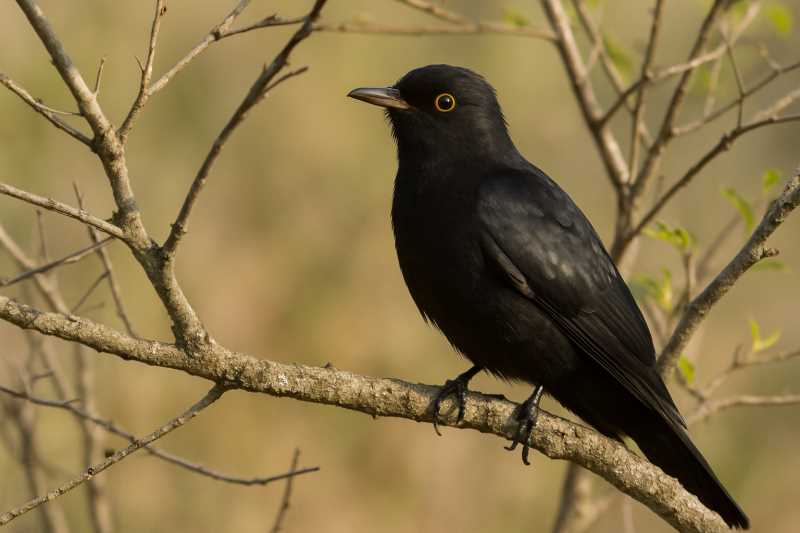
The Black Cuckoo is about 32–34 centimetres long. Adults are predominantly glossy black or deep slate-grey above, with a dark head and upper breast, paler or barred underparts and small white markings on the tail. The eye is typically reddish, although this feature can be difficult to see in poor light or at a distance.
The sexes are broadly similar and are not reliably separated in the field. Plumage can vary geographically, and younger birds are generally duller and more heavily barred than adults. The long tail, slightly downcurved bill and cuckoo-like shape are useful structural features, but the species is often detected by its voice before it is seen.
Range and Habitat
The Black Cuckoo occurs widely across sub-Saharan Africa, from parts of West Africa eastwards to Ethiopia and south through Central and eastern Africa to Angola, Namibia, Botswana, Zimbabwe, Mozambique and South Africa.
The central African form, Cuculus clamosus gabonensis, is regarded as largely resident. The southern African form, Cuculus clamosus clamosus, is a breeding migrant that usually arrives during the austral spring and summer. In southern Africa, calling and breeding activity are concentrated mainly between October and March, although timing varies with latitude, rainfall and habitat.
It favours wooded habitats rather than the interior of dense forest. Suitable environments include Acacia woodland, miombo, riparian thickets, valley bushveld, evergreen woodland, plantations and mature trees around settlements. It can occur from lowlands into higher country where suitable woodland is present.
Where to See This Species
Kruger National Park, Limpopo and Mpumalanga, South Africa
SANParks lists the Black Cuckoo on the park bird checklist and identifies it as a summer visitor. Dense bush and woodland around Pretoriuskop are noted as places where the species may be heard calling, particularly during the warmer months. Listen carefully from wooded camps and scan the upper canopy, where the bird can remain concealed.
Nearby accommodation: Kruger has several recognised rest camps, including Pretoriuskop, Skukuza and Pafuri, with campsites, self-catering units and lodge-style accommodation in and around the park.
iSimangaliso Wetland Park, KwaZulu-Natal, South Africa
The park’s bird checklist records the Black Cuckoo. Wooded sections, riverine vegetation, thickets and forest margins provide suitable habitat, although the species is generally easier to detect by its call than by direct observation. Summer is the most promising period in southern Africa.
Nearby accommodation: St Lucia is the principal gateway settlement, with guest houses, hotels, lodges, self-catering accommodation and campsites.
Kgalagadi Transfrontier Park, Northern Cape, South Africa and Botswana
BirdLife’s regional birding guide records the Black Cuckoo around Mata Mata and in the park’s summer bird community. The species is most likely in greener periods, especially around large trees and thornveld near water points and camps, rather than in the most open dune areas.
Nearby accommodation: Mata Mata, Twee Rivieren and Nossob are recognised accommodation areas within the park, offering campsites and park accommodation. Upington is the nearest major service town for the South African side.
Behaviour and Diet
The Black Cuckoo is usually solitary and unobtrusive. It often perches high in trees and may remain motionless for long periods, making it difficult to locate. Its loud, repetitive whistle is an important way of establishing a territory and attracting a mate, and is often the first indication that the species is present.
Its diet consists mainly of insects, especially caterpillars, but also includes beetles, grasshoppers, termites and winged ants. Eggs and nestlings of potential host species may occasionally be eaten. The species forages in foliage and woodland canopies, where its dark plumage can provide effective concealment.
The Black Cuckoo is an obligate brood parasite. Its principal hosts are bushshrikes and boubous in the genus Laniarius, including the Southern Boubou, Tropical Boubou and Crimson-breasted Shrike. The female lays an egg in a host nest, and the cuckoo chick may remove host eggs or young after hatching. The host adults then provide the food and care required by the growing cuckoo.
Identification Tips
- Look for a medium-sized, long-tailed cuckoo with mainly black or deep slate-grey plumage.
- Check for reddish eyes, a slightly downcurved bill and small white markings on the tail.
- The underparts may appear grey, barred or partly white, depending on the bird’s plumage and the viewing conditions.
- Listen for a loud, highly repetitive whistle, especially in woodland during the southern African summer.
- It is often confused with other dark Cuculus cuckoos, including the Red-chested Cuckoo and African Cuckoo. Habitat, season, call and the Black Cuckoo’s generally darker appearance are more reliable than a brief view alone.
- Do not rely on the colour of the underparts in isolation, as plumage can vary and poor light can make the bird appear almost entirely black.
Conservation Status
The Black Cuckoo is currently classified as Least Concern on the IUCN Red List. It has a large sub-Saharan African range and is locally common in suitable woodland, although a precise global population estimate is not available.
Habitat loss, woodland clearance and the degradation of riparian thickets may affect local populations. In some areas, plantations and trees around settlements have increased the amount of available habitat, but this does not remove the need to protect native woodland and the bushshrike species on which the cuckoo depends. Maintaining connected woodland, protecting breeding habitats and continuing regional bird monitoring are appropriate conservation measures.
Frequently Asked Questions
Where is the Black Cuckoo found?
The Black Cuckoo is found across much of sub-Saharan Africa, from West and Central Africa to Ethiopia and southwards through eastern and southern Africa.
Is the Black Cuckoo migratory?
Southern African populations are mainly intra-African breeding migrants. They arrive during the austral spring and summer and move northwards after the breeding season. Populations in parts of Central Africa are more resident.
What does the Black Cuckoo eat?
It mainly eats caterpillars and other insects, including beetles, grasshoppers, termites and winged ants. It may also take bird eggs or nestlings opportunistically.
Which birds host Black Cuckoo eggs?
The main hosts are bushshrikes and boubous of the genus Laniarius. Recorded hosts include the Southern Boubou, Tropical Boubou and Crimson-breasted Shrike.
How can the Black Cuckoo be identified?
Listen for its loud, repetitive whistle and search the upper canopy of woodland and thickets. A dark cuckoo with a long tail, reddish eye and small white tail markings is a strong candidate, but the call and habitat are important for confirmation.
Is the Black Cuckoo endangered?
No. The species is currently assessed as Least Concern, although local populations may be affected by woodland loss, habitat degradation and declines in suitable host habitat.
References
- IOC World Bird List
- IUCN Red List of Threatened Species
- The Atlas of Southern African Birds
Related posts