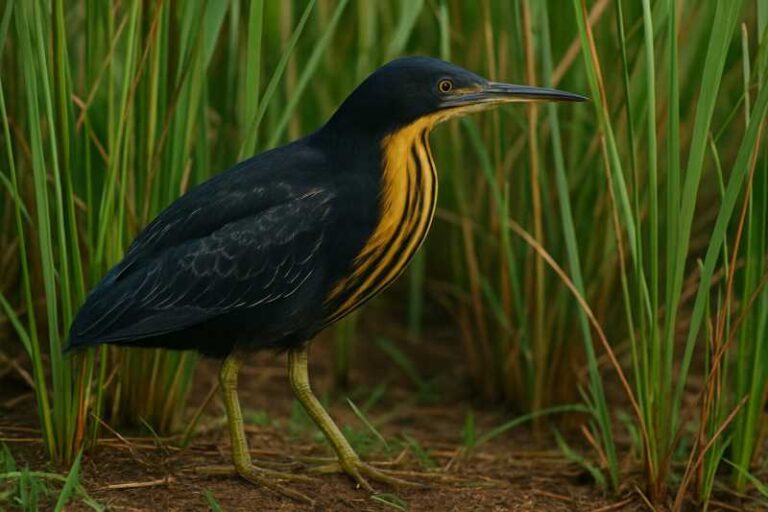
The American Three-toed Woodpecker (Picoides dorsalis) is a quiet, elusive resident of North America’s boreal forests and high mountain conifer woodlands. Often overlooked due to its remote habitat and unobtrusive behavior, this woodpecker plays a vital role in forest health by feeding on bark-boring insects and aiding in the natural cycle of decay and renewal. Unlike most woodpeckers, it sports only three toes—an adaptation that may enhance its agility as it clings to vertical trunks and peels bark from dead or dying trees.
Adapted to thrive in burned or insect-damaged forests, the American Three-toed Woodpecker serves as an indicator species of ecological change and forest regeneration.
Physical Characteristics
The American Three-toed Woodpecker is a medium-sized woodpecker, measuring about 20–23 cm (8–9 inches) in length with a wingspan of approximately 35–40 cm (14–16 inches). It has a boldly patterned black-and-white appearance. The back is mostly black with a prominent white patch running down the center, while the flanks and underparts are white with black barring.
Adult males have a distinctive yellow crown patch, setting them apart from the females, who have entirely black crowns. The face is patterned with white and black stripes, and the bill is short and chisel-like—ideal for stripping bark and extracting insects from beneath tree surfaces.
Unlike most woodpeckers, which have four toes (two forward, two back), the American Three-toed Woodpecker has only three: two forward-facing toes and one behind. This rare trait is shared with only a few other woodpecker species and may allow for more efficient climbing and maneuvering on tree trunks.
Range and Habitat
The American Three-toed Woodpecker is found across the boreal forests of Canada and Alaska, extending southward into the Rocky Mountains, northern Great Lakes region, and parts of the northeastern United States. It also inhabits higher elevation coniferous forests in the western mountains.
Its preferred habitat is mature or old-growth coniferous forest, particularly spruce and fir stands, often those affected by wildfire, beetle outbreaks, or wind damage. These disturbed environments provide an abundance of dying trees and bark-boring insect larvae—the woodpecker’s primary food source.
Because of its association with disturbed or regenerating forests, the species can often be found in recently burned areas, where it may become temporarily abundant as it exploits the surge in insect prey.
Behavior and Feeding
The American Three-toed Woodpecker is a methodical and focused forager. Rather than drumming loudly or making conspicuous flights, it tends to move quietly from tree to tree, scaling bark with its bill to expose insect galleries. This species specializes in feeding on larvae of bark beetles and wood-boring insects, which it accesses by flaking off bark—a behavior that leaves visible patches of exposed wood and is a good field clue to its presence.
Its feeding technique plays a critical ecological role by helping to control insect populations and facilitating the breakdown of dead wood, thus aiding nutrient cycling in forest ecosystems.
Although primarily insectivorous, it may also consume tree sap, spiders, ants, and occasionally berries.
Breeding and Lifecycle
Breeding typically begins in late spring. Pairs excavate nest cavities in dead or decaying conifer trees, usually between 1–6 meters (3–20 feet) above ground. These cavities are often reused in subsequent years or by other cavity-nesting species once abandoned.
The female lays 3–6 white eggs, which are incubated by both parents for about 12–14 days. Chicks hatch altricial (naked and helpless) and are fed by both parents. Fledging occurs approximately 3 weeks later.
Unlike some woodpecker species that defend large territories, American Three-toed Woodpeckers often maintain smaller, overlapping foraging areas and may tolerate some conspecifics nearby if food is abundant.
Conservation and Threats
The American Three-toed Woodpecker is currently listed as a species of Least Concern by the IUCN, thanks to its broad range and stable population. However, it is highly sensitive to changes in forest structure and composition. Logging, fire suppression, and habitat fragmentation reduce the availability of suitable dead and dying trees essential for foraging and nesting.
Conservation strategies for this species focus on preserving mature forest stands, allowing natural disturbance events to occur, and maintaining snags (standing dead trees) in managed forests. Because the woodpecker thrives in post-disturbance environments, it often serves as an indicator species for healthy forest succession.
A Silent Steward of Northern Forests
Though rarely seen by casual observers, the American Three-toed Woodpecker is a vital part of the boreal ecosystem. Its quiet diligence in foraging, its specialized niche in bark-foraging, and its dependence on naturally disturbed forests make it both ecologically important and fascinating to study.
For those who venture into the deep coniferous woods, the telltale signs of stripped bark or a fleeting glimpse of a yellow-crowned woodpecker may offer a rare and rewarding connection to one of North America’s most specialized avian residents.
Related posts