Introduction
The Dusky Grouse (Dendragapus obscurus) is a large, ground-dwelling forest grouse of western North America. It occurs mainly in montane forests and adjacent shrublands, meadows and subalpine habitats from Alaska and western Canada through the Rocky Mountains and other inland ranges of the western United States. Once grouped with the Sooty Grouse under the name Blue Grouse, it is now recognised as a separate species.
Physical Description
The Dusky Grouse is a heavyset, chicken-like bird measuring approximately 44–57 cm in length, with a wingspan of about 65–67 cm. Both sexes have short bills, strong legs, feathering that extends towards the middle toe, and a rounded or fan-shaped tail with a pale grey terminal band. The species may weigh roughly 1.16–1.28 kg, although mass varies with sex, age and season.
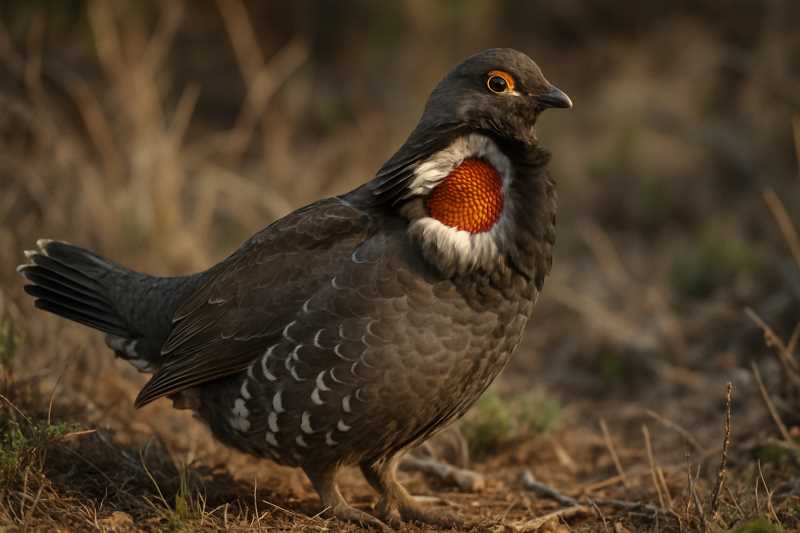
Males are generally slate-grey or blue-grey, with darker tails, pale markings on the flanks and white feathers surrounding the neck sacs. During courtship, the neck sacs appear purplish-red and the yellow eye combs enlarge and may become reddish. Females are smaller-looking and more cryptically coloured, with brownish-grey, barred and mottled plumage that provides concealment while nesting and raising young.
Young birds are downy and mobile soon after hatching. They resemble females more closely than adult males and become fully grown by autumn. Four recognised subspecies show geographical variation, particularly in the markings of the tail, scapulars and wing coverts.
Range and Habitat
The Dusky Grouse is a resident species with regular seasonal movements rather than long-distance migration. Its range extends from southeastern Alaska and the Northwest Territories south through western Canada and the mountainous western United States, including the Rocky Mountains, Great Basin and associated ranges reaching parts of California, Arizona, Colorado and New Mexico.
Breeding birds use montane forests dominated by firs, Douglas-fir, ponderosa pine, lodgepole pine, quaking aspen and other conifers. During spring and summer, they also forage in adjacent grasslands, sagebrush and bitterbrush shrublands, creek bottoms, subalpine meadows and alpine habitats near the treeline. Females with broods often select more open areas that provide abundant insects, seeds and low-growing vegetation.
Seasonal movements are commonly altitudinal. In many areas, birds move between relatively open breeding habitats and denser coniferous forests used during winter. Wintering birds may feed and roost in stands of Douglas-fir, white fir, lodgepole pine, Engelmann spruce, western hemlock and mountain hemlock. The direction and distance of movement vary geographically, and some individuals remain at high elevations throughout the year.
Behaviour and Diet
Dusky Grouse spend much of the day feeding or resting. They forage on the ground for leaves, flowers, berries, seeds and invertebrates, but also climb into trees to feed on buds, shoots, leaves and conifer needles. Plants form most of the diet. Grasshoppers, beetles, ants and other insects are particularly important during summer, especially for growing chicks. In winter, the diet may consist largely of conifer needles and buds.
Feeding is usually most active early in the morning and again near dusk. Birds commonly occur alone outside the breeding season, although females remain with dependent young through summer and early autumn. Young birds become independent during their first winter.
Breeding begins in early spring, often while snow is still present. Males defend widely spaced display territories and advertise with low hoots, wing claps, short fluttering flights, strutting, tail fanning, head movements and exposure of the purplish-red neck sacs. This display is sometimes described as lek-like, but Dusky Grouse males generally defend individual territories rather than gathering in a centralised lek.
Females build a shallow, lined scrape on the ground, usually beneath a shrub, log, rock or other cover. A clutch may contain one to 12 eggs, with six to nine being typical in many accounts. Incubation lasts approximately 25–28 days and is performed by the female. The chicks are downy and able to follow her within one or two days of hatching. Males do not assist with nest building, incubation or brood-rearing.
Identification Tips
- Look for a large, compact grouse with a small head, short bill, strong legs and a dark, medium-length tail.
- Adult males are blue-grey or slate-grey overall, while females are more brown, barred and mottled.
- The pale grey tail band is often conspicuous, especially on males, although its prominence varies geographically.
- A displaying male may reveal reddish-purple neck sacs, a bright yellow or reddish eye comb, a fanned tail and a distinctive low hooting call.
- Dusky Grouse are often detected by movement on the ground or by a sudden, powerful flush from forest cover.
- The Sooty Grouse is the most relevant comparison. It is associated more strongly with wet Pacific coastal forests and differs in plumage, display, vocalisations and genetics. Spruce Grouse are generally smaller and show different plumage patterns.
Conservation Status
The Dusky Grouse is listed as Least Concern on the IUCN Red List. North American Breeding Bird Survey estimates cited by the Cornell Lab of Ornithology indicate that populations have been broadly stable since 1966, although trends may vary between regions and local populations.
Potential pressures include logging, habitat fragmentation, grazing, hunting and changes to the structure of montane forests and adjoining shrublands. In some areas, isolated mountain populations may be particularly sensitive to habitat loss or degradation. Important conservation measures include maintaining connected montane forest, aspen and shrubland mosaics, protecting breeding and wintering habitat, managing forests to retain suitable cover and openings, and continuing population monitoring.
Frequently Asked Questions
Where does the Dusky Grouse live?
It lives in mountainous parts of western North America, from southeastern Alaska and western Canada through the Rocky Mountains and other inland ranges of the western United States.
What does the Dusky Grouse eat?
It eats mainly plant material, including leaves, buds, shoots, berries and conifer needles. In summer, grasshoppers, beetles, ants and other insects are important, particularly for young birds.
Do Dusky Grouse migrate?
They do not undertake long-distance migration, but many make seasonal movements between breeding habitats and wintering forests. These movements are often altitudinal and may involve moving uphill or downhill depending on local conditions.
How can a Dusky Grouse be identified?
Look for a large, compact grouse with a small head and dark tail. Males are blue-grey with a pale tail band and reddish-purple neck sacs during display, while females are brownish-grey and heavily mottled.
Where does the Dusky Grouse nest?
The female makes a shallow, lined nest scrape on the ground, usually beneath a shrub, log, rock or thick vegetation. Nests may occur from shrubsteppe habitats to high-elevation krummholz near the treeline.
Is the Dusky Grouse endangered?
No. The species is currently assessed as Least Concern globally, although local populations can be affected by habitat loss, forest management, grazing, hunting and other pressures.
References
- BirdLife International. 2021. Dusky Grouse Dendragapus obscurus Species Factsheet. BirdLife DataZone. Available at: https://datazone.birdlife.org/species/factsheet/dusky-grouse-dendragapus-obscurus (accessed 8 September 2026).
- Cornell Lab of Ornithology. 2026. Dusky Grouse: Overview. All About Birds. Available at: https://www.allaboutbirds.org/guide/Dusky_Grouse/overview (accessed 8 September 2026).
- Cornell Lab of Ornithology. 2026. Dusky Grouse: Identification. All About Birds. Available at: https://www.allaboutbirds.org/guide/Dusky_Grouse/id (accessed 8 September 2026).
- Cornell Lab of Ornithology. 2026. Dusky Grouse: Life History. All About Birds. Available at: https://www.allaboutbirds.org/guide/Dusky_Grouse/lifehistory (accessed 8 September 2026).
- Colorado Parks and Wildlife. n.d. Dusky Grouse. Colorado Parks and Wildlife. Available at: https://cpw.state.co.us/species/dusky-grouse (accessed 8 September 2026).
- Environment and Climate Change Canada and Birds Canada. 2024. The State of Canada’s Birds: Dusky Grouse. NatureCounts. https://doi.org/10.71842/q4cp-f076.
- Gill, F., D. Donsker and P. Rasmussen, eds. 2026. IOC World Bird List, version 15.2. International Ornithologists’ Union. Available at: https://www.worldbirdnames.org/ (accessed 8 September 2026).
- Landry, D. 2026. “Dusky grouse seasonal resource selection in the Great Basin isolated mountain ranges of Nevada, USA.” Wildlife Biology. Available at: https://nsojournals.onlinelibrary.wiley.com/doi/full/10.1002/wlb3.01462 (accessed 8 September 2026).
- Dettenmaier, S. J., et al. 2017. “Effects of livestock grazing on rangeland biodiversity: A meta-analysis of grouse populations.” Ecology and Evolution 7: 7683–7692. https://doi.org/10.1002/ece3.3287.
Related posts