Introduction
The Lazuline Sabrewing (Campylopterus falcatus) is a large hummingbird of the northern Andes. It occurs in Colombia, Ecuador and Venezuela, where it inhabits montane forest, forest edges, plantations, gardens and the lower margins of páramo. Its rich blue plumage, contrasting maroon tail and powerful flight make it one of the more distinctive sabrewings in its range.
Physical Description
The Lazuline Sabrewing is a medium-sized to large hummingbird, measuring approximately 11.5 to 13 cm in length and weighing about 6.4 to 8 g. It has a robust body, broad wings and a noticeably downcurved bill.
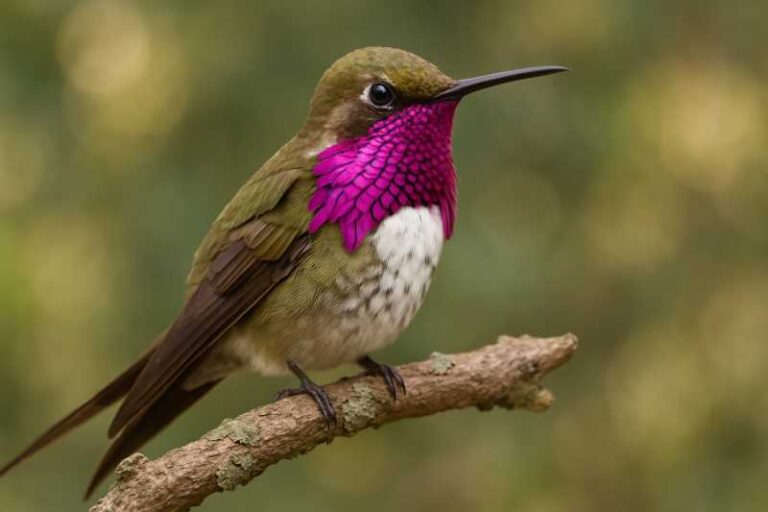
Adult males have vivid blue underparts, often appearing more violet or greenish blue in different light, with green upperparts, dark wings and a maroon or wine-coloured tail. Females are less brightly coloured, with greyer underparts, a pale or greyish moustachial stripe and the same distinctive maroon tail pattern. Immature birds are duller than adults and may show less clearly defined colour on the head and underparts.
The sabrewing name refers to the broad, powerful wings that produce a characteristic buzzing sound in flight. As with other hummingbirds, the wings allow hovering and rapid changes of direction while feeding.
Range and Habitat
The Lazuline Sabrewing has a discontinuous distribution across the northern Andes. It occurs in the mountains of northern and western Venezuela, the Sierra de Perijá along the Colombia-Venezuela border, the Sierra Nevada de Santa Marta and the eastern Andes of Colombia, extending southwards into northern Ecuador, including Napo Province.
It is mainly associated with humid or semi-deciduous montane forest, woodland edges, flowering gardens, plantation margins, secondary growth and the lower reaches of páramo. It is generally recorded between about 900 and 3,000 metres, although the exact elevational range varies between regions. Records from lower elevations have also been reported in Colombia.
The species is considered largely sedentary, although local movements may occur in response to flowering conditions and food availability. It is not currently regarded as a long-distance migrant.
Where to See This Species
El Dorado Nature Reserve, Magdalena, Colombia
The ProAves El Dorado Nature Reserve in the Sierra Nevada de Santa Marta is a well-documented site for the Lazuline Sabrewing. The species has been recorded around the reserve’s feeders and forest edges, where flowering plants provide suitable feeding habitat. It occurs alongside the range-restricted Santa Marta Sabrewing, so careful attention to tail colour is important when identifying birds in this area.
Nearby accommodation: The reserve itself provides lodge-style accommodation, while Minca and the surrounding Sierra Nevada foothills offer guest houses, ecolodges and other small-scale accommodation.
San Isidro Lodge and Reserve, Napo, Ecuador
San Isidro Lodge and Reserve in the eastern Andes of Ecuador has documented Lazuline Sabrewings visiting feeders and flowers around the lodge. The reserve’s montane forest and gardens provide suitable habitat, and the species may be encountered while watching hummingbirds around flowering plants or forest clearings.
Nearby accommodation: San Isidro provides lodge accommodation, with additional guest houses and small lodges available in the nearby town of Cosanga and the wider Quijos Valley.
Henri Pittier National Park, Aragua and Carabobo, Venezuela
Lazuline Sabrewings have been recorded in the montane forests of Henri Pittier National Park, including the Portachuelo Pass area. The park’s humid forest, flowering plants and elevational variation make it a realistic location for searching, although the species is not necessarily seen on every visit.
Nearby accommodation: Maracay and the coastal gateway towns near the park offer hotels, guest houses and other visitor accommodation. Access arrangements and local conditions should be checked before travelling.
Behaviour and Diet
The Lazuline Sabrewing is active during the day and usually forages alone. It often follows a regular route between flowering plants, a behaviour known as trap-lining. Individuals may also defend productive flowers or small feeding areas against other hummingbirds and intruders.
Nectar forms the main part of its diet. The bird commonly feeds in the forest understory and middle levels, visiting a variety of flowering plants. It also takes small insects and spiders, either by catching them in the air or gleaning them from leaves and other vegetation. This animal prey provides important protein, particularly during periods when nectar is less abundant.
Breeding information is limited. Available records suggest that breeding may occur at different times in different parts of the range, including during June in the Sierra de Perijá and around October in northern Venezuela. As in other hummingbirds, the female is expected to build the nest, incubate the eggs and feed the young, but detailed information on nest structure, clutch size and parental care remains scarce.
By transferring pollen between flowers, the species contributes to the reproduction of montane plants. Its visits to gardens and plantations may also bring it into contact with flowering plants in modified landscapes.
Identification Tips
- Look for a relatively large, powerful hummingbird with a robust, downcurved bill.
- Adult males are recognised by their bright blue to violet-blue underparts, green upperparts and contrasting maroon tail.
- Females are duller and greyer below, often with a pale moustachial stripe, but retain the maroon tail.
- The maroon tail is a particularly useful feature when distinguishing this species from other large hummingbirds.
- In the Sierra Nevada de Santa Marta, take care not to confuse it with the Santa Marta Sabrewing. Tail colour and overall plumage pattern are important, as the Lazuline Sabrewing is generally more widespread in the area.
- It may visit hummingbird feeders, but it also occurs along forest trails, flowering edges, gardens and plantations.
Conservation Status
The Lazuline Sabrewing is classified as Least Concern on the IUCN Red List. Its global population size and precise trend are not well quantified, and the species can be uncommon or patchily distributed in parts of the northern Andes.
Deforestation, agricultural expansion and the conversion of montane forest remain potential local threats. The species appears able to use some disturbed habitats, including plantations, forest edges and gardens, but it still depends on the continued availability of flowering vegetation and suitable woodland. Protected areas, habitat restoration and the conservation of connected montane forest are important measures for maintaining its range.
Frequently Asked Questions
Where is the Lazuline Sabrewing found?
The species occurs in Colombia, Ecuador and Venezuela. Its range includes the Sierra Nevada de Santa Marta, the eastern Andes of Colombia, northern Ecuador and several mountain systems in Venezuela.
What does the Lazuline Sabrewing look like?
The male has bright blue or violet-blue underparts, green upperparts and a maroon tail. The female is greyer below and has a pale moustachial stripe, but also shows the characteristic maroon tail.
What does the Lazuline Sabrewing eat?
It mainly feeds on nectar from flowering plants. It also catches small insects and spiders in flight or gleans them from vegetation.
Is the Lazuline Sabrewing migratory?
It is generally considered sedentary. Local movements may occur when birds follow changes in flowering and food availability, but it is not known for long-distance migration.
Where can I see a Lazuline Sabrewing?
Documented wildlife-viewing locations include El Dorado Nature Reserve in Colombia, San Isidro Lodge and Reserve in Ecuador, and Henri Pittier National Park in Venezuela. It may be seen at flowers, forest edges and hummingbird feeders.
Is the Lazuline Sabrewing endangered?
No. The species is currently classified as Least Concern, although habitat loss and degradation remain concerns in parts of its Andean range and its population trend is not well known.
References
- BirdLife International
- Cornell Lab of Ornithology
- IUCN Red List of Threatened Species
Related posts