Introduction
The Emerald-bellied Puffleg (Eriocnemis aline) is a small hummingbird of the humid Andes. It occurs in Colombia, Ecuador and Peru, where it inhabits mossy montane and cloud forests on the eastern and central Andean slopes. The species is also known in older literature as Eriocnemis alinae.
Physical Description
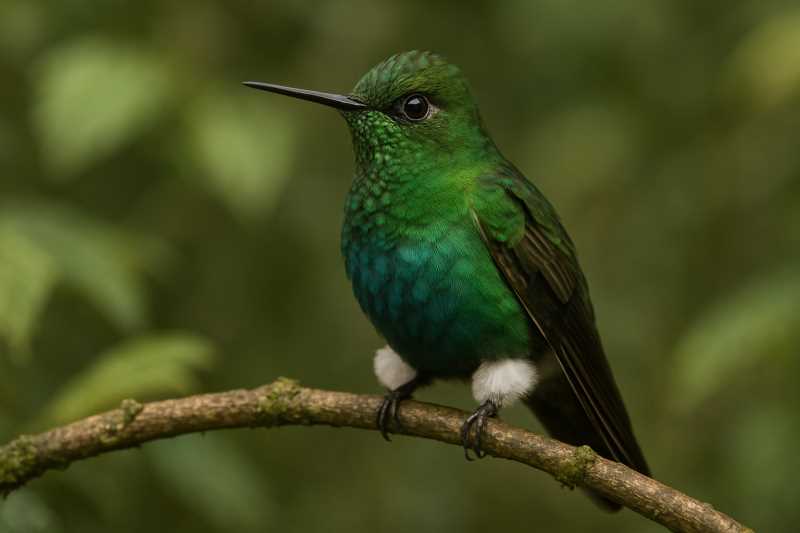
The Emerald-bellied Puffleg is approximately 9 cm long and has a short, slightly forked green tail. Its upperparts are dark, bright green, while the rump, forehead and underparts show stronger emerald iridescence. A conspicuous white patch is present on the centre of the breast, often mottled with green.
Both sexes have prominent, fluffy white leg puffs, a characteristic feature of pufflegs. The male usually has a more strongly iridescent forehead, while the female is generally duller and lacks this bright frontal sheen. The bill is straight, slender and black.
Range and Habitat
The species is distributed through the central and eastern Andes of Colombia, the eastern slope of Ecuador and the northern and central eastern Andes of Peru. Two subspecies are generally recognised: the nominate E. a. aline, found from Colombia into Ecuador, and E. a. dybowskii, found in Peru.
It is associated mainly with humid montane forest, cloud forest, mossy forest, oak forest and mountain ridges. It is usually recorded between approximately 1,600 and 2,600 metres above sea level, although local records may vary. The Emerald-bellied Puffleg is resident rather than a long-distance migrant, but individuals may move locally in response to flowering conditions.
Where to See This Species
Abra Patricia, Amazonas, Peru
Abra Patricia is a recognised montane-forest birding site on the eastern Andean slope, and the Emerald-bellied Puffleg has been documented there, including around the Owlet Lodge area. Look in humid cloud forest, forest edges and flowering areas at roughly 2,000 to 2,400 metres. The species can be unobtrusive, so patient observation around flowering plants and feeding stations is useful.
Nearby accommodation: Owlet Lodge provides accommodation within the Abra Patricia conservation area. Additional guest houses and small hotels are available in nearby gateway settlements such as Pomacochas.
Behaviour and Diet
The Emerald-bellied Puffleg is usually solitary and is most often found in the lower and middle layers of humid forest. It may defend productive feeding territories, although it is less frequently seen at open forest edges than some related pufflegs.
Its diet consists primarily of nectar from a variety of montane flowers, including plants associated with the heath family, bromeliads, rubiaceous plants and campanulaceous plants. It also captures small insects, sometimes by making short sallies from a perch. These insects provide important protein, particularly during periods when nectar is less abundant.
Detailed information about nesting and breeding remains limited. As with other hummingbirds, the species is expected to rely on plant resources and sheltered vegetation for successful breeding, but specific nesting data should not be assumed without local evidence.
Identification Tips
- Look for a small, predominantly green hummingbird with a bright emerald belly and rump.
- The large white breast patch is an important feature, especially when seen against the iridescent green underparts.
- The conspicuous white leg puffs are visible on perched birds and help separate it from many other hummingbirds.
- The tail is green, short and slightly forked.
- Females are less brightly coloured on the forehead than males.
- The Sapphire-vented Puffleg can appear similar, but the Emerald-bellied Puffleg has a green, strongly iridescent belly and undertail area, together with an irregular white breast patch and green tail.
Conservation Status
The Emerald-bellied Puffleg is currently assessed as Least Concern. This global category indicates that it is not presently considered at a high risk of extinction, but it does not mean that local populations are secure.
The species depends on humid montane forest, which remains vulnerable to agricultural expansion, logging, mining-related disturbance and habitat fragmentation in parts of the Andes. Conservation of cloud-forest remnants, protection of forest corridors and maintenance of flowering plants are important measures for supporting the species and the wider hummingbird community. No reliable global population estimate is provided here.
Frequently Asked Questions
Where is the Emerald-bellied Puffleg found?
It occurs in the Andes of Colombia, Ecuador and Peru, mainly on humid montane forest slopes between about 1,600 and 2,600 metres.
What does the Emerald-bellied Puffleg look like?
It is a small green hummingbird with an iridescent emerald belly, a white central breast patch, green tail and conspicuous white leg puffs.
How can males and females be distinguished?
Males usually show a brighter iridescent forehead. Females are generally duller and lack the same strong frontal sheen, although both sexes have white leg puffs and similar body patterning.
What does the Emerald-bellied Puffleg eat?
It feeds mainly on nectar from montane flowers and also captures small insects for additional protein.
Is the Emerald-bellied Puffleg migratory?
It is considered a resident Andean species rather than a long-distance migrant. Local movements may occur when birds follow changing food supplies.
Where is a practical place to see this species?
Abra Patricia in Amazonas, Peru, is a documented site with humid cloud forest, flowering plants and established birding accommodation around Owlet Lodge.
References
- BirdLife International
- AviList: The Global Avian Checklist
- PeruAves
Related posts