Introduction
Salvadori’s Pheasant, Lophura inornata, is a little-known pheasant endemic to the mountain forests of Sumatra, Indonesia. It belongs to the family Phasianidae and is currently treated as a single species, with Hoogerwerf’s Pheasant recognised by the IOC as the subspecies Lophura inornata hoogerwerfi. The species was described by the Italian ornithologist Tommaso Salvadori in 1879. Its specific name, inornata, means “unadorned” or “plain”, referring to the male’s relatively subdued plumage compared with many other pheasants. (ww.worldbirdnames.org)
Physical Description
Salvadori’s Pheasant is a medium-sized pheasant measuring approximately 46–55 cm in length. It has a short, rounded tail and lacks the prominent crest found in several related pheasants.
The sexes are strongly dimorphic:
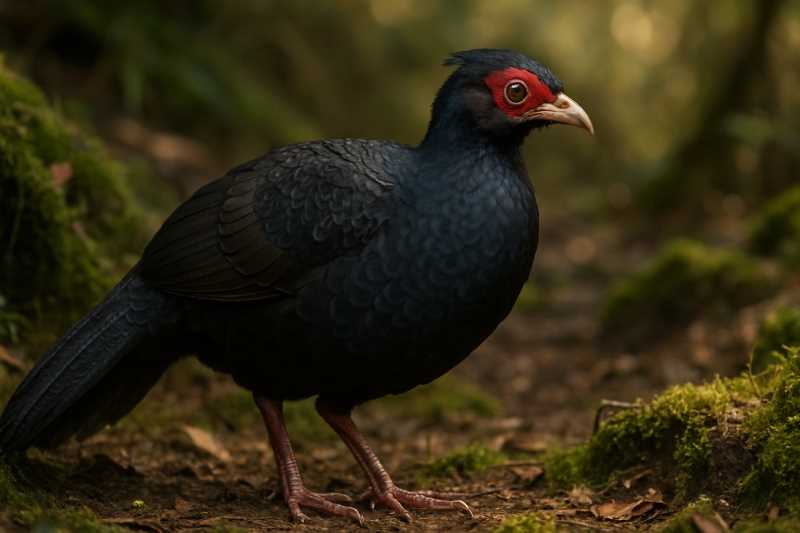
- Male: Predominantly dark bluish-black or blue-black, with subtle bluish edging to some feathers. The facial skin is bright red, the bill is pale, and the legs are greyish-blue. Males have a strong spur on the leg.
- Female: Smaller and more cryptically coloured, with warm reddish-brown plumage, fine dark markings and paler shaft streaks that create a mottled appearance. The tail is darker brown and the legs are less brightly coloured. Females lack the male’s spur.
- Juveniles: Young birds resemble females but generally show paler buff edges to the feathers, producing a more obviously scaled pattern.
The male can be confused with the female of the Crestless Fireback, Lophura erythrophthalma. Salvadori’s Pheasant is generally longer and has a paler bill, while the Crestless Fireback is more robust and typically holds its tail more upright. (picturebirdai.com)
Range and Habitat
Salvadori’s Pheasant is endemic to Sumatra and is associated with humid montane and submontane forest, including dense forest with suitable cover on the forest floor. It is a resident species rather than a regular migrant.
Published summaries place it broadly between about 650 and 2,200 metres above sea level, although the precise elevational range varies between localities and subspecies. The nominate subspecies, L. i. inornata, occurs mainly in the central and southern Barisan Mountains. Hoogerwerf’s Pheasant, L. i. hoogerwerfi, is restricted to northern Sumatra, particularly the Aceh region, and is much less frequently recorded. (picturebirdai.com)
Behaviour and Diet
This pheasant is predominantly terrestrial and usually forages quietly on the forest floor, often alone or in pairs. It is shy and difficult to observe, retreating into dense vegetation when disturbed. Its short tail and subdued colouring are well suited to movement through thick montane forest.
The diet is considered omnivorous and includes seeds, fallen fruit and invertebrates collected from leaf litter and the soil surface. Detailed studies of its feeding ecology remain limited.
Vocal and display behaviour is also poorly documented. Males are reported to give deep contact calls and to produce audible wing-whirring displays during courtship. Available accounts suggest that the species may form monogamous pairs. The female is believed to incubate the eggs, and the chicks are precocial, leaving the nest relatively soon after hatching. Clutch-size information is limited, so broad figures should be treated cautiously. (ebird.org)
Identification Tips
When identifying Salvadori’s Pheasant in the field, look for the following combination of features:
- A chunky, forest-dwelling pheasant with a short, rounded tail.
- A male that appears almost black at a distance but shows dark blue or blue-black iridescence at closer range.
- Bright red bare facial skin in both sexes.
- A pale bill and greyish-blue legs.
- A female with warm reddish-brown, finely mottled plumage.
- Quiet, secretive behaviour in humid montane forest.
The most useful comparison is with the female Crestless Fireback. The male Salvadori’s Pheasant resembles that species’ female, but is usually longer, has a paler bill and tends to hold its tail down. Salvadori’s Pheasant also occupies higher elevations in Sumatra than the Crestless Fireback in areas where their ranges approach one another. (picturebirdai.com)
Conservation Status
Salvadori’s Pheasant is assessed as Near Threatened on the IUCN Red List. Its restricted range and dependence on forest make it vulnerable to continued habitat loss and degradation. Major threats include deforestation for agriculture, logging, forest fragmentation and hunting. The species’ secretive behaviour and limited field data also make population monitoring difficult. (datazone.birdlife.org)
Conservation priorities include protecting remaining montane and submontane forest, maintaining habitat connections across the Barisan Mountains, reducing hunting pressure and improving surveys of poorly known populations, particularly in northern Sumatra. Protected areas are important, but their effectiveness depends on continued control of forest clearance and illegal hunting. Responsible ecotourism may provide local benefits where it supports protected-area management, but visits should be carefully managed to avoid disturbing birds and their habitat.
Frequently Asked Questions
Where does Salvadori’s Pheasant live?
It is endemic to Sumatra, Indonesia, where it inhabits humid montane and submontane forests, mainly in the Barisan Mountains.
What does the male Salvadori’s Pheasant look like?
The male is predominantly dark bluish-black, with bright red facial skin, a pale bill, greyish-blue legs and a short, rounded tail. It lacks a prominent crest.
What does the female Salvadori’s Pheasant look like?
The female is smaller and reddish-brown, with fine dark markings and pale shaft streaks that provide camouflage in forest undergrowth.
Is Salvadori’s Pheasant migratory?
No. It is regarded as a resident species of Sumatra and is not known for regular long-distance migration.
What does Salvadori’s Pheasant eat?
It forages on the forest floor for a mixture of seeds, fallen fruit and invertebrates. The species’ detailed diet has not been studied extensively.
Why is Salvadori’s Pheasant threatened?
Its main threats are the loss and fragmentation of montane forest, logging, agricultural expansion and hunting. Its restricted island range increases its vulnerability to these pressures.
References
- BirdLife International. n.d. “Salvadori’s Pheasant Lophura inornata Species Factsheet.” BirdLife DataZone. Accessed 8 September 2026. https://datazone.birdlife.org/species/factsheet/salvadoris-pheasant-lophura-inornata
- Gill, F., Donsker, D. & Rasmussen, P., eds. 2026. IOC World Bird List, version 15.2. International Ornithologists’ Union. Accessed 8 September 2026. https://www.worldbirdnames.org/
- del Hoyo, J. & Collar, N. J. 2014. HBW and BirdLife International Illustrated Checklist of the Birds of the World, Volume 1: Non-passerines. Lynx Edicions, Barcelona.
- Sözer, R., Shepherd, C. R. & Daijono, M. J. 2006. “First description of male Hoogerwerf’s Pheasant Lophura (inornata) hoogerwerfi (Chasen, 1939), with notes on distribution.” Bulletin of the British Ornithologists’ Club 126: 207–211. https://www.biodiversitylibrary.org/part/76518
- Cornell Lab of Ornithology. n.d. “Salvadori’s Pheasant Lophura inornata.” eBird. Accessed 8 September 2026. https://ebird.org/species/salphe1
- International Union for Conservation of Nature. n.d. The IUCN Red List of Threatened Species. Species assessment information for Lophura inornata. Accessed 8 September 2026. https://www.iucnredlist.org/
Related posts