Introduction
The Bahama Woodstar (Nesophlox evelynae) is a small hummingbird endemic to the Lucayan Archipelago, including The Bahamas and the Turks and Caicos Islands. It is a resident species of gardens, scrub, woodland edges and other habitats where flowering plants provide nectar. The species was formerly placed in Calliphlox, but current taxonomies place it in the genus Nesophlox.
Physical Description
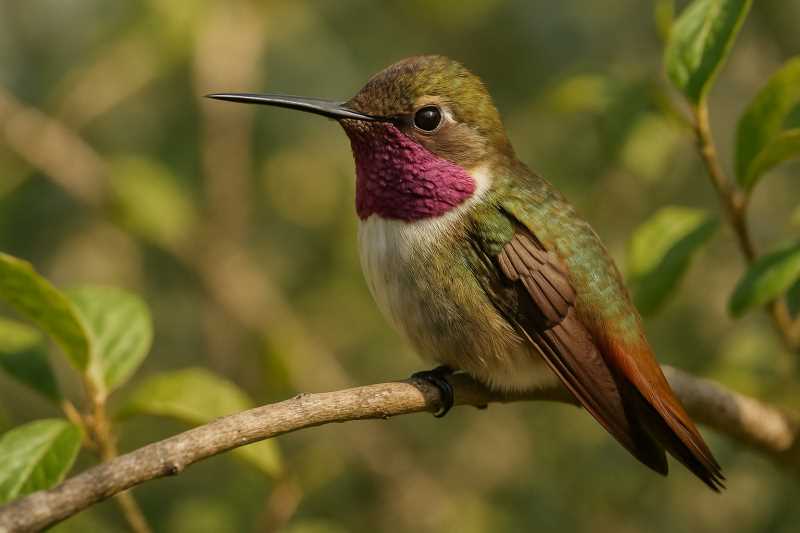
The Bahama Woodstar is a tiny, fast-flying hummingbird with green upperparts, a pale underside and a slender, slightly curved bill. Adult males are distinguished by a glittering purple throat patch, or gorget, which can appear violet, magenta or dark depending on the light and the bird’s angle.
Females lack the bright purple gorget and are generally more subdued, with greyish underparts and greenish-brown upperparts. Females have a rounded tail, whereas males have a more noticeably forked tail. Immature birds resemble females and develop adult male plumage gradually as they mature.
As with other hummingbirds, the wings beat rapidly enough to support sustained hovering. The bird’s small size, direct flight and audible wing hum are useful clues when it is feeding among flowers.
Range and Habitat
The Bahama Woodstar is endemic to the Lucayan Archipelago. It occurs across much of The Bahamas and the Turks and Caicos Islands, but it is absent from Great Inagua and Little Inagua, where the closely related Inagua Woodstar (Nesophlox lyrura) occurs instead. The Bahama Woodstar is non-migratory, although individuals may occasionally wander beyond their normal range.
It uses a broad range of lowland habitats, including dry and moist woodland, Caribbean pine forest, coppice, scrub, forest edges, clearings, gardens and urban green spaces. Flower-rich gardens can be particularly productive, while woodland and shrubland provide nesting cover and insect prey. Important island populations occur on New Providence, Andros, Abaco, Eleuthera, Grand Bahama and other islands and cays within its range.
Where to See This Species
Abaco National Park, Abaco, The Bahamas
Abaco National Park protects extensive Caribbean pine and coppice forest, habitat in which the Bahama Woodstar is documented. Look around flowering plants, forest edges and clearings, especially where native vegetation is well developed.
Nearby accommodation: Marsh Harbour and settlements such as Cherokee Point provide the main practical base, with hotels, guest houses, lodges and self-catering accommodation available on Abaco.
Blue Holes National Park, Andros, The Bahamas
Bird lists for the park and the surrounding Central Andros birding area include the Bahama Woodstar. Pine woodland, coppice, thickets, wetlands and flowering plants create suitable feeding habitat, and the species may be encountered along accessible trails and roadsides.
Nearby accommodation: Andros Town and Fresh Creek are the most practical gateway settlements, with small hotels, guest houses, lodges and self-catering accommodation.
Leon Levy Native Plant Preserve, Eleuthera, The Bahamas
This publicly accessible national park and botanical preserve is a particularly realistic place to look. The preserve records the Bahama Woodstar as a common resident land bird, and flowering gardens and hummingbird feeders near the welcome centre can provide close views.
Nearby accommodation: Governor’s Harbour is the nearest recognised accommodation area, with guest houses, small hotels, villas and self-catering accommodation.
Behaviour and Diet
The Bahama Woodstar is active and agile, often hovering in front of flowers while probing for nectar. It also takes small insects and spiders, which provide protein and other nutrients, particularly during nesting and chick-rearing.
It is generally territorial rather than sociable. Several birds may gather where flowers are abundant, but individuals commonly chase intruders away from favoured feeding areas. Males use aerial displays, chases, rapid movements and vocalisations during courtship and territorial interactions.
Breeding can occur throughout the year, with activity concentrated in spring in some parts of the range. The female builds a small open cup nest from soft plant material and spider silk, often decorating the exterior with bark or other fibres. Nests may be placed on a branch a short distance above the ground. The female alone incubates the eggs and raises the young. Two white eggs are normally laid, although incubation and nesting periods may vary with local conditions.
Identification Tips
- Look for a very small hummingbird with green upperparts, a pale underside and a slender bill.
- Adult males show a brilliant purple throat patch, which may look violet, magenta or almost black in shadow.
- Females and immature birds lack the purple gorget and appear plainer and greyish below.
- The male’s tail is more forked, while the female’s tail is rounded.
- Watch flowering shrubs, gardens, pine woodland edges, coppice and clearings rather than only dense forest.
- Do not confuse birds on Great Inagua or Little Inagua with the Bahama Woodstar. Those islands support the distinct Inagua Woodstar, whose males have different tail and forehead features.
Conservation Status
The Bahama Woodstar is listed as Least Concern on the IUCN Red List, with a stable population trend in the most recent global assessment. No reliable global population estimate is available.
The principal concerns are habitat alteration and loss caused by development, agriculture and other land-use changes. Hurricanes and other severe weather events can temporarily reduce shelter and flowering food plants, while long-term climate and sea-level changes may increase pressure on low-lying island habitats. The species benefits from protected areas, native vegetation in gardens and legal protection under Bahamian wildlife legislation.
Frequently Asked Questions
Where is the Bahama Woodstar found?
It is found across much of The Bahamas and the Turks and Caicos Islands. It is absent from Great Inagua and Little Inagua, which support the Inagua Woodstar.
Is the Bahama Woodstar migratory?
No. It is considered a resident species, although occasional wandering beyond its usual range has been recorded.
What does the Bahama Woodstar eat?
It feeds mainly on flower nectar, supplemented by small insects and spiders. Insects are especially important when adults are feeding growing young.
How can you identify a male Bahama Woodstar?
The adult male has a bright, iridescent purple throat patch, green upperparts and a more forked tail. The throat colour can change noticeably with the light.
Where is the best place to see a Bahama Woodstar?
Public sites with documented records include Abaco National Park, Blue Holes National Park on Andros and the Leon Levy Native Plant Preserve on Eleuthera. Flowering gardens and forest edges are often productive.
Is the Bahama Woodstar endangered?
It is currently assessed as Least Concern. Nevertheless, habitat loss, severe storms and changes to island vegetation remain conservation concerns.
References
- IUCN Red List of Threatened Species
- IOC World Bird List
- Bahamas National Trust
Related posts