Introduction
The Rufous-shafted Woodstar (Chaetocercus jourdanii) is a very small hummingbird in the family Trochilidae. It occurs mainly in northern Venezuela and northern Colombia, with additional records from Trinidad. Its distinctive rufous tail shafts, compact build and iridescent throat make it a notable species of montane scrub, forest edges and other semi-open habitats.
Physical Description
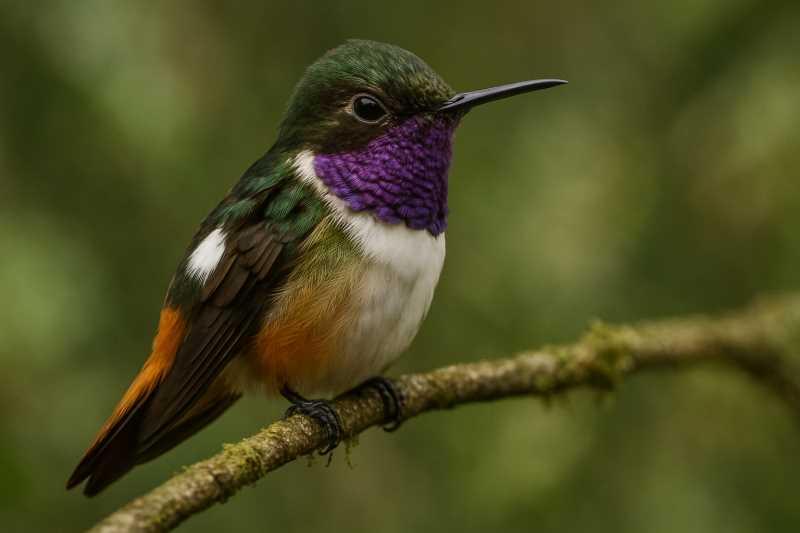
The Rufous-shafted Woodstar is a tiny hummingbird, measuring approximately 7 cm in length. It has glossy green upperparts, a pale underside and conspicuous rufous tones in the rump, flanks and tail feathers. The outer tail feathers and their shafts contribute to the species’ common name.
The sexes differ noticeably. The adult male has a bright iridescent gorget, usually appearing purple, rose or reddish depending on the subspecies and the angle of light. The female lacks the full gorget and is generally duller, with more subdued underparts and stronger pale facial and body markings. Immature males may show an incomplete throat patch as the adult plumage develops.
The long, narrow wings and pointed bill are adapted for hovering and for taking nectar from tubular flowers. The tail shape is also useful for identification, particularly when distinguishing this species from other very small woodstars.
Range and Habitat
The species is distributed in a discontinuous range across northern Venezuela, the Sierra de Perijá on the Colombia–Venezuela border, and the eastern Andes of northern Colombia and western Venezuela. It has also been recorded in Trinidad, where it is regarded as an erratic or uncommon visitor rather than a reliably resident species in all taxonomic treatments.
The Rufous-shafted Woodstar favours semi-open landscapes, including montane scrub, woodland margins, forest edges, coffee plantations and flowering vegetation in disturbed habitats. It is usually associated with elevations of roughly 900 to 2,500 metres, although higher records have been treated cautiously. In Venezuela, some seasonal movement between elevations has been reported, apparently in response to rainfall and the availability of flowers.
Geographic variation is reflected in the recognised subspecies. Males from different parts of the range can vary in the colour and extent of the iridescent gorget.
Where to See This Species
Asa Wright Nature Centre, Northern Range, Trinidad and Tobago
The Asa Wright Nature Centre is a realistic place to look for this species in Trinidad because several documented records have been made there. Sightings are uncommon and may be seasonal, with confirmed Trinidad records concentrated mainly from May to August. Flowering plants around the centre can attract visiting woodstars and other hummingbirds, but the species should be treated as a scarce visitor rather than a guaranteed sighting.
Nearby accommodation: The surrounding Northern Range and the nearby village of Asa Wright provide access to nature-centre lodging, guest houses and small eco-lodges.
Behaviour and Diet
The Rufous-shafted Woodstar feeds mainly on nectar from flowering plants and trees, including tubular flowers and other blooms available in scrub, plantations and forest edges. It also takes small arthropods, which provide protein and other nutrients.
It forages at several levels in the vegetation, but is often seen in the middle and upper layers. Its flight can appear slower and more bumblebee-like than that of some larger hummingbirds. The species does not appear to defend feeding territories consistently and may enter the feeding areas of other hummingbirds, probably because of its small size and unobtrusive behaviour.
Breeding information is limited. Observations from Colombia indicate that breeding may occur during November in at least part of the range, but the species’ breeding season is not fully documented. Detailed information about nest construction, incubation and chick development remains scarce, so precise figures should be treated cautiously.
Identification Tips
Look for the following combination of features:
- Very small size and a compact, short-bodied appearance.
- Green upperparts with rufous tones on the rump, flanks and tail.
- A pointed bill and rapid hovering flight at flowers.
- A bright purple, rose or reddish gorget in adult males.
- Females and immature birds with a paler, less iridescent appearance.
- Distinctive tail shape and rufous tail shafts, especially when the bird is perched or seen from behind.
The species can be confused with other tiny woodstars and small hummingbirds. Tail structure, the extent of the rufous colouring and the male’s gorget are more reliable identification features than overall size alone. Care is particularly important in Trinidad, where the Rufous-shafted Woodstar is rare and other small hummingbirds may occur at the same flowering plants.
Conservation Status
The Rufous-shafted Woodstar is currently assessed as Least Concern. Its population size has not been reliably quantified, but the species has a relatively broad distribution and is not currently considered globally threatened.
Habitat alteration remains a potential concern, particularly where montane scrub, forest margins and traditional coffee-growing landscapes are cleared or intensively modified. Maintaining flowering vegetation, protecting forest edges and retaining habitat corridors can support the species and the wider hummingbird community. In Trinidad, continued monitoring is especially valuable because confirmed records are infrequent and may represent seasonal or irregular movements from the mainland.
Frequently Asked Questions
Where can the Rufous-shafted Woodstar be found?
It occurs mainly in northern Venezuela and northern Colombia, including the Sierra de Perijá and the eastern Andes. It has also been recorded in Trinidad, where it is uncommon and irregular.
What habitat does the Rufous-shafted Woodstar prefer?
It prefers semi-open montane habitats such as scrub, forest edges, woodland margins, coffee plantations and flowering vegetation in modified landscapes.
How can the Rufous-shafted Woodstar be identified?
Its small size, green upperparts, rufous tail and flank markings, pointed bill and distinctive tail shape are useful clues. Adult males also have a vivid iridescent gorget.
What does the Rufous-shafted Woodstar eat?
It feeds mainly on nectar from flowers and supplements its diet with small insects and other arthropods.
Is the Rufous-shafted Woodstar migratory?
It is not generally treated as a long-distance migrant. Local or seasonal movements between elevations have been reported, and birds recorded in Trinidad appear to be irregular visitors or wanderers.
Is the Rufous-shafted Woodstar endangered?
No. It is currently classified as Least Concern, although habitat loss and degradation may affect local populations and the species’ ecology is still incompletely known.
References
- IUCN Red List of Threatened Species
- Cornell Lab of Ornithology, Birds of the World
- Trinidad and Tobago Field Naturalists’ Club, Living World Journal
Related posts