Introduction
The Andaman Nightjar (Caprimulgus andamanicus Hume, 1873) is a nocturnal member of the nightjar family, Caprimulgidae. It is endemic to the Andaman Islands, where its cryptic plumage and ground-roosting habits make it difficult to observe by day. The species was formerly treated by some authorities as a subspecies of the Large-tailed Nightjar, but distinctive territorial vocalisations support its recognition as a separate species.
Physical Description
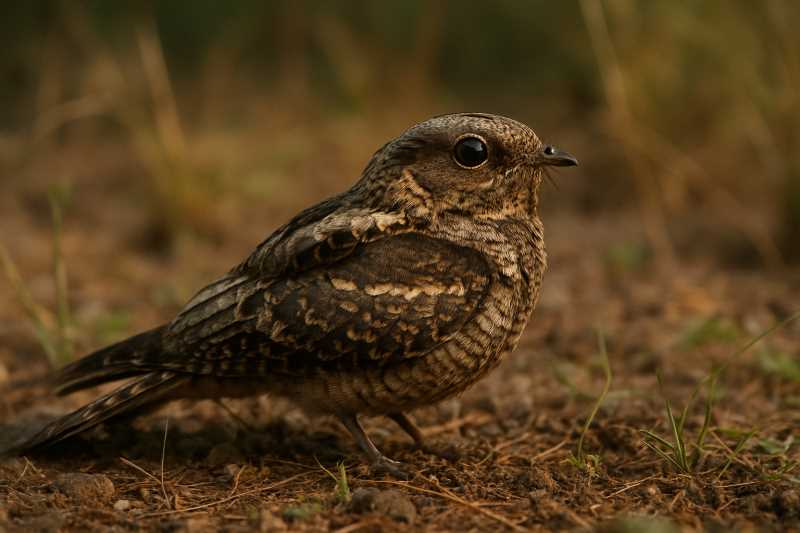
The Andaman Nightjar is a medium-sized nightjar, measuring approximately 23–28 cm in length. Its plumage is predominantly dark brown, greyish brown and buff, with fine mottling and vermiculation that provide effective camouflage among leaf litter, bare ground and shaded vegetation.
Like other nightjars, it has a broad, gaping mouth suited to catching flying insects, large eyes adapted to low-light conditions and long, pointed wings for agile flight. The plumage is generally similar between the sexes, although males and females may differ subtly in the extent and brightness of pale or white markings on the wings and tail. Detailed information on juvenile plumage remains limited, but young birds are expected to be more uniformly downy and less sharply marked than adults.
Range and Habitat
The Andaman Nightjar is restricted to the Andaman Islands of India and is considered a resident species rather than a long-distance migrant. Records extend across the main Andaman island group, including forested areas and open habitats with scattered trees. Its distribution does not include the Nicobar Islands.
It has been associated with tropical forest, forest edges, clearings, open woodland, grassland and mangrove areas. The species may use relatively open ground for roosting and feeding, while remaining close to vegetation that provides cover during daylight. Because it is endemic to a small island region, changes to native forest and other suitable habitats may have disproportionate effects on the species.
Behaviour and Diet
The Andaman Nightjar is crepuscular and nocturnal. It usually becomes active around dusk, when it leaves a daytime roost on the ground or in low vegetation to forage. It catches insects in flight, including moths, beetles, grasshoppers and other flying invertebrates. A typical hunting method is to wait on a low perch before making short sallies into the air to seize prey with its wide mouth.
During daylight, the bird relies on its cryptic plumage and remains inconspicuous among leaf litter, shaded ground or low vegetation. It is generally solitary or encountered in pairs, although more than one bird may be present where suitable habitat is available.
The territorial song is an important means of communication. It is a rapidly repeated, distinctive note often rendered as a series of short “tyuk” sounds. Unlike the deeper, more resonant song associated with the Large-tailed Nightjar, the Andaman Nightjar’s vocalisation lacks the same pronounced following tremolo. Available observations indicate that breeding takes place mainly in the dry-season period, with eggs laid directly on the ground rather than in a constructed nest. Reports describe clutches of one or two eggs, but detailed information on incubation and chick development remains limited.
Identification Tips
- Look for a medium-sized, dark brown nightjar with finely mottled plumage and strong camouflage against leaf litter or shaded ground.
- Search at dusk and after dark in open woodland, forest clearings, forest edges and mangrove-associated habitats on the Andaman Islands.
- Listen for the rapidly repeated territorial song, often described as a series of short “tyuk” notes.
- The voice is usually more useful than plumage for separating this species from closely related nightjars.
- The Large-tailed Nightjar is the most relevant comparison. The Andaman Nightjar is distinguished especially by its different territorial song, which is more rapidly delivered and lacks the characteristic deep, resonant quality and following tremolo of the Large-tailed Nightjar.
Conservation Status
The Andaman Nightjar is currently assessed as Least Concern on the IUCN Red List. Its population size has not been reliably quantified, and detailed information on population trends is limited.
The species’ restricted island distribution makes the protection of native forest, woodland edges, clearings and other suitable habitats important. Potential local pressures include habitat loss, fragmentation, infrastructure development and other forms of human encroachment. Conservation priorities include maintaining connected natural habitats, protecting important areas within the Andaman Islands and improving field surveys to clarify distribution, abundance, breeding ecology and population trends.
Frequently Asked Questions
Where does the Andaman Nightjar live?
The species occurs only in the Andaman Islands of India. It has been recorded in forest, open woodland, clearings, grassland and mangrove-associated habitats.
Is the Andaman Nightjar found in the Nicobar Islands?
The Andaman Nightjar is regarded as endemic to the Andaman Islands. It should not be confused with nightjar records from the separate Nicobar island group.
Is the Andaman Nightjar nocturnal?
Yes. It is mainly active from dusk through the night and may also be active during the early morning. During the day it usually rests quietly on or near the ground.
What does the Andaman Nightjar eat?
It feeds mainly on flying insects and other aerial invertebrates, including moths, beetles, grasshoppers and similar prey.
How can the Andaman Nightjar be identified by sound?
Its territorial song consists of rapidly repeated short notes, often rendered as “tyuk”. The song differs from the deeper and more resonant call of the Large-tailed Nightjar.
Is the Andaman Nightjar endangered?
It is currently classified as Least Concern by the IUCN. However, its restricted island range and limited available population data make habitat protection and further monitoring important.
References
- BirdLife International. n.d. “Andaman Nightjar Caprimulgus andamanicus Species Factsheet.” BirdLife DataZone. Accessed 8 September 2026. https://datazone.birdlife.org/species/factsheet/andaman-nightjar-caprimulgus-andamanicus
- Gill, F., D. Donsker and P. Rasmussen, eds. 2026. IOC World Bird List, version 15.2. International Ornithologists’ Union. Accessed 8 September 2026. https://www.worldbirdnames.org/
- Sangster, G. and F. G. Rozendaal. 2004. “Systematic notes on Asian birds. 41. Territorial songs and species-level taxonomy of nightjars of the Caprimulgus macrurus complex, with the description of a new species.” Zoologische Verhandelingen 350: 7–52. Naturalis Biodiversity Center. https://repository.naturalis.nl/document/43935
- Integrated Taxonomic Information System. n.d. “Caprimulgus andamanicus Hume, 1873, Andaman Nightjar.” ITIS Report. Accessed 8 September 2026. https://www.itis.gov/servlet/SingleRpt/SingleRpt?search_topic=TSN&search_value=686706
- Pande, S. et al. 2011. “Birds of South Andaman Island, Andaman and Nicobar Islands, India.” Indian Birds 7(4). Indian Birds. https://indianbirds.in/pdfs/IB7.4_Pande_SouthAndaman.pdf
- Department of Environment and Forests, Andaman and Nicobar Administration. 2024. Bird Watching in Andaman and Nicobar Islands. Government of India. Accessed 8 September 2026. https://www.andamantourism.gov.in/admin-pannel/docfile/70-Final%20Bird%20Watching_compressed.pdf
Related posts