Introduction
The Biak Scrubfowl (Megapodius geelvinkianus), also known as the Biak Megapode, is a little-known member of the megapode family, Megapodiidae. It is endemic to islands in Cenderawasih Bay, Indonesia, including Biak, Supiori and Numfor. Like other megapodes, it is associated with unusual egg-incubation behaviour in which environmental heat, rather than the adult bird’s body heat, is used to incubate the eggs.
Physical Description
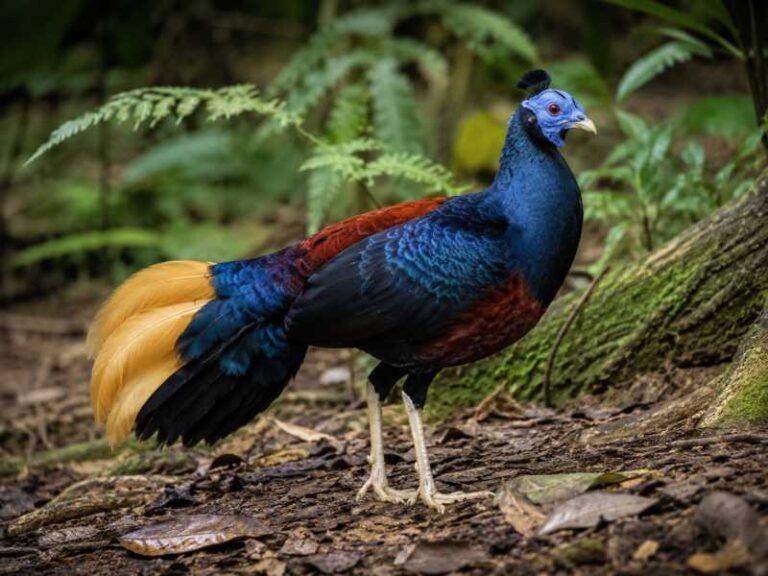
The Biak Scrubfowl is a stocky, medium-sized ground bird measuring about 36 cm in length. Its plumage is mainly dark grey to brownish-grey, with a slight crest on the head. The bare skin around the face may appear reddish or bluish, while the legs and feet can vary from reddish to dark grey.
It has the large feet and strong legs characteristic of megapodes. These adaptations are used for scratching through leaf litter and soil and, in megapodes generally, for constructing or maintaining nesting sites. Reliable information on sexual dimorphism, juvenile plumage and age-related variation in the Biak Scrubfowl is limited.
Range and Habitat
The Biak Scrubfowl is endemic to the Geelvink Bay islands of north-western New Guinea, Indonesia. Confirmed and reported localities include Biak, Supiori, Numfor, Mios Korwar, Manim and Mios Num. Records have also been reported from other nearby islands, including Owi and Rani, although the distribution on some of these islands requires further confirmation.
It has been recorded in primary forest, selectively logged forest, mature secondary forest, dry scrub and scrub near rivers. On Supiori, it has been recorded in lowland primary forest on limestone karst up to approximately 305 metres above sea level. The species is non-migratory and has a highly restricted island range.
Behaviour and Diet
Species-specific information about the Biak Scrubfowl’s behaviour and diet remains scarce. It is primarily associated with the forest floor and is likely to search through leaf litter and soil for invertebrates, seeds, fallen fruit and other small food items, as do related megapodes. However, a detailed published account of its diet is not currently available.
The species is thought to use the unusual reproductive strategy typical of megapodes. Instead of incubating eggs directly, megapodes bury their eggs in warm substrates or nesting mounds. Heat from decomposing vegetation, sunlight or other environmental sources provides the incubation warmth. For the Biak Scrubfowl specifically, historical sources suggest the use of nest mounds or the burial of eggs among decaying tree roots, but its breeding biology has not been adequately studied.
Adults have been recorded singly or in small numbers. There is no evidence that the species undertakes regular long-distance movements between islands, and its isolated island populations may be vulnerable to local habitat changes.
Identification Tips
- Look for a stocky, dark grey to brownish-grey bird moving quietly on the forest floor.
- Note the slight crest, bare reddish or bluish facial skin and strong legs.
- The bird is more likely to be detected by movement or brief calls than by prolonged views in dense vegetation.
- Its restricted island range is an important identification clue. On Biak, Supiori and nearby islands, it should be considered before mainland New Guinea megapodes or other large ground-foraging birds.
- Taxonomic treatments have historically differed, with some authorities grouping the Biak bird with the Dusky Megapode or related forms. Current major bird lists recognise Megapodius geelvinkianus as the Biak Scrubfowl.
Conservation Status
The Biak Scrubfowl has a restricted distribution and an incompletely known population. Current taxonomic databases citing the IUCN Red List classify it as Near Threatened. Other BirdLife International assessments and recent regional ornithological literature have treated it as Vulnerable, so the differing assessments should be acknowledged when interpreting its conservation status.
The principal concerns are loss and degradation of forest through logging, agricultural expansion and other land conversion. Hunting and egg collection have also been identified as potential threats, while introduced ground predators may pose an additional risk. Some of these threats are documented only indirectly because the species has received little detailed field study.
Recent observations indicate that the species became less frequently encountered in parts of southern Biak between approximately 2010 and 2019, although a reliable island-wide population trend has not been established. Its conservation requires surveys across the full island range, protection of remaining forest and nesting areas, research into breeding ecology, and monitoring of hunting, egg collection and introduced predators. Biak-Utara and Supiori nature reserves provide important protected habitat.
Frequently Asked Questions
Where does the Biak Scrubfowl live?
It occurs on islands in Cenderawasih Bay, Indonesia, especially Biak, Supiori and Numfor, with records from several nearby islands including Mios Korwar, Manim and Mios Num.
What does the Biak Scrubfowl look like?
It is a stocky bird about 36 cm long, with mostly dark grey to brownish-grey plumage, a slight crest, variable reddish or bluish facial skin and strong legs.
Does the Biak Scrubfowl migrate?
No regular migration is known. The species is endemic to a small group of islands and is regarded as non-migratory.
How does the Biak Scrubfowl incubate its eggs?
Like other megapodes, it is believed to bury its eggs in warm nesting material or another suitable substrate rather than incubating them directly with body heat. Detailed information on its own nesting behaviour remains limited.
What does the Biak Scrubfowl eat?
Its diet has not been studied in detail. It is expected to forage on the ground for a mixture of invertebrates, seeds, fallen fruit and other small food items, as do related megapodes.
Why is the Biak Scrubfowl threatened?
Its restricted island range makes it vulnerable to forest loss and degradation. Logging, agricultural expansion, hunting, egg collection and possible predation by introduced mammals are the main conservation concerns identified in available assessments.
References
- BirdLife International. 2001. Threatened Birds of Asia: The BirdLife International Red Data Book. Cambridge, UK: BirdLife International. Species account: Biak Megapode, Megapodius geelvinkianus. Available at: https://birdlifedata.blob.core.windows.net/red-data-books/megageel.pdf
- Bishop, K. D. and van Balen, S. 2023. The avifauna of Biak Island, Papua, Indonesia, with comments on the status and distribution of selected species. Bulletin of the British Ornithologists’ Club, 143(1). https://doi.org/10.25226/bboc.v143i1.2023.a2
- Gill, F., Donsker, D. and Rasmussen, P. (eds). 2026. IOC World Bird List, version 15.2. International Ornithologists’ Union. https://www.worldbirdnames.org/
- International Union for Conservation of Nature. 2021. Megapodius geelvinkianus, IUCN Red List taxon assessment, taxon ID 22728514. Current assessment and assessment history available through the IUCN Red List database: https://www.iucnredlist.org/
- Jones, D. N., Dekker, R. W. R. J. andدم McGowan, P. J. K. 1995. Megapodes: An Action Plan for their Conservation. Gland, Switzerland: IUCN and World Pheasant Association. https://portals.iucn.org/library/sites/library/files/documents/1995-009.pdf
- Madge, S. and McGowan, P. 2002. Pheasants, Partridges and Grouse: A Guide to the Pheasants, Partridges, Quails, Grouse, Guineafowl, Buttonquails and Sandgrouse of the World. London: Christopher Helm.
- Avibase. n.d. Megapodius geelvinkianus, Biak Scrubfowl, taxonomic and distribution database entry. Accessed 8 September 2026. https://avibase.bsc-eoc.org/species.jsp?avibaseid=8252F53BEE59E4E5&lang=EN
- Birks, S. M. and Edwards, S. V. 2002. A phylogeny of the megapodes, Aves: Megapodidae, based on nuclear and mitochondrial DNA sequences. Molecular Phylogenetics and Evolution, 23(3), 408-421. https://doi.org/10.1016/S1055-7903(02)00025-7
Related posts