Introduction
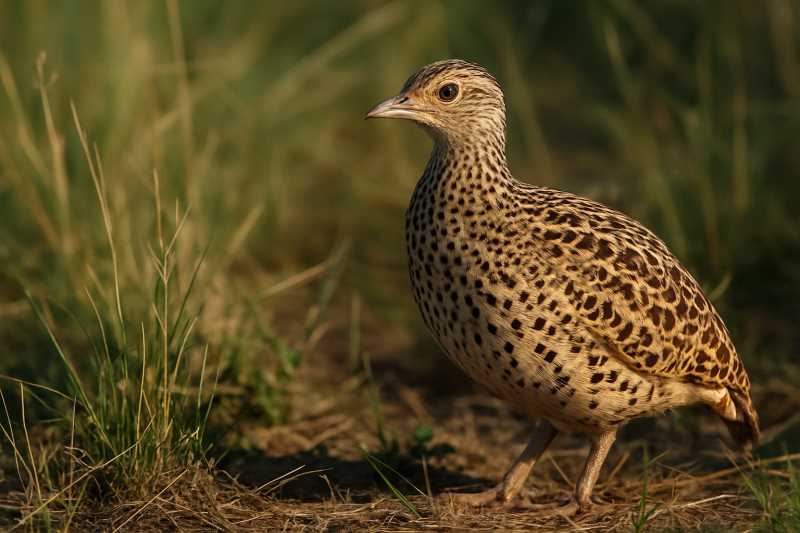
The Spotted Nothura (Nothura maculosa) is a small, ground-dwelling tinamou of open habitats in South America. It occurs mainly in grasslands, savannas, pastures and agricultural landscapes, where its mottled brown plumage provides effective camouflage. Although capable of flight, it usually relies on concealment, running and a sudden short flush to escape danger.
Physical Description
The Spotted Nothura is approximately 24–28 centimetres long. It has a compact, rounded body, short wings, a relatively short bill and strong legs suited to life on the ground. Adults are predominantly brown, buff and grey above, with dark streaking, spotting and barring. The underparts are generally buff or pale brown, with darker markings on the breast and flanks, while the throat is whitish.
Plumage colour and pattern vary geographically. Some populations are darker, whereas others are paler and more buff-coloured. The legs are usually yellowish-grey to brown, and the eyes are conspicuous against the cryptic plumage. Females may be slightly larger than males, but the sexes are otherwise broadly similar in appearance. Juveniles are more softly marked and may appear less strongly patterned than adults.
Range and Habitat
The species is distributed across much of eastern and southern South America, including Argentina, Bolivia, Brazil, Paraguay and Uruguay. Its range includes lowland and upland areas, and some geographically variable populations occur at elevations of more than 2,000 metres.
Spotted Nothuras favour open country with sufficient vegetation for cover. Habitats include natural grasslands, savannas, shrub-steppe, pasture, fallow fields, crop margins and other lightly to moderately disturbed agricultural areas. They may occur in rice, maize and soybean landscapes, although intensive cultivation can reduce the availability of suitable cover and feeding areas.
The species is generally resident rather than a long-distance migrant. Its distribution shows considerable geographic variation in size and plumage, and several named subspecies have been recognised. The former Chaco Nothura, Nothura maculosa chacoensis, is treated as a subspecies of the Spotted Nothura by current IOC taxonomy.
Behaviour and Diet
Spotted Nothuras are primarily diurnal and terrestrial. They usually walk or run through vegetation while searching for food and may remain motionless when approached. Their cryptic plumage makes them difficult to detect, but they often flush at close range with rapid wingbeats and a brief, low flight before landing in cover.
They are often encountered alone or in small groups. Their call consists of short, high-pitched notes, and calling birds may respond to one another across open country.
The diet is omnivorous and varies with season and locality. It includes seeds from grasses, weeds and crops, as well as insects and other small invertebrates. Birds may forage in soil, leaf litter, pasture and field edges, taking advantage of food exposed by grazing animals or agricultural activity.
Breeding takes place in a shallow ground nest, usually concealed beneath vegetation or beside a tussock. The nest may be formed by bending or gathering nearby grass. Clutches commonly contain four to eight eggs, although clutch size varies between accounts and regions. The eggs are typically glossy and brownish to dark reddish-brown. As in other tinamous, the male performs the main incubation duties and cares for the precocial chicks after hatching.
Identification Tips
- Look for a small, rounded, quail-like bird in open grassland, pasture or crop margins.
- The overall plumage is brown, buff and grey, with dark streaking and spotting that closely matches dry vegetation.
- The pale throat, barred or spotted breast and strongly marked back are useful features when the bird is visible.
- It usually stays on the ground and may freeze before suddenly flushing at close range.
- In flight, it shows a short, rapid escape flight rather than sustained aerial movement.
- The Spotted Nothura can resemble other small tinamous, but its combination of moderate size, heavily marked brown plumage and occurrence in open grassland helps separate it from smaller or more specialised nothuras. Geographic variation means that colour alone should not be relied upon for identification.
Conservation Status
The Spotted Nothura is classified as Least Concern on the IUCN Red List. The species has a broad distribution and remains widespread in suitable habitats, but local populations can be affected by agricultural intensification, conversion of native grasslands, loss of field margins and excessive hunting pressure.
Research in Argentina has linked poorer survival and habitat use to landscapes dominated by intensive row-crop agriculture, while mixed landscapes containing pasture, fallow fields and more varied vegetation can provide better conditions. Conservation measures include retaining native grassland, maintaining vegetated field edges and fallow areas, managing grazing and cultivation in ways that preserve cover, and applying sustainable hunting regulations where the species is taken as game.
Frequently Asked Questions
Where does the Spotted Nothura live?
It occurs in Argentina, Bolivia, Brazil, Paraguay and Uruguay, mainly in open grasslands, savannas, pastures, shrub-steppe and agricultural landscapes.
Is the Spotted Nothura a migratory bird?
It is generally considered resident rather than a long-distance migrant. Local movements may occur in response to vegetation, food availability, grazing and changes in agricultural land use.
What does the Spotted Nothura eat?
Its omnivorous diet includes seeds from grasses, weeds and crops, along with insects and other small invertebrates. The balance between plant and animal food varies by region and season.
Does the Spotted Nothura fly?
Yes. Although it spends most of its time walking or running on the ground, it can make a rapid, short flight when flushed or threatened.
Who incubates the Spotted Nothura’s eggs?
The male carries out the main incubation and cares for the chicks after they hatch. The chicks are precocial and can move soon after hatching.
Is the Spotted Nothura endangered?
No. It is currently assessed as Least Concern, although local populations may decline where grasslands are converted, agricultural practices become more intensive or hunting is poorly managed.
References
- Gill, F., Donsker, D. and Rasmussen, P. (eds.). 2026. IOC World Bird List, version 15.2. International Ornithologists’ Union. https://www.worldbirdnames.org/ Accessed 8 September 2026.
- World Bird Names. n.d. “Spotted Nothura / Nothura maculosa.” Tinamiformes species listing. https://www.worldbirdnames.com/tinamiformes Accessed 8 September 2026.
- BirdLife International. n.d. “Nothura maculosa, Spotted Nothura.” BirdLife Data Zone. https://datazone.birdlife.org/ Accessed 8 September 2026.
- IUCN. n.d. “Nothura maculosa, Spotted Nothura.” The IUCN Red List of Threatened Species. https://www.iucnredlist.org/ Accessed 8 September 2026.
- Hayes, F. E., Rodríguez, O., Thalman, E. R., Castellanos, E. A. and Sterling, J. 2018. Taxonomic status of Paraguay’s only endemic bird, the Chaco Nothura Nothura chacoensis (Aves: Tinamidae). Zootaxa 4392(2): 347–360. https://doi.org/10.11646/zootaxa.4392.2.7
- Thompson, J. J. and Carroll, J. P. 2009. Habitat use and survival of the Spotted Tinamou (Nothura maculosa) in agroecosystems in the Province of Buenos Aires, Argentina. National Quail Symposium Proceedings 6, Article 14. https://doi.org/10.7290/nqsp068w7x
- Kirwan, G. M. and Areta, J. I. 2022. New breeding information on Brazilian birds. 1: Rheidae, Tinamidae. Bulletin of the British Ornithologists’ Club 142(4). https://doi.org/10.25226/bboc.v142i4.2022.a4
Related posts