The Enigmatic Barred Owlet-nightjar: A Glimpse into the Nocturnal World of Aegotheles bennettii
In the dense, shadowy forests of New Guinea and the northern reaches of Australia, an elusive avian marvel known as the Barred Owlet-nightjar, or **Aegotheles bennettii**, makes its home. This small, nocturnal bird, with its cryptic plumage and secretive habits, has intrigued ornithologists and bird enthusiasts alike. Despite its relative obscurity in popular avian literature, the Barred Owlet-nightjar is a fascinating species, offering unique insights into the adaptability and survival strategies of nocturnal birds.
A Distinctive Appearance
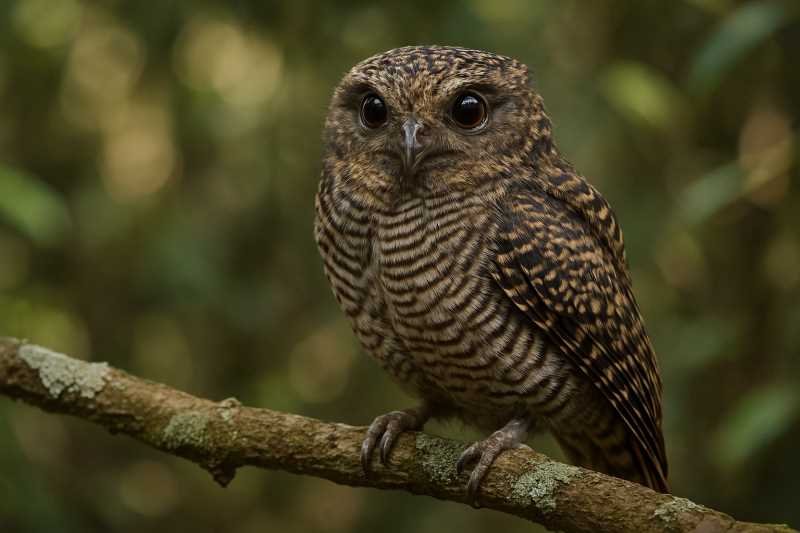
The Barred Owlet-nightjar is a small, robust bird, typically measuring around 21 to 25 centimeters in length. Its appearance is characterized by a large head, short neck, and a tiny bill, which are complemented by its soft, intricate plumage. The bird’s upper parts are predominantly grayish-brown, adorned with intricate barring and spots that provide excellent camouflage against the forest backdrop. Its underparts are lighter, typically a creamy hue with subtle barring, aiding in its nocturnal concealment.
One of the most distinctive features of the Barred Owlet-nightjar is its large, dark eyes, adapted to its nocturnal lifestyle. These eyes, along with its facial bristles, enhance its ability to hunt and navigate in low-light conditions. The bird’s short tail and rounded wings are perfectly designed for agile flight through dense vegetation, further exemplifying its adaptation to a life of stealth and secrecy.
Habitat and Distribution
Aegotheles bennettii is primarily found in the tropical rainforest regions of New Guinea and the Cape York Peninsula of Australia. These areas provide the ideal environment for the Barred Owlet-nightjar, offering abundant food supply and ample cover from predators. The bird is most commonly associated with lowland and hill forests, where it roosts and nests in tree cavities, often at considerable heights above the ground.
The species is known to be sedentary, with no significant migration patterns observed. Its range is largely defined by the availability of suitable forest habitat, and it is considered relatively stable, though deforestation poses a potential threat to its long-term survival.
Nocturnal Behavior and Diet
As a nocturnal species, the Barred Owlet-nightjar is most active during the night, when it embarks on its hunting expeditions. Its diet primarily consists of insects and small arthropods, which it captures with remarkable precision. The bird employs a sit-and-wait strategy, perching silently until prey comes within reach, then launching into swift, agile flights to capture its quarry.
The Barred Owlet-nightjar’s vocalizations are a series of soft, melodic whistles and trills, often heard at dusk and throughout the night. These calls play a crucial role in communication between mates and in establishing territory boundaries. Despite its vocal nature, the bird’s calls are subtle and often go unnoticed by human observers, further contributing to its enigmatic reputation.
Reproduction and Lifespan
Breeding in the Barred Owlet-nightjar typically occurs during the dry season, when food is plentiful and conditions are favorable for raising young. The species is known to be monogamous, with pairs forming strong bonds that may last for several breeding seasons.
Nesting occurs in natural tree cavities, where the female lays a clutch of one to two eggs. Both parents participate in incubation, which lasts approximately 25 to 30 days. After hatching, the chicks are altricial, requiring extensive parental care. They fledge about 30 days post-hatching, though they remain dependent on their parents for food and protection for several weeks thereafter.
The lifespan of the Barred Owlet-nightjar in the wild is not well-documented, but like many small birds, it is believed to range from 5 to 10 years, depending on environmental factors and predation pressures.
Conservation Status and Challenges
Currently, the Barred Owlet-nightjar is listed as Least Concern by the IUCN. However, ongoing habitat destruction, particularly due to logging and agricultural expansion, poses a significant threat to its habitat. Conservation efforts aimed at preserving the tropical forests of New Guinea and northern Australia are crucial for ensuring the continued survival of this species.
In addition to habitat conservation, further research into the species’ behavior, population dynamics, and ecological role is vital. Enhancing our understanding of the Barred Owlet-nightjar will not only aid in its preservation but also contribute to the broader knowledge of nocturnal avian species and their ecological significance.
Conclusion
The Barred Owlet-nightjar, with its mysterious allure and specialized adaptations, represents a fascinating component of the nocturnal ecosystem. As we continue to explore and understand the complexities of our natural world, this enigmatic bird serves as a reminder of the intricate connections and delicate balance that sustain biodiversity. By prioritizing conservation and research initiatives, we can ensure that the Barred Owlet-nightjar, along with countless other species, continues to thrive in its natural habitat for generations to come.
Related posts