The Violet-headed Hummingbird: A Jewel of the Neotropics
The Violet-headed Hummingbird, known scientifically as *Klais guimeti*, is a captivating and vibrant species that epitomizes the dazzling diversity of hummingbirds. Found predominantly in the tropical regions of Central and South America, this small bird is a marvel of nature, both in its striking appearance and its agile, energetic behavior.
Habitat and Distribution
The Violet-headed Hummingbird inhabits a range of environments across Central America, from the lowland forests of Costa Rica and Panama to the lower montane regions of Colombia, Ecuador, and Venezuela. These birds favor the edges of humid forests, secondary growth areas, and sometimes gardens, where flowering plants are abundant. The altitudinal range they occupy extends from sea level up to about 1,500 meters, though they are most commonly found at elevations around 300 to 1,200 meters.
Physical Characteristics
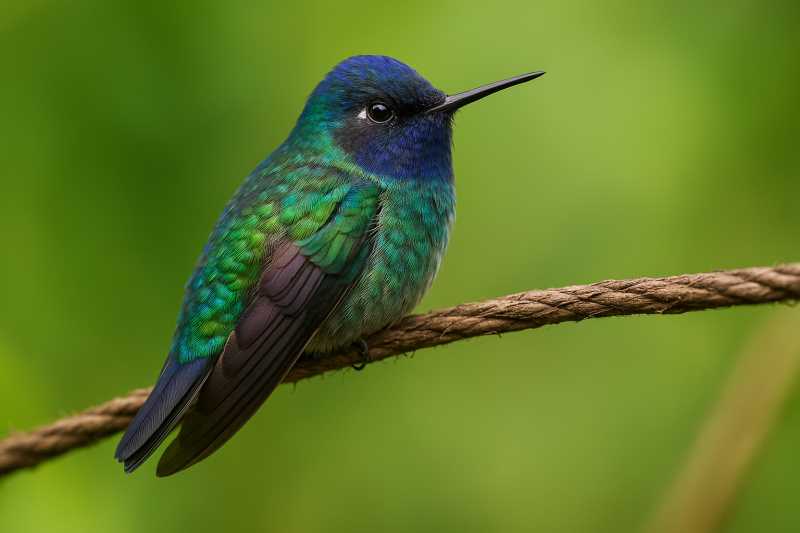
True to its name, the Violet-headed Hummingbird boasts a head shimmering with iridescent violet hues. The vibrant coloration is due to microscopic platelets in the feathers that refract light, creating the bird’s dazzling appearance. The rest of the plumage is predominantly emerald green, with a white patch on the lower belly and a slightly forked tail. Males and females are similar in appearance, although females tend to have slightly less intense coloration.
Behavior and Diet
The Violet-headed Hummingbird is a solitary creature, fiercely territorial and often seen defending its feeding grounds from other hummingbirds. They feed primarily on nectar, favoring brightly colored flowers with high sugar content. This diet is supplemented by small insects and spiders, which provide essential proteins. Their long, specialized bills and extendable tongues allow them to access nectar deep within flowers.
These birds are known for their rapid and agile flight, capable of hovering in place as they feed. This remarkable ability is facilitated by their unique wing structure, allowing for a full range of motion and the capability to beat their wings up to 80 times per second.
Breeding and Life Cycle
Breeding season for the Violet-headed Hummingbird varies by region, but generally coincides with periods of abundant flower bloom. Courtship involves elaborate aerial displays, where the male performs a series of dives and loops to impress the female. Once paired, the female is solely responsible for nest building and chick rearing.
Nests are typically constructed on thin branches, using plant down and spider silk to create a small, cup-shaped structure. The female lays two tiny, white eggs, which she incubates for about 15 to 19 days. After hatching, the chicks are fed a regurgitated mixture of nectar and insects until they are ready to fledge at around 20 to 26 days old.
Conservation Status
Currently, the Violet-headed Hummingbird is classified as Least Concern by the International Union for Conservation of Nature (IUCN). Their wide distribution and adaptability to different habitats have helped maintain stable population numbers. However, habitat destruction, especially deforestation and land conversion for agriculture, poses potential threats. Conservation efforts focusing on habitat preservation and restoration are crucial to ensure the long-term survival of this species.
Significance and Cultural Impact
Hummingbirds, including the Violet-headed Hummingbird, hold significant cultural value in many societies. They are often seen as symbols of beauty, agility, and resilience. Their presence in ecosystems is also vital, as they play a crucial role in pollination, supporting the reproduction of many flowering plants.
In conclusion, the Violet-headed Hummingbird is a remarkable example of the biodiversity found in tropical ecosystems. Its vibrant colors, energetic behavior, and ecological role make it a fascinating subject for both scientific study and nature enthusiasts. Protecting the habitats of these and other hummingbird species is essential for preserving the ecological and cultural richness they embody.
Related posts