Introduction
The Stripe-breasted Starthroat (Heliomaster squamosus) is a hummingbird endemic to Brazil. It is recognised by its long, straight bill, deeply forked tail, white facial markings and, in adult males, a brilliant violet throat. The species occurs mainly in eastern and south-eastern Brazil, where it uses forest edges, gallery woodland, savanna and other semi-open habitats.
Physical Description
The Stripe-breasted Starthroat is a medium-sized hummingbird measuring approximately 11–12 cm in length. It has a long, slightly decurved black bill and a deeply forked, dark green to blue-green tail.
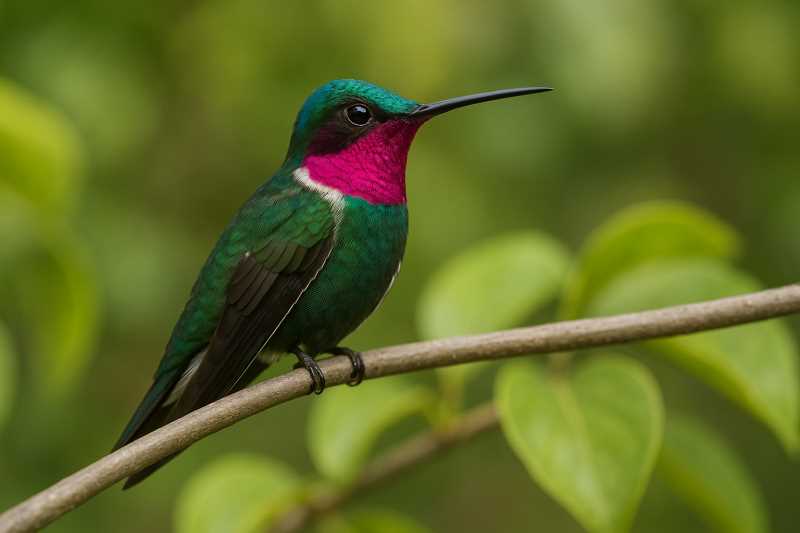
The adult male is bronze-green above, often with a brighter crown. A white streak behind the eye and a short white moustache or malar stripe are visible at close range. The throat is typically bright violet and iridescent, with the colour extending towards the upper breast. A narrow white line runs down the centre of the darker underparts, contrasting with the green flanks.
The female is duller than the adult male. She lacks the male’s brilliant violet throat and usually has a more obviously scaled throat, formed by dark feathers with pale edges. Her underparts are greyer, the central white stripe is less prominent and the tail is less deeply forked, with white tips on the outer feathers.
Adult males can also show a less colourful post-breeding plumage. During this period, the throat becomes darker and more finely scaled, making the bird resemble a female or immature individual. This seasonal change is unusual among hummingbirds and can complicate identification.
Range and Habitat
The Stripe-breasted Starthroat is endemic to Brazil. Its principal range extends through eastern Brazil from Pernambuco southwards to São Paulo. Occasional records have been reported beyond the core range, including Argentina, but these should not be interpreted as evidence of a regular population there.
It uses a variety of habitats, including forest edges, gallery forest, woodland, savanna, cerrado, caatinga and other semi-open areas with flowering plants. It may also occur in secondary vegetation, plantations, gardens and small woodland fragments. Most records are from lowlands and foothills, generally from sea level to about 800 metres.
The species is regarded as essentially sedentary, although individuals may wander locally or move to higher elevations when conditions are suitable. No recognised subspecies are currently generally accepted.
Where to See This Species
Serra de Baturité Environmental Protection Area, Ceará, Brazil
The Stripe-breasted Starthroat has been documented in the Serra de Baturité Environmental Protection Area. The area’s forest remnants, gallery vegetation, flowering plants and semi-open habitats provide suitable conditions for the species. It is best treated as a local possibility rather than a guaranteed sighting, and careful observation around forest edges and flowering vegetation is advisable.
Nearby accommodation: Guaramiranga and other settlements in the Serra de Baturité region provide guest houses, small hotels, lodges and self-catering accommodation.
Serra do Cipó National Park, Minas Gerais, Brazil
The species has been recorded in Serra do Cipó National Park, including forest patches within a landscape of cerrado, rocky fields and montane vegetation. Look around woodland edges and flowering areas, particularly where forest patches meet more open habitat.
Nearby accommodation: Santana do Riacho and the village of Serra do Cipó are the main gateways, with pousadas, guest houses, small hotels and self-catering accommodation.
El Palmar National Park, Entre Ríos, Argentina
El Palmar National Park lies outside the species’ main Brazilian range, but Stripe-breasted Starthroats have been documented there, including a reported nesting record. The species is unusual in Argentina, so sightings are likely to be local and irregular. Gallery woodland, parkland and flowering vegetation around the park facilities are the most sensible areas to check.
Nearby accommodation: Ubajay is the nearest practical settlement, with inns, guest houses and small accommodation options, while campsites are available in and around the national park area.
Behaviour and Diet
The Stripe-breasted Starthroat is usually encountered singly and is territorial around productive flowering plants. It may defend a flower patch from other Stripe-breasted Starthroats, although it can be less aggressive towards other hummingbird species. It commonly forages several metres above the ground and may make rapid, direct flights between perches and flowers.
Nectar from a wide variety of flowering plants forms the main part of its diet. The bird also captures small insects in flight, providing an important source of protein. This combination of nectar feeding and aerial insect capture allows it to use both natural vegetation and modified habitats where flowering plants remain available.
The nest is a small cup made from soft plant material and is attached with spider silk. Lichens and other material may be added to the outside for camouflage. Nests are usually placed on a horizontal branch several metres above the ground, although unusual sites have also been recorded.
The female performs the nesting duties. A typical clutch contains two eggs, which are incubated for approximately 14–16 days. Young birds generally leave the nest about 21–24 days after hatching.
Identification Tips
- Look for a relatively large hummingbird with a long, straight or slightly decurved bill and a deeply forked tail.
- Adult males in breeding plumage show a striking iridescent violet throat, a narrow white central stripe below the throat and green flanks.
- The white streak behind the eye and short white moustache are useful supporting features.
- Females and immature birds are duller, with a scaled dark-and-pale throat, greyer underparts and white tips to the outer tail feathers.
- Do not rely on throat colour alone. Adult males may become much duller after breeding and can resemble females.
- The combination of a long bill, deeply forked tail, central white stripe and scaled throat helps separate this species from other Heliomaster hummingbirds. Detailed comparison is often necessary where the ranges of similar species overlap.
Conservation Status
The Stripe-breasted Starthroat is currently assessed as Least Concern on the IUCN Red List. Its population size has not been reliably quantified, but it is generally considered stable at a global level.
The principal conservation concern is the loss and degradation of native vegetation through deforestation, agricultural expansion, urban development and the removal of flowering plants. Fragmented habitats may still support the species, but the availability of native flowers and nesting sites remains important. Protecting forest edges, gallery woodland, cerrado, caatinga and other native vegetation, together with planting locally appropriate flowering species, can benefit this and other pollinating birds.
Frequently Asked Questions
Where is the Stripe-breasted Starthroat found?
It is endemic to Brazil, occurring mainly in eastern and south-eastern Brazil from Pernambuco to São Paulo. Exceptional records have been reported in Argentina.
Is the Stripe-breasted Starthroat migratory?
It is considered essentially sedentary. Local movements and occasional wandering to higher elevations may occur, but it is not regarded as a regular long-distance migrant.
What does the Stripe-breasted Starthroat eat?
It feeds mainly on nectar from flowering plants and supplements this diet with small insects captured in flight.
How can the male be identified?
The adult male has a brilliant violet throat, bronze-green upperparts, a white facial streak and moustache, a narrow white central stripe below the throat and a deeply forked dark tail.
What does the female look like?
The female is less brightly coloured, with a scaled throat, greyer underparts, a less prominent central white stripe and white tips on the outer tail feathers. Her tail is also less deeply forked than the male’s.
Is the Stripe-breasted Starthroat threatened?
It is currently classified as Least Concern. Nevertheless, habitat destruction and the loss of native flowering plants may affect local populations, especially where natural vegetation is heavily fragmented.
References
- Birds of the World
- IUCN Red List of Threatened Species
- São Paulo Municipal Secretariat for Green and Environment
Related posts