Introduction
The Greenish Puffleg (Haplophaedia aureliae) is a small hummingbird of humid montane forests in eastern Panama and the northern Andes. Its range includes Panama, Colombia, Ecuador and northern Peru. The species is named for its predominantly green plumage and the soft feather tufts around its legs, a characteristic shared by pufflegs.
Physical Description
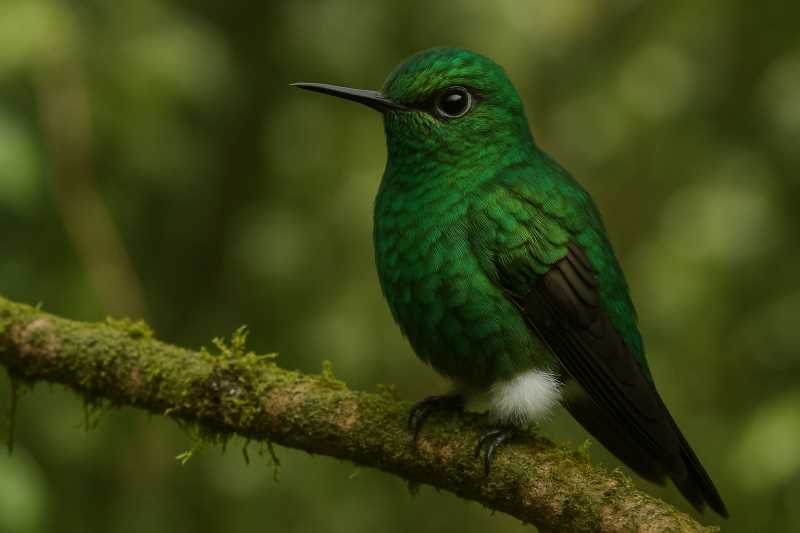
The Greenish Puffleg is a compact hummingbird measuring approximately 9–10 centimetres in length. Its plumage is mainly green, with bronze or bluish tones that become more noticeable in suitable light. The throat and upper breast may appear paler or more bluish-green, while the bill is straight, slender and adapted for probing flowers.
The most distinctive feature is the pair of fluffy white, buff or pale cinnamon feather tufts around the legs. These leg puffs are visible when the bird perches and help distinguish it from many other small Andean hummingbirds. The sexes are broadly similar in appearance, and there is no strong sexual dimorphism that is consistently useful for field identification. Juveniles may appear duller than adults, but age-related plumage details are not well documented in standard field sources.
Range and Habitat
The Greenish Puffleg occurs locally in humid montane and cloud forests from eastern Panama and adjacent north-western Colombia through the Colombian Andes, eastern Ecuador and into northern Peru. The distribution is geographically variable, with several recognised subspecies associated with different parts of the range.
It is primarily a resident species of forest understorey, forest edges and regenerating vegetation in the subtropical Andes. It has been recorded broadly between about 1,500 and 3,100 metres above sea level, although it is generally more frequent below 2,500 metres. The species is not considered migratory, but local movements may occur in response to flowering conditions and changes in food availability.
Where to See This Species
Reserva ProAves Las Tángaras, Chocó, Colombia
The Greenish Puffleg is included on the reserve’s bird checklist. Las Tángaras protects humid Chocó and Andean cloud-forest habitats across a substantial elevational range, making forest trails and flowering edges suitable places to look for this inconspicuous hummingbird. It is usually best searched for quietly in the understorey and along forest margins.
Nearby accommodation: El Carmen de Atrato is the practical gateway for local guest houses, small hotels and basic self-catering accommodation. Access arrangements for the reserve should be confirmed locally.
Serranía de los Churumbelos, Cauca and Putumayo, Colombia
A ProAves survey of the Serranía de los Churumbelos recorded the Greenish Puffleg in the area’s montane forests. The protected landscape includes humid forest on the eastern Andes, where the species may be encountered along forest trails, edges and flowering vegetation at middle elevations.
Nearby accommodation: Mocoa is the main practical gateway, with hotels, guest houses, lodges and self-catering options available for visitors exploring the surrounding protected forests.
Behaviour and Diet
The Greenish Puffleg is an agile hummingbird that can hover while feeding and move rapidly between flowers, perches and patches of cover. It is usually encountered singly, although several individuals may gather where nectar is plentiful. It may also occur alongside other hummingbirds at productive flowering sites without forming a cohesive social group.
Nectar is the main energy source, obtained from a variety of flowering plants. Small insects and spiders are also taken and provide protein, particularly when feeding young. The bird’s ecological role includes pollination, although the plant species it pollinates vary across its wide geographic range.
Detailed information about courtship, nesting and parental care is limited. As with other hummingbirds, breeding activity is likely to depend partly on local flowering conditions, but a single breeding season cannot be assumed across the entire range.
Identification Tips
- Look for a small, compact hummingbird with mainly green plumage in humid Andean forest.
- Check the legs carefully for conspicuous pale, fluffy feather tufts, the feature that gives pufflegs their name.
- The straight, slender bill and hovering flight are typical hummingbird features, but the combination of green plumage and leg puffs is more diagnostic.
- Search shaded understorey, forest edges, flowering shrubs and quiet trails rather than exposed, open habitats.
- Take care with identification where other Haplophaedia species occur. Plumage colour can vary with light, wear and subspecies, so the leg puffs, overall structure, location and habitat should be considered together.
Conservation Status
The Greenish Puffleg is currently assessed as Least Concern. A precise global population estimate is not given here, and the overall population trend is not sufficiently clear to state confidently.
The main long-term concern is the loss, degradation and fragmentation of humid montane forest through agricultural expansion, logging, road construction and other development. Protection of remaining cloud forest, maintenance of habitat connectivity and restoration of degraded forest are important conservation measures. Protected areas and privately managed bird reserves within the species’ range provide valuable habitat, but continued monitoring is needed because local populations may decline even when the species remains widespread overall.
Frequently Asked Questions
Where is the Greenish Puffleg found?
The species occurs in eastern Panama, Colombia, Ecuador and northern Peru, mainly in humid montane and cloud forests of the Andes.
What habitat does the Greenish Puffleg use?
It uses forest understorey, forest edges and secondary or regenerating vegetation in the subtropical Andes, generally between about 1,500 and 3,100 metres above sea level.
How can the Greenish Puffleg be identified?
Look for a small green hummingbird with pale, fluffy feather tufts around the legs. The bird’s compact shape, straight bill and preference for shaded montane forest are also useful clues.
What does the Greenish Puffleg eat?
It feeds mainly on nectar from flowering plants and supplements its diet with small insects and spiders.
Is the Greenish Puffleg migratory?
It is regarded as a resident species rather than a long-distance migrant. Local movements may occur when flowering conditions or food availability change.
Is the Greenish Puffleg endangered?
It is currently classified as Least Concern, but habitat loss and fragmentation in Andean montane forests remain important conservation concerns.
References
- BirdLife International
- IOC World Bird List
- Fundación ProAves
Related posts