Introduction
The Olivaceous Thornbill (Chalcostigma olivaceum) is a small Andean hummingbird of the family Trochilidae. It occurs locally in high-elevation grasslands and shrublands of Peru and Bolivia, where its subdued plumage helps it blend into open montane vegetation.
Physical Description
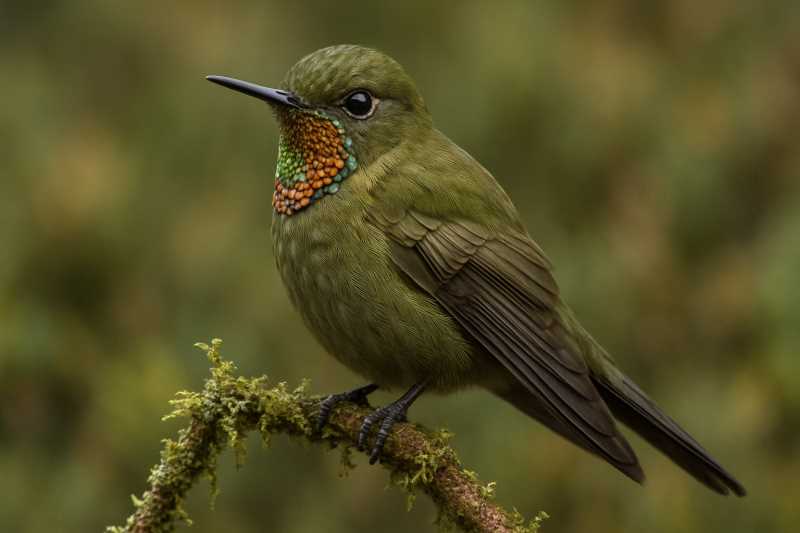
The Olivaceous Thornbill is approximately 14–15 cm long. It has a straight black bill, grey-green to olive upperparts and mostly grey or sooty-grey underparts. The male has a narrow, iridescent green throat patch, or gorget, which can be difficult to see in dull light. Females lack the prominent gorget and generally appear plainer, with a slightly notched dusky tail.
Young birds may show paler or buff margins to some feathers and lack the full adult male throat pattern. The species is relatively dark and short-billed compared with several other high-Andean hummingbirds.
Range and Habitat
The species is resident and has a patchy distribution in the Andes of Peru and Bolivia. The western-slope form, C. o. pallens, is recorded locally in central Peru from Ancash to north-western Junín. The nominate form, C. o. olivaceum, occurs from south-eastern Peru, including the Apurímac region, south-eastwards to the La Paz area of Bolivia.
It is usually found between about 2,800 and 4,500 metres, with some Peruvian records extending into the higher puna zone. Preferred habitats include open puna grassland, short turf with scattered shrubs, cushion plants and high-elevation montane scrub. It may also occur around the edges of Polylepis woodland, but it is not primarily a dense-cloud-forest species. Its separated populations and localised distribution mean that it may be uncommon even in apparently suitable habitat.
Where to See This Species
Huascarán National Park, Ancash, Peru
The Olivaceous Thornbill is included in bird checklists for Huascarán National Park, whose high-elevation puna, shrubland and montane habitats fall within the species’ documented central Peruvian range. The dry season from May to October is generally the most practical period for visiting the park and searching open habitats, although sightings are not guaranteed.
Nearby accommodation: Huaraz is the main practical base, with hotels, guest houses, lodges and other visitor accommodation, while smaller settlements near park access points offer more limited options.
Junín National Reserve, Junín and Pasco, Peru
The species is documented from the Junín area, including habitats around Lake Junín and nearby high-Andean grasslands. The reserve is publicly accessible for birdwatching and other nature-based activities. Search open puna, low shrub patches and suitable grassland away from the busiest wetland viewpoints, particularly during the recommended May to October visiting season.
Nearby accommodation: Junín and the settlements around Lake Junín provide simple hotels, guest houses and locally arranged accommodation. Ondores and Huayre are useful local access points for some reserve activities.
Cotapata National Park and Integrated Management Natural Area, La Paz Department, Bolivia
Olivaceous Thornbill is included on bird checklists for Cotapata. The protected area spans a substantial elevational range and is accessible from La Paz, the La Cumbre area and routes towards Coroico. The best chance of finding the species is in the high, open sections near treeline rather than in the warmer forested Yungas, where other hummingbirds are more typical.
Nearby accommodation: Coroico is the principal gateway settlement, with hotels, guest houses, lodges and self-catering options. La Paz also provides a wider range of accommodation for visits beginning near La Cumbre.
Behaviour and Diet
The Olivaceous Thornbill is usually encountered alone while feeding in open highland vegetation. It may perch on low shrubs or other exposed stems, but it is also notable for moving on or close to the ground while visiting very small flowers among short grass. This behaviour can make it easy to overlook as it blends into the surrounding vegetation.
Its diet consists mainly of nectar from small high-altitude flowers, supplemented by small insects and spiders. Insects are particularly important as a source of protein. Like other hummingbirds, it can defend profitable feeding areas, although the intensity of territorial behaviour varies with food availability and local conditions.
The species is resident rather than a long-distance migrant. Detailed information on its breeding season, nest construction and incubation is limited. As in other hummingbirds, the female is expected to undertake the main nesting and parental duties, but precise breeding measurements should be treated cautiously unless based on local observations.
Identification Tips
- Look for a small, dark, olive or grey-green hummingbird in open puna grassland and low shrubland at high elevation.
- The straight black bill and relatively subdued plumage are useful initial clues.
- Adult males may show a narrow green iridescent gorget, but the colour can disappear when the bird is viewed from the wrong angle.
- Females are plainer and lack the obvious throat patch.
- Watch the ground and short grass as well as flowering shrubs, because the species may walk or feed close to the ground.
- Do not rely on a long, strongly curved bill or brilliant overall plumage. Those features point towards other hummingbirds rather than the Olivaceous Thornbill.
- The female Blue-mantled Thornbill can show somewhat similar ground-associated behaviour in parts of the range, but the Olivaceous Thornbill is generally duller and has different plumage patterning.
Conservation Status
The Olivaceous Thornbill is currently assessed as Least Concern. It has a relatively broad overall distribution across the high Andes, but it is locally uncommon and occurs in separated or patchy populations, especially in parts of Peru.
Potential pressures include the conversion or degradation of puna grassland and montane scrub through agriculture, intensive grazing, burning and other land-use changes. Climate change may also alter the distribution of high-elevation plants and suitable habitat. No reliable population estimate is included here. Protecting puna, shrubland and high-Andean wetland margins, together with monitoring local populations, should benefit this species and the wider mountain ecosystem.
Frequently Asked Questions
Where can the Olivaceous Thornbill be found?
It is found in the high Andes of Peru and Bolivia. Its distribution is localised, with populations on both western and eastern Andean slopes in Peru and extending into the La Paz region of Bolivia.
What habitat does the Olivaceous Thornbill prefer?
It prefers open puna grassland, short turf, scattered shrubs and high-elevation montane scrub, usually from roughly 2,800 to 4,500 metres. It may also occur near Polylepis woodland edges and cushion plants.
How can the Olivaceous Thornbill be identified?
Look for a small, dark olive or grey-green hummingbird with a straight black bill. Adult males have a narrow iridescent green throat patch, while females are plainer and lack the prominent gorget.
Does the Olivaceous Thornbill migrate?
It is considered resident within its Andean range rather than a long-distance migrant. Local movements may occur in response to flowering conditions, weather or habitat availability.
What does the Olivaceous Thornbill eat?
It feeds mainly on nectar from small high-altitude flowers and supplements this diet with small insects and spiders. It may forage close to the ground among short grasses.
Is the Olivaceous Thornbill endangered?
No. The species is currently classified as Least Concern, although local populations may be affected by habitat degradation, changes in land use and climate-related changes to high-elevation ecosystems.
References
- BirdLife International
- IOC World Bird List
- Servicio Nacional de Áreas Naturales Protegidas por el Estado, Peru
Related posts