Introduction
The Yucatan Bobwhite, also known as the Black-throated Bobwhite, is a compact New World quail in the family Odontophoridae. Its accepted scientific name is Colinus nigrogularis. The species is a resident of parts of Mexico and Central America, where it occupies open, shrubby habitats and forest margins.
Physical Description
The Yucatan Bobwhite is a compact, ground-dwelling bird measuring about 20 cm in length. It has a rounded body, short wings and a short tail that is usually held low while the bird is walking or foraging.
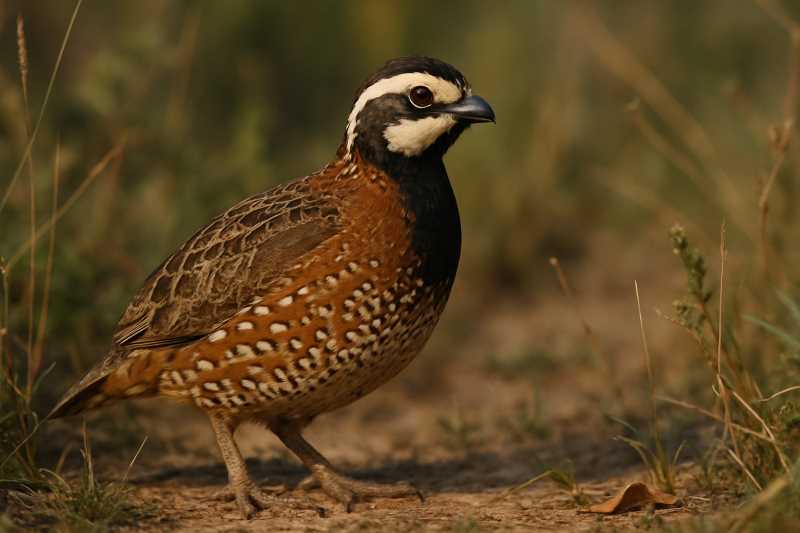
Adult males are distinctive. They have a black throat and black facial markings, with a pale or white forehead and contrasting white and buff patterning. The upperparts are mainly brown and reddish-brown, with fine spotting or barring, while the underparts have a strongly patterned, scalloped appearance. The lower belly and undertail may show warm cinnamon tones.
Females are less strongly marked. Their plumage is generally brown, buff and reddish-brown, providing effective camouflage in grass and leaf litter. The throat is paler than the male’s, and the breast and belly are barred or mottled. Juveniles are duller and less sharply patterned than adults, although detailed age-related plumage information is limited.
Range and Habitat
The Yucatan Bobwhite is distributed from the Yucatán Peninsula of south-eastern Mexico through Belize and adjacent Guatemala, with separate populations extending through Honduras and north-eastern Nicaragua. Four subspecies are generally recognised in major modern treatments, although the limits and treatment of geographic variation may differ between taxonomic authorities.
It is a non-migratory or largely sedentary species. Preferred habitats include dry shrubland, open pine woodland, forest clearings, woodland edges, rough grassland, seasonally wet lowland grassland, agricultural margins and some plantations. Coastal mangroves and heavily degraded former forest have also been reported as habitats. In parts of its range it occurs below approximately 1,800 m, although most records are from lowland or lower-elevation areas.
The species benefits from a varied vegetation structure, especially a combination of open ground for feeding and dense grass, shrubs or other cover for nesting and protection. It is not restricted to undisturbed forest.
Behaviour and Diet
Yucatan Bobwhites are primarily terrestrial and spend much of the day walking through vegetation, scratching among leaf litter and feeding on the ground. They usually avoid sustained flight, but can rise suddenly with rapid wingbeats when startled.
Outside the breeding season, birds commonly occur in coveys containing several individuals. Reported covey sizes vary, but groups of roughly 3-15 birds, and occasionally up to about 20, have been recorded. Coveys provide social contact and may improve the chances of detecting approaching predators.
The diet consists mainly of small seeds and other plant material, including buds and fruits where available. Invertebrates are also eaten, particularly when they are seasonally abundant and when they are important for growing young. The precise balance between seeds, other plant foods and insects varies with habitat and season.
Breeding usually coincides with the wetter or warmer part of the year, although timing differs across the species’ broad range. The nest is a shallow, grass-lined depression on the ground, generally concealed beneath dense vegetation. Clutches commonly contain about 10 eggs, with reports of approximately 10-15 eggs in some areas. Incubation lasts about 23-24 days. The chicks are precocial, leaving the nest soon after hatching and following the adults while they forage. Detailed information on pair bonds, parental roles and breeding success remains limited in comparison with better-studied bobwhite species.
Identification Tips
- Look for a small, rounded quail moving quietly through grass, scrub or woodland edge rather than perching in trees.
- The adult male’s black throat and dark facial pattern, contrasted with a pale forehead and reddish-brown, white-spotted plumage, are the most useful visual clues.
- Females are more difficult to identify because they are mainly brown, buff and barred. Their compact shape, terrestrial behaviour and association with coveys are helpful supporting features.
- The species is more likely to be detected by a sudden burst of flight or by its calls than by prolonged observation in the open.
- In the northern part of its range, care is needed when separating it from the Northern Bobwhite, Colinus virginianus. The Yucatan Bobwhite is identified especially by the male’s black throat and facial pattern, together with its more southerly distribution. Local range and plumage should be considered alongside the call.
Conservation Status
The Yucatan Bobwhite is currently assessed as Least Concern at global level. A precise global population estimate is not included here because reliable, range-wide figures are unavailable. The species is generally described as relatively widespread, but its status may vary between regions and populations.
The principal conservation concern is the loss or deterioration of suitable open and semi-open habitat through agricultural expansion, urban development, changing land-use practices and the loss of grassland, scrub and woodland-edge mosaics. Local assessments may assign a higher level of concern than the global assessment, particularly where habitat loss or hunting pressure is substantial.
Useful conservation measures include retaining native grass and shrub cover, protecting forest edges and seasonal grasslands, maintaining habitat mosaics rather than uniform dense vegetation, reducing unnecessary disturbance during nesting, and monitoring local populations. Further surveys are needed to clarify population trends and the status of geographically separated populations.
Frequently Asked Questions
Where does the Yucatan Bobwhite live?
It occurs from the Yucatán Peninsula of Mexico through Belize and adjacent Guatemala, with additional populations in Honduras and north-eastern Nicaragua. It uses dry scrub, open woodland, grassland, forest edges, agricultural margins and some wet lowland habitats.
Is the Yucatan Bobwhite migratory?
No. It is considered a resident or largely sedentary species. Individuals may move locally in response to food, cover and seasonal conditions, but it is not known for regular long-distance migration.
What does the Yucatan Bobwhite eat?
Its diet is based mainly on small seeds and other plant material, including buds and fruits. It also takes insects and other small invertebrates, especially when these foods are seasonally available or required by growing chicks.
How can the male be identified?
The adult male has a conspicuous black throat and dark facial markings, a pale or white forehead, and reddish-brown plumage with contrasting white and buff patterning. The female is more subdued, with mainly brown, buff and barred plumage.
Does the Yucatan Bobwhite live in groups?
Yes. Outside the breeding season it commonly forms coveys, usually containing several birds and sometimes up to about 20 individuals. During breeding, coveys may break up as pairs form and nest.
Is the Yucatan Bobwhite endangered?
It is not currently considered globally endangered. The species is assessed as Least Concern, although local populations may face habitat loss and other pressures. Regional conservation assessments can therefore be more serious than the global category.
References
- BirdLife International. 2024. HBW-BirdLife Taxonomic Checklist, Version 9.0. BirdLife International, Cambridge. Available from the BirdLife DataZone taxonomy resources. Accessed 8 September 2026.
- BirdLife International. n.d. BirdLife DataZone. BirdLife International, Cambridge. Available at: https://datazone.birdlife.org/. Accessed 8 September 2026.
- Carroll, J. P., Kirwan, G. M. and Boesman, P. 2020. Black-throated Bobwhite (Colinus nigrogularis). In: Birds of the World. Cornell Lab of Ornithology. https://doi.org/10.2173/bow.bltbob1.01. Accessed 8 September 2026.
- Gill, F., Donsker, D. and Rasmussen, P. (eds.). 2026. IOC World Bird List, Version 15.2. International Ornithologists’ Union. Available at: https://www.worldbirdnames.org/. Accessed 8 September 2026.
- Howell, S. N. G. and Webb, S. 1995. A Guide to the Birds of Mexico and Northern Central America. Oxford University Press, Oxford.
- Johnsgard, P. A. 1988. The Quails, Partridges, and Francolins of the World. Oxford University Press, Oxford.
- Williford, D., et al. 2016. Phylogeography of the bobwhite (Colinus) quails. Wildlife Monographs 193: 1-54. https://doi.org/10.1002/wmon.1017.
- Young, R. P., et al. 2020. National Threatened Avian Species Assessment for Belize. Forest Department, Government of Belize. Available at: https://forest.gov.bz/wp-content/uploads/2023/09/Resource-National-Threatened-Avian-Species-Belize-2020_230829_164309.pdf. Accessed 8 September 2026.
Related posts