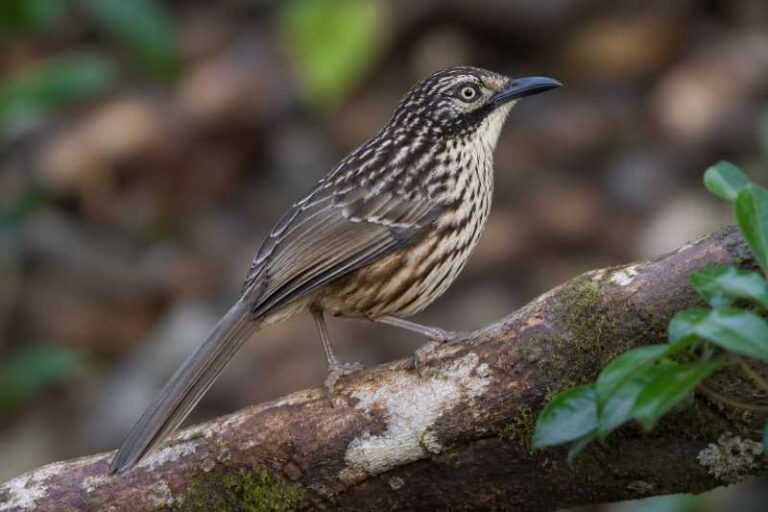
Introduction
The Horned Guan (Oreophasis derbianus) is a large, distinctive member of the Cracidae family and the only recognised species in its genus. It is restricted to high-elevation cloud forests in southern Mexico and Guatemala, where its fragmented distribution and specialised habitat requirements make it one of Mesoamerica’s most conservation-dependent birds. (biodiversidad.gt)
Physical Description
The Horned Guan is a large, long-tailed bird measuring approximately 77–85 cm in length. Adults have glossy blue-black plumage over the head, neck, back and wings, contrasting with a white throat, chest and upper breast. The long tail is dark and has a conspicuous white band near its base. The bill is yellowish, the legs are reddish, and the eyes are pale.
Its most distinctive feature is the fleshy, bright red horn or casque projecting from the forehead. In adults, this structure may reach about 5–6 cm in length and is supported by the skull. The sexes are broadly similar in plumage, although their vocalisations differ and may be more useful than appearance for determining sex. Young birds are duller, with browner wings and tail feathers and a smaller developing casque. (repository.si.edu)
Range and Habitat
The species is known from the Sierra Madre de Chiapas in southern Mexico and from highland regions of western and central Guatemala. Its range is highly fragmented, reflecting the scattered distribution of suitable montane cloud forest.
Horned Guans occupy humid, mature mountain forests with dense undergrowth, tree ferns, vines, mosses and epiphytes. They may also use forest containing oaks, laurels and other broad-leaved trees, sometimes with small areas of pine or cypress. Recorded elevations vary geographically, but the species is generally found between about 1,600 and 3,350 metres, with many records concentrated between 2,000 and 3,100 metres. (birdlifedata.blob.core.windows.net)
The Horned Guan is considered resident, although local movements, including possible seasonal changes in elevation, have been suggested. Evidence for regular long-distance migration is lacking. Important protected areas include Mexico’s El Triunfo and Volcán Tacaná reserves, together with protected cloud-forest sites in Guatemala. (web.ua.es)
Behaviour and Diet
Horned Guans spend much of their time in trees, where they rest, preen and feed. They can move rapidly along branches and through dense vegetation, but they are also capable of walking on the forest floor. They are often encountered alone, in pairs or in small groups, and are generally difficult to observe because of their quiet movements and remote habitat.
The diet is primarily vegetarian. Documented foods include fruits, green leaves and, occasionally, flowers. Studies in the El Triunfo Biosphere Reserve recorded the use of numerous plant species, while observations in Guatemala have included fruits from several native trees and nectar from flowers of the hand-shaped tree (Chiranthodendron pentadactylon). Small invertebrates have sometimes been reported, but plant material forms the main part of the diet. The species may contribute to seed movement, although its effectiveness as a seed disperser remains an active research question. (conanp.gob.mx)
Breeding behaviour is not fully understood. Research in Mexico indicates a probably polygynous mating system. The nest is built in a tree, and the clutch usually contains two eggs. The incubation period has been estimated at approximately 35–36.5 days. Males and females produce different calls, with males using several vocalisation types and females giving distinct, more guttural calls. (digitalcommons.usf.edu)
Identification Tips
- Look for a large, dark cracid in the upper levels of humid mountain forest.
- The bright red, upright horn on the forehead is the clearest identification feature.
- Adults show a strong contrast between glossy black upperparts and a white throat, chest and upper breast.
- A broad white band near the base of the otherwise dark tail is visible in good views.
- Pale eyes, a yellowish bill and reddish legs provide additional confirmation.
- Juveniles are browner and less sharply marked, with a much smaller casque.
- The species is unlikely to be confused with other local guans when the red casque is visible. In poor views, its size, dark upperparts, white chest and high-elevation cloud-forest habitat are useful supporting clues.
Conservation Status
The Horned Guan is classified as Endangered on the IUCN Red List. The principal threats are the loss, degradation and fragmentation of montane cloud forest through agricultural expansion, logging, fuelwood collection, fires and other land-use changes. Hunting and the illegal capture or trade of birds may also affect some populations. Small, isolated subpopulations are particularly vulnerable to local extinction. (biodiversidad.gt)
Conservation measures include protecting remaining cloud forests, maintaining habitat connectivity, monitoring populations and improving knowledge of the species’ movements, diet and breeding ecology. Mexico’s CONANP has developed a species action programme and supports monitoring in areas such as El Triunfo and Volcán Tacaná. Conservation breeding has also been attempted, although captive breeding has historically been difficult. Effective conservation depends on cooperation between protected-area authorities, researchers and local communities. (conanp.gob.mx)
Frequently Asked Questions
Where does the Horned Guan live?
The Horned Guan lives in humid montane cloud forests of southern Mexico and Guatemala, generally at elevations from about 1,600 to 3,350 metres.
Why is the Horned Guan called “horned”?
The name refers to the bright red, fleshy horn-like casque projecting from the forehead of adult birds.
What does the Horned Guan eat?
Its diet consists mainly of fruits and green leaves, with flowers also recorded. Small invertebrates may occasionally be taken, but plant material predominates.
Are male and female Horned Guans different in appearance?
The sexes are broadly similar in plumage. Their calls differ, and vocal behaviour can be more useful than external appearance for distinguishing them.
Is the Horned Guan migratory?
The species is generally regarded as resident. Local seasonal movements, including possible changes in elevation, may occur, but regular long-distance migration has not been established.
Why is the Horned Guan endangered?
It has a restricted and fragmented range, and its cloud-forest habitat is threatened by agricultural expansion, logging, fires, fuelwood collection and other forms of habitat degradation. Hunting and illegal capture may add further pressure.
References
- BirdLife International. 2020. Oreophasis derbianus. The IUCN Red List of Threatened Species 2020: e.T22678453A177970135. IUCN Red List of Threatened Species. https://doi.org/10.2305/IUCN.UK.2020-3.RLTS.T22678453A177970135.en. Accessed 8 September 2026.
- BirdLife International. 2009. Threatened Birds of the Americas: The ICBP/IUCN Red Data Book. Species account: Horned Guan (Oreophasis derbianus). BirdLife International. https://birdlifedata.blob.core.windows.net/red-data-books/Oreophasis_derbianus_eng.pdf. Accessed 8 September 2026.
- González-García, F. 1995. Reproductive biology and vocalizations of the Horned Guan (Oreophasis derbianus) in Mexico. The Condor, 97(2), 415–426. https://digitalcommons.usf.edu/condor/vol97/iss2/11/.
- Cornejo, J. M. 2009. Breeding programme for Horned Guan Oreophasis derbianus at Africam Safari, Mexico. International Zoo Yearbook, 43(1), 171–176. https://doi.org/10.1111/j.1748-1090.2008.00070.x.
- Comisión Nacional de Áreas Naturales Protegidas. 2009. Programa de Acción para la Conservación de la Especie: Pavón (Oreophasis derbianus). CONANP, Mexico. https://www.conanp.gob.mx/pdf_especies/PACE%20Pavon.pdf. Accessed 8 September 2026.
- González-García, F. 2017. Ecología e Historia Natural del Pavón Oreophasis derbianus: Un Crácido de Montaña. Doctoral thesis, Universidad de Alicante. https://rua.ua.es/dspace/bitstream/10045/71312/1/tesis_fernando_gonzalez_garcia.pdf. Accessed 8 September 2026.
- Gill, F., Donsker, D. and Rasmussen, P., eds. 2026. IOC World Bird List, version 15.2. International Ornithologists’ Union. https://www.worldbirdnames.org/. Accessed 8 September 2026.
Related posts